Klaas and Mariche’s Abusive Marriage
Women TalkingKlaas and Mariche’s marriage is presented as an abusive relationship in which Klaas exercises control within the household and responds violently when Mariche resists or acts without his permission. Their conflict is not confined to the marriage: their daughter Autje is also harmed when she tries to intervene. In the women’s debate over leaving Molotschna, Mariche’s experience makes the costs of remaining concrete, while the prospect of departure exposes how little freedom she has to make that choice safely.
Household Authority and Family
Klaas’s authority appears in his control over family members and their movements. When he comes to the women’s meeting, he tells Julius Penner to leave the loft with him and return home, and instructs Mariche to collect their other children from Nettie/Melvin. The account notes that Klaas and Mariche have many children, though their exact number is not given. Their children’s movements are thus part of the household’s larger contest over who gives directions and who is expected to obey them.
The children are not merely background to the marriage. Klaas’s order that Mariche retrieve them places her in the position of carrying out his instructions, while his effort to take Julius home asserts his authority directly. The family is also a source of practical stakes when the women consider leaving: their decision concerns children as well as wives, and the possibility of separation is shaped by the adults who control where a child may go. The evidence does not describe a settled arrangement between Klaas and Mariche; it shows a household under pressure as the women’s collective plan challenges existing authority.
Violence and Mariche’s Account
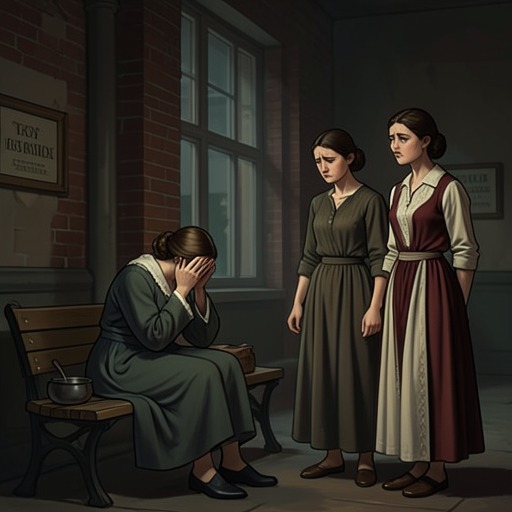
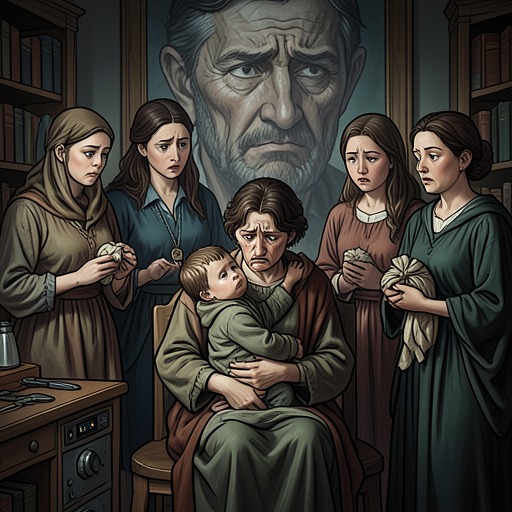
The consequences of Klaas’s conduct become visible when Mariche and Autje take their places at the table with signs of recent harm. Mariche’s arm is supported in a sling made from a feed bag, and Autje also has a visible mark. Asked why she has come to the meeting, Mariche answers defiantly by pointing to Klaas’s presence. Her reply makes his presence, rather than any abstract discussion of marriage, the immediate explanation for why she has joined the women.
Mariche later explains the circumstances. After Ruth and Cheryl were discovered missing, Klaas demanded that she account for the horses. She told him they had broken out while he was unconscious during a dental procedure; he rejected her explanation and struck her more than once. When Autje intervened, he struck her as well. Mariche’s account connects the household violence to the women’s preparations: the horses’ disappearance becomes the occasion for punishment, and a daughter’s attempt to protect her mother brings her into the conflict. The violence is therefore both an expression of Klaas’s control and a direct consequence of the women’s coordinated actions.
Departure and the Threat of Return
The marriage is placed within a wider system that threatens to restrict women’s choices. The remaining men of Molotschna have gone to the city to post bail for the imprisoned attackers, hoping they can return to the colony while awaiting trial. Peters has told the women that, once the men return, they will be expected to forgive them; refusal means leaving the colony for an outside world the women know little about. The deadline is short. For Mariche, this collective ultimatum intersects with the danger inside her own household: leaving is not simply a decision about where to live, but a response to both male authority in the colony and Klaas’s control at home.
Mariche argues that the women will not be permitted to leave once the men return. Her warning gives urgency to the plan to depart after dark, avoiding the Chortiza and Hiakjeke colonies. The group’s preparations include a map concealed around a block of cheese, a safe placed in the back of Greta Loewen’s buggy, and basic supplies such as onions, soap, and pieces of wood for traction or kindling. These details show how departure requires practical planning under conditions of uncertainty. They also sharpen the contrast between the collective preparations and Mariche’s restricted position within her marriage: the women can organize a route together, but Klaas’s authority remains a danger they must account for.
Significance and Limits of the Account
Mariche’s testimony turns private abuse into evidence in a communal argument about safety, responsibility, and leaving. She does not present her injuries as an isolated domestic matter; she explains how they followed the discovery that Ruth and Cheryl had been moved, and how Autje was harmed when she tried to help. The scene makes clear that the consequences of Klaas’s actions reach beyond the spouses and affect their daughter as well.
At the same time, the account does not provide a reconciliation or a final resolution between Klaas and Mariche. It records his instructions, her defiance, and the harm that prompts her explanation, then places their marriage against the women’s imminent departure. The relationship’s significance lies in that unresolved pressure: the family remains subject to Klaas’s authority even as Mariche joins a collective effort to leave before the men return. The narrative establishes the risks she faces and the urgency of her choice, without claiming what ultimately happens to the marriage.