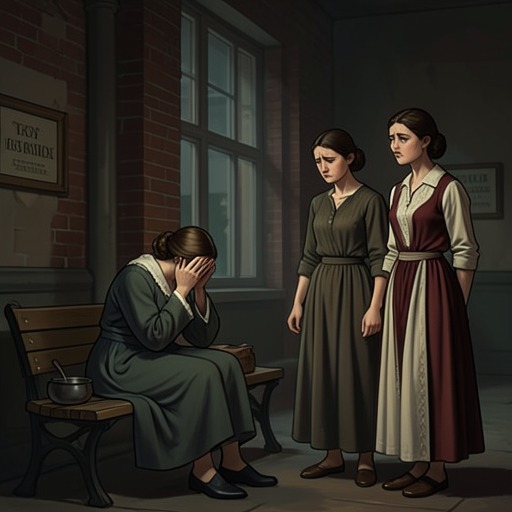
Mina Friesen
Women TalkingMina Friesen is the younger sister of Ona Friesen and Salome Friesen and the mother of Neitje Friesen. Known throughout the Molotschna Colony as Happy Mina for her perpetual smile, she is remembered in the women’s meeting through both that familiar expression and the circumstances of her death. Her story exposes the cost of a community in which women’s accounts of violence can be denied and recast by male authority.
Identity and Family
Mina’s reputation as a constant smiler is shared by women across the colony. When Ona smiles with genuine appreciation at Mariche Loewen’s humor, the narrator recognizes the expression as like Mina’s: not a nervous gesture, but a remembered quality associated with her younger sister. Even after Mina’s death, that image of her remains vivid to the women.
Mina was Neitje’s mother. After Mina’s death, Neitje came into the care of Salome, her aunt. This family connection carries Mina’s story beyond the circumstances of her own life: the women’s decisions about safety and children also concern a girl who has already suffered violence and lost her mother.
Neitje’s Attack and Mina’s Death
Mina hanged herself after Neitje was attacked in her bedroom. Peters first told Mina that Satan was responsible and that the attack was divine punishment for women’s sins; he later said that Mina had made the attack up. Faced with these incompatible explanations, Mina challenged him to say which one he believed. The account records that she then harmed herself and died in the yearling shed.
After finding Mina, Peters told the colony that she had died from inhaling ammonia while cleaning the shed. The explanation replaced the truth of her suicide with an accidental death and concealed the events that preceded it. Agata Friesen, Mina’s mother, washed her body while grieving; the women say they witnessed her grief themselves.
The Funeral and Ona’s Protest
Mina’s funeral was held outside the church because the bodies of people who died by suicide were not permitted in the sanctuary. Her body lay on a block of ice in the sun. During the service, Peters interrupted and directed Deacons Klippenstein and Unrau to take Ona home. Instead, Ona pulled Mina’s kerchief down enough to reveal the marks on her neck and told the congregation that Mina had not died from ammonia fumes, as Peters had claimed.
The intervention turned the funeral into a public confrontation over who could name Mina’s death. Peters prayed for Ona as the congregation bowed its heads, but Ona’s testimony had already contradicted the account offered by the colony’s authority. Her act made Mina’s death impossible to reduce to the accident Peters had described.
Memory and Significance
At the women’s meeting, Mina’s smile returns as a measure of what the women remember and have lost. The contrast between Happy Mina and the account of her final days is stark: a woman known for smiling was also a daughter and mother left without meaningful support after violence against her child. Her story gives particular weight to the women’s debate about whether remaining in the colony would expose them and their children to further harm.
Mina’s death also reveals the conflict between professed faith and the treatment of women’s testimony. As the women consider pacifism, forgiveness, and the duty to protect their children, Mina’s experience stands behind the question of what those commitments require in practice. Her funeral protest does not undo the concealment surrounding her death, but Ona’s refusal to accept Peters’s explanation preserves the truth the colony tried to replace.