Molotschna Colony sexual assaults
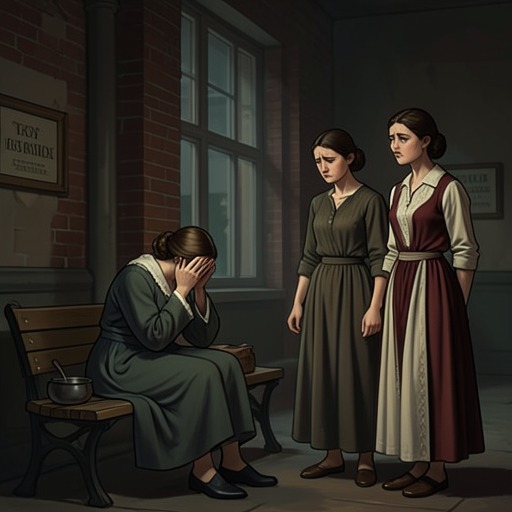
Women TalkingMolotschna Colony sexual assaults are the prolonged campaign of attacks that forms the crisis behind the women’s meetings in the novel. The assaults turn private bedrooms into places of danger and expose a community in which women’s accounts are dismissed even as the violence spreads across generations. Their eventual discovery changes the question facing the women: the danger is no longer an invisible force to endure, but crimes committed by men from within the colony.
Causes and Background
In the novel’s account, attacks begin in 2005 and continue for several years. Girls and women wake after being made unconscious, often unable to explain what has happened to them. Some members of the community attribute the assaults to ghosts or Satan and regard them as punishment for sin; others accuse the women of lying, seeking attention, or concealing adultery. Still others treat the accounts as products of female imagination. These explanations turn the victims into objects of suspicion and leave the perpetrators concealed behind supernatural speculation and communal denial.
The scale is not incidental. August Epp calculates that between 2005 and 2009, more than three hundred girls and women in the Molotschna Colony were attacked in their own beds, with an assault occurring, on average, every three or four days. The victims include women from three generations of the Friesen and Loewen families, and many are attacked repeatedly. This repetition makes the violence more than a sequence of isolated crimes: it is a sustained condition shaping family life and the women’s sense of safety.
The novel distinguishes its fictional setting from the historical context described in its prefatory note. That note locates the real-life events that prompted the book in the Manitoba Colony in Bolivia, where women and girls were attacked between 2005 and 2009. The novel relocates its imagined community to Molotschna while presenting the story as a fictional response to those events. In both accounts, an animal anesthetic is used to incapacitate victims before the assaults. The familiar material of farm life thus becomes part of the means by which violence is hidden.
Discovery and Identification
The attacks become legible as human crimes through Leisl Neustadter’s persistence. She forces herself to remain awake night after night until she catches a young man prying open her bedroom window with a jug of Belladonna Veterinary Spray. Leisl and her adult daughter wrestle him to the ground and bind him with baler twine. Their intervention breaks the pattern of unseen attacks: a suspected supernatural threat is confronted as a person caught in the act.
Peters is brought to the house, where the captured man, Gerhard Schellenberg, identifies the other seven men involved. The revelation is especially disturbing because many of the perpetrators are close relatives of the women they have attacked: brothers, cousins, uncles, and nephews. August Epp recognizes one of the men only faintly from childhood. The memory of a boy who once played with him makes the disclosure intimate without making it less terrible; the perpetrators are not outsiders who have entered a sealed community, but men formed within its own relationships.
Consequences for Women and Families
The disclosure does not make the consequences disappear. Nearly every female member of the colony has been violated by the group, while women who do not attend the meetings remain occupied with the work that sustains the community, including caring for livestock. The women who gather must therefore consider their response amid both the continuing demands of daily life and the knowledge that the men responsible belong to the same social world as their families.
Ona Friesen’s pregnancy shows how the colony’s response can extend the harm beyond the assaults themselves. Pregnant and nauseated, she is treated as marked by Narfa and as unsuitable for marriage because she is not a virgin. The elders judge her incapable of reason, while the child conceived through the assault is expected to be given to another colony family, perhaps even the family of the perpetrator. The proposed arrangement makes the victim bear the stigma and separation, while the community’s judgment threatens to determine her child’s future without her consent.
The attacks also give urgency to the women’s deliberations about leaving. Salome Friesen and Mejal Loewen, despite their frequent disagreements, come together in crisis as the mothers face the prospect of separation from sons who cannot all accompany them. Salome raises a further danger: if accused men return, boys aged thirteen and fourteen could become targets. August Epp acknowledges that boys of that age can cause harm, but insists they are also children capable of learning. The debate grows from the assaults into a larger question of how to protect vulnerable people without treating an entire age group as irredeemable.
Aftermath and Significance
The prefatory note reports that eight men from the real Manitoba Colony were convicted in a Bolivian court in 2011 and received lengthy prison sentences. It also notes that reports of similar assaults and other sexual abuse continued in 2013 while the convicted men remained imprisoned. That continuation resists a simple ending in which identification and punishment settle the matter. The novel’s own crisis likewise turns discovery into a beginning: the women must decide what safety, faith, and communal life can mean after the truth is known.
The assaults are therefore both a plot catalyst and a test of whose testimony counts. For years, supernatural explanations and accusations against the victims obscure the perpetrators; when their identities emerge, kinship does not soften the revelation but sharpens its reach. The women’s meetings answer the violence not with a single shared interpretation of what to do, but with collective deliberation about departure, responsibility, and the future of their children. The event’s force lies not only in what the men did, but in the social order that made the attacks difficult to name and left the women to decide how to live after naming them.