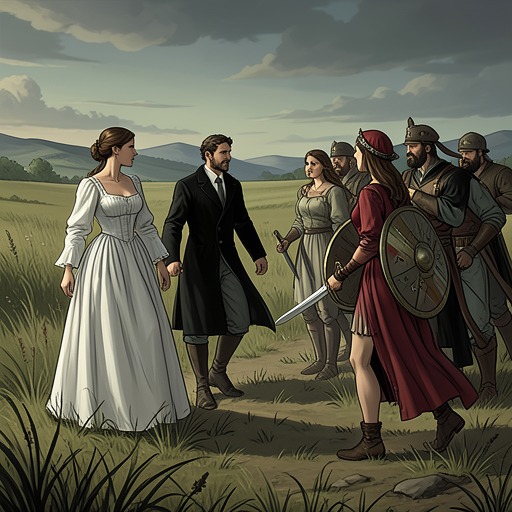
Molotschna Women's Meeting and Decision to Leave
Women TalkingThe Molotschna Women's Meeting and Decision to Leave is the process through which women facing danger and an imposed choice make a collective plan to depart. Their decision is constrained by a two-day deadline, the prospect that accused men will return on bail, and the threat that women who refuse to forgive them will have to leave the colony. The meetings turn that ultimatum into an argument about what safety, faith, and collective responsibility require—and into practical preparations for an uncertain departure.
Crisis and the Meeting's Record
The immediate pressure comes from the men’s possible return while awaiting trial. Peters and the elders have said that the women will be expected to forgive the accused men; refusal would mean leaving Molotschna for an outside world the women know nothing about. With only two days to organize their response, the women meet to consider what to do. They have already voted among three options: Do Nothing, Stay and Fight, or Leave. The choice is not made under ordinary conditions of free movement: both remaining and departing carry consequences imposed by the colony’s leaders and by the danger surrounding the case.
Ona Friesen asks August Epp to record the meetings. He has been appointed minute-taker because the women are illiterate and cannot make the written record themselves. Their discussions take place in Plautdietsch, an unwritten language, so August must translate what he hears into English as he writes. The minutes are therefore mediated: they preserve the women’s deliberations through a recorder who selects, translates, and interprets, rather than giving the speakers direct access to the written document.
The women meet in Earnest Thiessen’s farm loft, away from the children who fill the colony’s kitchens. Ona proposes using a large sheet of brown cheese-and-meat packaging paper to list the options’ advantages and disadvantages. The women cannot read the writing, but she wants the sheet kept in the loft as an artifact for others to discover. The proposed record thus has a future audience beyond the meeting, even though its makers cannot consult it in written form themselves.
From Ballot to Shared Aims
The debate exposes differences between the Friesen and Loewen families, including disagreement over whether Do Nothing is a genuine option. Salome Friesen has argued that it is not, while accepting that allowing a vote on it can still be empowering. Mejal Loewen counters that Salome cannot decide alone what the options are. The women nevertheless agree that the two families will debate the alternatives and determine how to implement a course of action. Their procedure makes disagreement part of the decision rather than proof that no collective position is possible.
As the meetings proceed, Mariche Loewen articulates three aims: the children must be safe, the women must remain steadfast in their faith, and they must be able to think. She speaks through tears, but the formulation gives the decision a shared political and moral frame. Ona recognizes it as the beginning of a new era and a manifesto. The stated aims do not reduce the choice to safety alone: the women seek a way to protect their children without abandoning faith or the capacity for independent thought.
Leaving also means confronting unequal vulnerabilities within the group. Ona is pregnant after the assaults and keeps an empty feed pail beside her because of nausea. When others hurriedly try to arrange her marriage to Julius Penner, she refuses, arguing that he deserves better and that marriage to a woman who is not a virgin would taint him with sin. The elders have judged her incapable of reasoning because of Narfa, and intend for her unborn child to be raised by another colony family. Her circumstances show how the community’s authority reaches beyond the women’s immediate safety to their marriages, reputations, and children.
The plan raises another question of protection: which boys may leave with the women? Fifteen-year-old boys are already in the city with the men, while boys twelve and under may accompany the women; Salome asks why thirteen- and fourteen-year-olds should be excluded. She fears they may be left vulnerable if the accused men return. August Epp answers that boys of that age can cause harm, but are still children capable of learning. He argues for firm love, patience, intellectual accuracy, and imaginative development rather than treating them as irredeemable threats. His response makes education and the possibility of changed conduct part of the group’s deliberation, even as the meeting must plan for immediate risks.
Choosing to Leave
Salome gives the decision its starkest expression when Mejal asks her to name a disadvantage of leaving. Salome says there are none. Her certainty does not erase the costs that the meeting has already acknowledged. She will leave Aaron behind for the time being, and Agata Friesen puts an arm around her shoulders, framing the grief as a reason to rebuild a better colony. Mejal, often at odds with Salome, crosses to embrace her. Their convergence during a crisis makes solidarity visible without suggesting that the women’s disagreements have disappeared.
The women also consider boys whose age places them between the two groups already designated to leave or remain. Their concern is not resolved simply by describing the boys as either harmless or dangerous. August’s answer holds both possibilities together: adolescents may cause damage, yet can be taught. The debate shows the plan being tested against the different risks faced by women, girls, children, and young adolescents rather than treating the group’s needs as uniform.
The manifesto’s meaning is also contested. Salome fears that men might alter or gradually degrade it, signing only to regain access to the women and then disregarding its terms. Agata answers by placing the undertaking within a journey the women have interpreted as God’s will and as a responsibility arising from faith, motherhood, and their humanity. Greta Loewen acknowledges that they cannot know everything that will happen; for now, they have made their plan. Their religious commitment is not simply a reason to remain under existing authority. It is part of how they justify acting together.
Departure Preparations and the Limits of Choice
The decision becomes concrete when Agata asks whether the women will leave that night after dark, passing the Chortiza and Hiakjeke colonies unseen. The women nod. August has wrapped a map around a large block of cheese and covered it with brown paper; a safe is beneath the back seat of Greta Loewen’s buggy. He has also packed onions, soap, and pieces of wood to help the wheels gain traction in mud or to serve as kindling. The map and dynamite are among the supplies placed in the buggy’s hatbox. These preparations give the decision a material shape: the women will need transport, food, useful supplies, and knowledge of a route beyond their own colony.
Departure cannot include everyone. Nettie, now called Melvin, reports that the little children are clean, fed, and ready, with extra clothing, linen, boots, and hats packed. But Cornelius will stay because his mother belongs to the Do Nothing group and he has no choice but to remain with her. The other young people hope that he and his mother may change their minds, while Mariche warns that once the men return, no women will be allowed to leave. The plan is collective, but the threat of closure and the constraints of family ties leave some people behind.
The record itself becomes one of the things the group tries to carry forward. At the end, August runs back to the plywood table to collect his notebooks and the minutes, then asks that they be given to Ona. Salome points out that Ona cannot read them and questions what use they will be to her. That exchange brings the meetings’ central contradiction into focus: the women have authored a decision and a record through speech, but the written account remains in a form they cannot read. Its significance lies both in preserving their deliberation and in showing the limits placed on who can write, possess, and interpret the colony’s history.