Molotschna women’s illiteracy
Women TalkingMolotschna women’s illiteracy is more than a lack of reading and writing skills: it is a structure of dependence that lets men control access to scripture, define what the women are permitted to know, and present submission as divinely required. During the women’s meetings, that arrangement becomes visible and contestable. The women question how they can be expected to obey a text they cannot read, and their deliberations show that restricted literacy has consequences not only for education but also for authority, testimony, and collective choice.
Literacy and Dependence
The women explain that they cannot read the Bible for themselves. What they have been told it contains comes from Peters, the elders, and their husbands—all men. Salome identifies the problem not simply as missing information, but as the male interpretation of scripture being handed down to women who have no independent way to check it. Ona makes the practical consequence explicit: being unable to read or write puts the women at a serious disadvantage whenever the meaning of the Bible is negotiated.
That disadvantage shapes a central argument about whether women must submit to their husbands. Salome observes that the women believe the Bible commands submission because their husbands have told them so. She tests the claim by asking whether Mejal would accept an equally forceful assertion that scripture authorized a husband to strike his wife for questioning him, or to punish children harshly for an accidental mistake. The point is not that the women have already established what the Bible says. It is that men’s access to interpretation has made their claims difficult to challenge, even when the claims are used to defend conduct the women recognize as harmful.
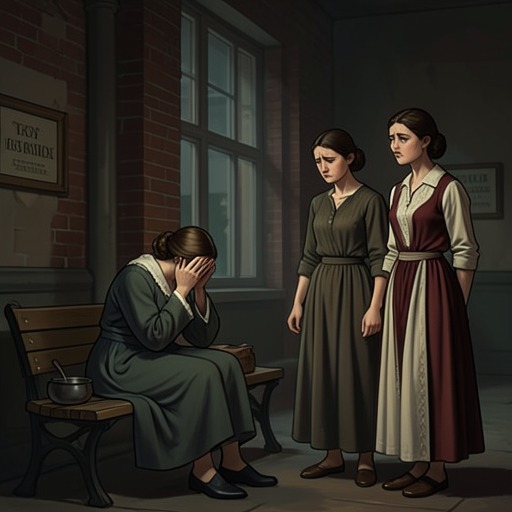
The imbalance also meets the women in their effort to understand the attacks that prompted their meetings. For years, girls and women in Molotschna Colony were attacked at night and believed by many to have been harmed by ghosts or Satan as punishment for sin. They later learned that eight real men from the colony were responsible, including men related to some of the victims. Ona asks what the women are obliged or able to forgive if they were unconscious during the attacks and cannot understand what happened to them. Her question joins the limits imposed on their knowledge to the elders’ demand for forgiveness: an authority that has denied them counseling also expects them to make a religious decision about experiences they were prevented from understanding.
Gendered Authority and Religious Interpretation
The meetings reveal how the literacy barrier operates within a broader distribution of power. Salome describes women as excluded from membership and expected to serve silently, while men and even fourteen-year-old boys may give orders, determine women’s fates, vote on excommunications, interpret the Bible, lead worship, and punish. The women’s lack of direct access to scripture reinforces this arrangement: those who control interpretation can present established male authority as a religious requirement rather than one interpretation among others.
The consequences become especially sharp as the women debate whether staying in the colony would be faithful or dangerous. Agata argues that pacifism is central to Mennonite faith and that staying would risk a collision with violence, turning Molotschna into a battlefield. She reasons that leaving may better preserve pacifism, love, and forgiveness, and teach those values to the children. Salome and Ona do not approach this question by claiming expertise in a text they cannot read. Instead, they expose who has supplied their religious knowledge and assess the choices before them through the stated values of their faith, their safety, and their responsibilities to their children.
Agata describes the women’s decision to influence their sons as a collective act grounded in motherhood, faith, love, and peace. Her account refuses the assumption that the women must simply wait for male instruction: their ethical judgement and responsibility to their children can guide a decision of their own. The meetings thus distinguish religious commitment from submission to the men who claim exclusive authority to define it.
Writing, Numbers, and the Map
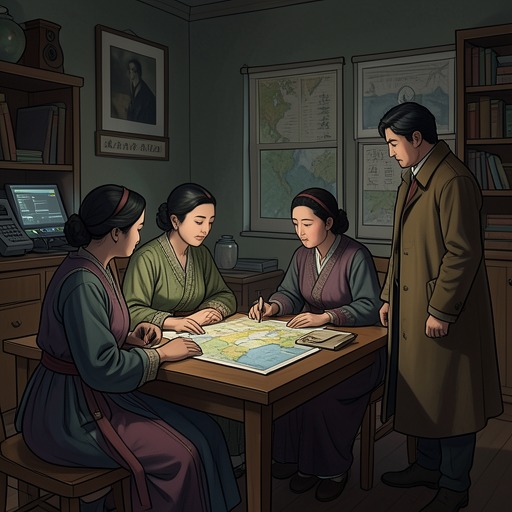
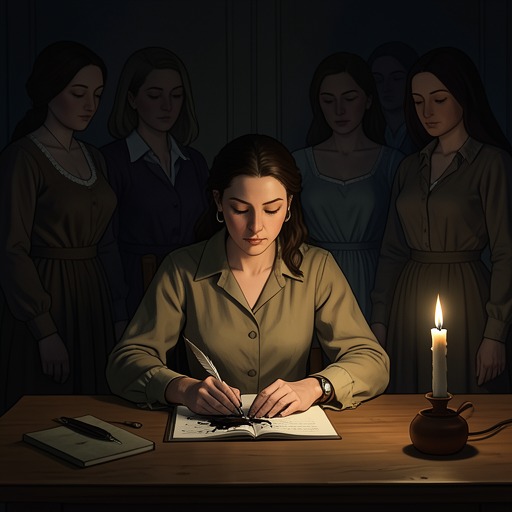
A later exchange makes the limits of the women’s education concrete. August Epp asks whether they know their numbers. Greta answers confidently, while Mariche questions whether they do; Greta clarifies that the girls know. When August asks about writing, Agata explains that the women know how to write their names, but that writing her own takes longer than planting a crop of canola. Greta adds the harvest the following autumn as another measure of that effort. Mariche admits that she has not learned to write her name because she has been too busy.
These details show that literacy is uneven and constrained, not a simple division between people who know nothing and people who know everything. The girls’ numbers are acknowledged, and some women can write their names, but even this limited writing remains laborious and incomplete. Mariche’s explanation connects that gap to time occupied by other responsibilities. The scene also gives the women’s limited access to written knowledge a practical setting: August has drawn a map showing rivers, roads, towns, cities, borders, and train tracks. Mariche first wonders whether it is a map of the heavens before August identifies it as a map of the Americas. The exchange exposes how unfamiliar the representation is, while making the map itself a possible starting point for learning rather than a test the women are expected to pass.
Consequences for Voice and Choice
The women’s inability to read is repeatedly used as a reason they should depend on male judgement, but their meeting demonstrates the reverse: they can identify the limits of what they have been told and reason about what those limits mean. Salome asks how women can know what is in the Bible if they cannot read it; Ona specifies the resulting disadvantage in negotiations over interpretation. Together, these arguments turn illiteracy from a private educational shortcoming into evidence of an unequal system for distributing knowledge and authority.
That system also makes the women’s testimony vulnerable to dismissal. The attacks were first explained through ideas of supernatural punishment, while the women themselves had to make sense of what happened after waking without understanding its cause. Once the perpetrators were identified as men from their own community, the women still faced an order to forgive and a threat of expulsion if they did not. Ona’s questions challenge that demand at its foundation: the women cannot be expected to offer informed, freely chosen forgiveness for experiences they were not allowed to understand, nor can a claim about their religious obligations be treated as settled when access to the text has been withheld.
The significance of Molotschna women’s illiteracy therefore lies in its connection to self-determination. The women do not resolve their disadvantage simply by announcing a new interpretation of the Bible; they name the dependence that has prevented them from forming one independently. Their discussions make room for another kind of authority, grounded in shared experience, careful questioning, faith, and responsibility for children. In that process, limited access to words and maps becomes part of a larger struggle over who may explain the world and who may decide how to live in it.