Molotschna's Patriarchal Power Structure
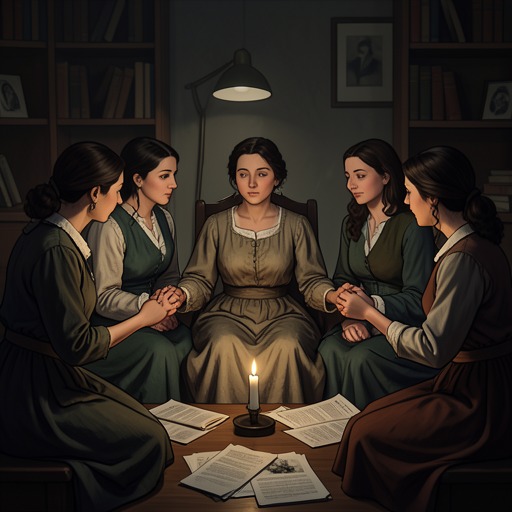
Women TalkingMolotschna's Patriarchal Power Structure is the colony’s system of male authority over women’s voices, religious interpretation, family life, and collective decisions. The assaults on women expose its practical force: power lies not only with individual perpetrators, but also with the leaders and customs that shape what women may know, contest, and choose. In the hayloft meetings, women begin to name those conditions and dispute the claim that obedience and forgiveness are the only faithful responses.
Governance, discipline, and the threat of expulsion
Molotschna is self-policed, but its local justice system does not place women in control of the response to the attacks. Peters first planned to confine the accused men in a shed for decades. When their lives appeared to be in danger after Salome Friesen attacked one man with a scythe and drunk male relatives hanged another, Peters and the elders called the police. The account presents the intervention as protection for the accused men, as well as a transfer of the case from colony discipline to the city authorities.
The men remaining in the colony then went to the city to post bail for the imprisoned attackers, hoping they could return while awaiting trial. Peters made the women’s place in the colony conditional on forgiveness: if they would not forgive the men, he said, they would have to leave for an outside world they knew nothing about. They had only two days to organize a response. Religious language thus functioned alongside legal and communal authority: forgiveness was presented not simply as a spiritual choice, but as the condition for remaining at home.
Everyday forms of male authority
The women describe a society in which they are expected to serve silently and submit to decisions made by men. Salome Friesen points to the breadth of that subordination: even fourteen-year-old boys may give women orders, help determine their fate, vote on excommunications, interpret the Bible, lead worship, and impose punishment. Women are denied the standing of full members in decisions that govern their lives, while male authority extends from the elders and Peters into the household and the next generation.
Control also reaches into marriage, pregnancy, and reputation. Ona Friesen is pregnant after an assault and experiences nausea during the meeting. When others hurriedly try to arrange a marriage for her, she refuses on the grounds that her condition and lack of virginity would taint the proposed husband. The elders describe her as marked by Narfa and unable to reason, even as they conclude that she has not willfully sinned. They also expect her child to be raised by another colony family. Her circumstances show how religious judgment and community arrangements can define a woman’s status and make decisions about her future and her child without giving her equal authority over either.
Scriptural interpretation and structural responsibility
Salome Friesen challenges the assumption that women’s submission is self-evidently required by the Bible. Women cannot read the text for themselves, she argues, and their belief that they must submit to their husbands rests on what their husbands have told them the Bible says. The restriction on access to scripture reinforces male authority: men control both the interpretation and the account of what the religious law requires.
Ona Friesen widens the question from the guilt of the imprisoned men to the conditions that made the assaults possible. Even if a particular man did not commit an attack, she asks whether men are responsible for knowing about the attacks and doing nothing. She argues that the colony’s circumstances were created and ordained by men, including the elders and Peters. In this account, responsibility is not limited to the eight named assailants: a hierarchy that gives men power over women has also made the violence possible. Ona further challenges Peters’s description of the perpetrators as simply evil, locating the deeper cause in the pursuit of power and in the lessons of power taught to boys and men.
Faith, resistance, and the choice to leave
The women do not frame their debate as a simple choice between faith and its rejection. Agata Friesen argues that staying would put them in a direct encounter with violence and risk turning Molotschna into a battlefield. For her, leaving is the more faithful practice of pacifism, love, and forgiveness; remaining could produce hatred and a coerced rather than genuine forgiveness. She also argues that leaving can teach their children to hold those values even when their fathers’ expectations point elsewhere.
That argument meets a question about responsibility for the boys. Salome Friesen asks why boys aged thirteen and fourteen cannot accompany the women when older boys are with the men and younger ones may go with the women. August Epp answers that boys of this age can cause harm, but are still children capable of being taught. He supports educating them through direction, firm love, and patience. Agata likewise describes the women’s decision to influence their sons as an expression of motherhood, faith, and love, rather than as a break from those commitments. The discussion contests the system’s assumption that male conduct is fixed and that women’s role is merely to endure it.
The women’s choices are not identical, and the costs of collective decisions fall unevenly. Some women select Do Nothing, while the women attending the meeting consider how to respond. Cornelius, a disabled young person whom the colony’s youth value, will not join the departure because his mother is in the Do Nothing group and he has no choice but to stay with her. The episode makes visible how family dependence and disability shape who can act on a decision. At the same time, Mariche Loewen warns that when the men return, women will not be allowed to leave. The threat of that return gives the debate its urgency: challenging patriarchal authority means not only naming its religious and social foundations, but acting before its restrictions close the possibility of departure.