Molotschna’s patriarchal social order
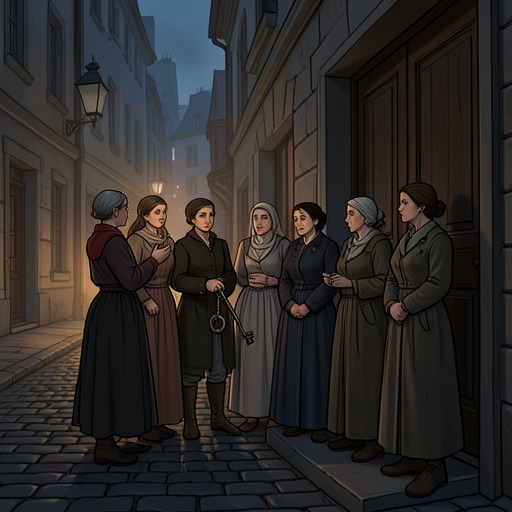
Women TalkingMolotschna’s patriarchal social order is a system in which men control religious interpretation and communal authority while women bear the consequences of decisions they have little power to shape. The women’s debate over whether to leave the colony exposes how this hierarchy reaches into knowledge, family life, bodily safety, and the meaning of religious obedience. Their challenge is not simply to reject faith, but to contest the male authority that claims to define it for them.
Authority and the Limits on Women’s Knowledge
Women in Molotschna are unable to read, and their access to the Bible is mediated by Peters, the elders, husbands, and sons. When Mejal raises the biblical instruction that wives should obey and submit to their husbands, Salome answers that the women cannot independently check what the Bible says. What they have been taught about scripture has come through men. The disagreement reveals a basic imbalance: men possess the means to interpret religious teaching, while women are expected to live under interpretations they cannot verify for themselves.
Salome presses the point beyond a general lack of information. The problem, she argues, is the way male interpretations are handed down and treated as authoritative. Ona identifies illiteracy as a serious disadvantage in any negotiation over biblical meaning. The women’s dependence is therefore not merely a matter of individual ignorance. It is a condition that prevents them from participating as equals in the religious reasoning used to govern their lives. The question of whether leaving violates scripture cannot be settled fairly when the women have been denied direct access to the text and its interpretation.
The hierarchy also appears in the colony’s response to the assaults. Since 2005, girls and women have been attacked at night after being rendered unconscious; many in the community initially attributed what happened to ghosts or Satan and understood it as punishment for sin. The attackers were later identified as eight men from Molotschna, many related to the women they had attacked. Yet the elders and Peters concluded that women did not require counseling because they had not been conscious during the assaults. Ona challenges the implication: if the women cannot understand what happened, she asks, what exactly are they being required or enabled to forgive? Her reasoning makes the contradiction plain: the women are denied knowledge and support, then expected to comply with a religious demand whose terms are set by male authorities.
Family, Gender, and Unequal Vulnerability
The order is reproduced in family life as well as in formal religious authority. The women’s debate concerns whether they may leave their husbands, but the practical stakes extend to children and to who is considered entitled to decide their futures. Ona is pregnant after an assault and has been judged by the elders to be beyond redemption because of Narfa, which they take to have impaired her reasoning. When a hurried effort is made to marry her to Julius Penner, Ona refuses on the grounds that he deserves better and would be tainted by marrying a woman who is not a virgin. The elders also determine that her unborn child will be raised by another colony family. Her circumstances show how pregnancy, stigma, and male judgment converge: even the future of her child is treated as a decision for others to make.
The women also confront the colony’s age-based divisions among boys. Fifteen-year-old boys, having reached the age of baptism and full church membership, are in the city with the men; boys twelve and under may leave with the women. Salome asks why boys aged thirteen and fourteen are excluded from the women’s plan, particularly if the accused men return and the girls and women are no longer present. August acknowledges that boys of those ages can pose risks, but insists they remain children who can be taught. He argues for firm love, patience, and guidance rather than treating them as irredeemable threats. The disagreement shows that leaving raises difficult questions about protection and responsibility, not only about women’s independence.
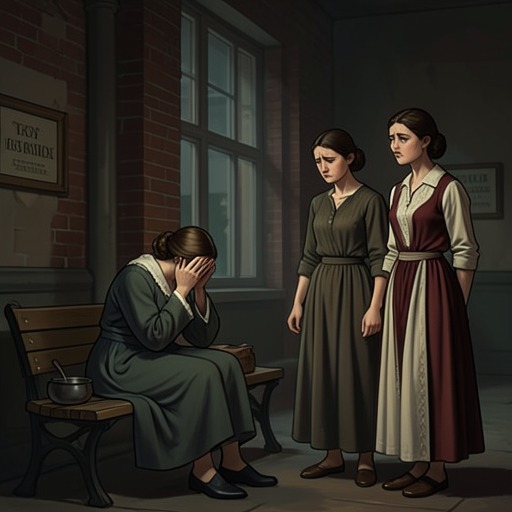
Care work and family attachment complicate any simple account of collective choice. Salome has to hide antibiotics in strained beets so that Miep will take them, and the women make plans to share soup, freshly baked spelt bread, and instant coffee as their meeting continues. Later, Salome grieves the temporary separation from Aaron, while Agata comforts her by connecting that loss to the possibility of building a better colony. Mejal, despite her frequent conflict with Salome, crosses the table to embrace her in a moment of shared crisis. The women’s deliberation takes place within the work of feeding and caring for others, even as they consider withdrawing themselves and their labor from the existing order.
Faith, Nonviolence, and the Decision to Leave
Agata argues that remaining in Molotschna would place the women in direct conflict with violence and compromise the Mennonite commitment to pacifism. If they stay, she reasons, the colony risks becoming a battlefield and the women risk responding to their attackers with violence of their own. Mejal accepts Agata’s conclusion. For Agata, leaving is not a retreat from faith; it is a way to live by the faith’s demands for peace and to avoid turning the community into a site of further harm.
Agata develops this argument through the women’s responsibilities to God, themselves, and their children. She says that remaining would risk pacifism, love, and forgiveness, and that any forgiveness offered under pressure would not be genuine. Leaving, by contrast, would allow them to pursue those values and teach them to their children, even when doing so conflicts with what their fathers expect. The reasoning reverses the authority’s moral framing: the women are not necessarily abandoning religious duty by leaving. They may be acting more faithfully than a system that makes forgiveness compulsory while withholding the conditions needed for it to be meaningful.
Salome’s challenge to male interpretation gives this decision a further dimension. She argues that women cannot know with certainty that leaving is disobedient when the injunction to submit has been transmitted to them by men and they cannot read the Bible for themselves. The point does not prove what scripture says; it exposes the unequal conditions under which the claim is being made. In this discussion, women’s restricted literacy is both a tool of control and a reason to question whether the authorities’ interpretation deserves unquestioned assent.
Collective Agency and the Order’s Consequences
Salome describes women as treated not as full members of the colony but as possessions whose lives and fates are directed by men. Her complaint encompasses the authority of boys as well as adult men: even fourteen-year-old boys are expected to give women orders, determine their futures, take part in decisions about excommunication, speak at the burials of their babies while women remain silent, interpret scripture, lead worship, and punish. The range of examples shows patriarchy operating not as a single rule but as a structure repeated in religious practice, public speech, discipline, and family relations.
The women’s proposed departure also makes clear that their circumstances are not identical. Salome has a son she expects to leave behind temporarily; other grieving mothers share her position, while Mejal is distressed despite having no son to leave behind. The age limits on which boys may accompany the women leave thirteen- and fourteen-year-olds in a particularly uncertain position. Later, Greta asks whether Cornelius is ready to go, but learns that he will stay because his mother belongs to the Do Nothing group and he has no choice but to remain with her. These cases reveal how a decision made collectively is shaped by parental obligations, age, disability, and the choices available to individual families.
The women’s effort to influence their sons becomes, in Agata’s account, both maternal and reasoned: their instinct to protect their children joins their intellect and faith. That combination matters because the existing hierarchy has treated women’s judgment as deficient, most starkly in the elders’ claim about Ona. By deliberating together, testing religious arguments, and considering the consequences for children, the women enact the intellectual and moral agency the order has constrained. Their intended departure is therefore a practical response to danger and a challenge to the assumption that male authority alone can define obedience, safety, or faithful conduct.