Narfa
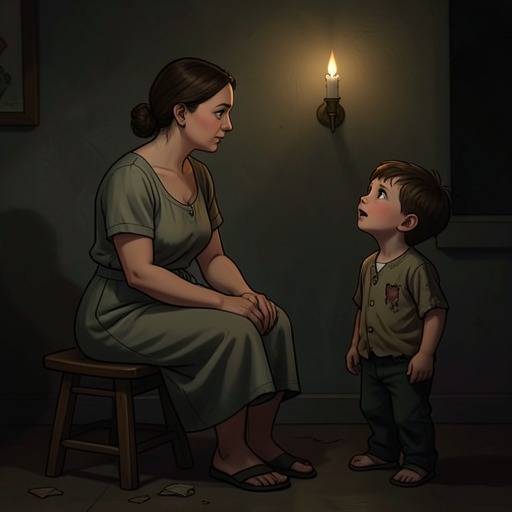
Women TalkingNarfa is the name August Epp and Ona Friesen use for a condition glossed as nervousness, but in Molotschna Colony it is also a social label with consequences. The narrative gives no clinical definition; instead, it shows how the term is attached to experiences of distress and then used to discount a person’s judgment. In Ona’s case, Narfa helps make her an object of suspicion and exclusion even as she continues to question the women’s choices. August’s account of his own history makes the condition personal to the minutes’ recorder as well as to the woman whose thoughts he is recording.
Meaning and Narrative Context
August connects Narfa to trembling through the meaning he gives his surname, Epp: he associates it with the aspen, whose leaves tremble, and with the tree sometimes called Women’s Tongue because its leaves are always moving. He says that both he and Ona are afflicted with Narfa. This association does not establish a medical explanation, but it places nervousness alongside the novel’s persistent concerns with voice, movement, and the difficulty of making oneself understood. August asks why the women want minutes if they cannot read them; Ona answers with a story about a squirrel repeatedly charging a rabbit, which escapes by leaping at the last moment. August values the story because Ona tells it, though at first he cannot see how it answers his question. Her indirect reply gives her thought a place in the record even when its meaning is not immediately recognized.
The minutes also make Narfa part of a wider problem of interpretation. Ona asks whether the women are deciding between protecting their children and entering the kingdom of heaven. Mejal Loewen rejects this as an exaggeration of the issue under discussion. The disagreement shows that Narfa does not mean Ona is silent: she voices a difficult interpretation, but other women may challenge how she frames the debate. The narrative preserves both her question and the response rather than reducing the exchange to a single authoritative account.
August Epp’s Experience
August’s description of his own Narfa is embedded in an account of precariousness rather than in a clinical history. He experienced a nervous breakdown in his fourth year at university in England and became involved in political activities for which he was eventually expelled and imprisoned. While he was in prison, his mother died; his father had disappeared years earlier, and August had no siblings because his mother’s uterus was removed after his birth. He completed a teaching degree by correspondence while incarcerated, but afterward he was homeless and without family support in England. He describes himself as having been close to suicide.
A librarian found him asleep in a public library near the park where he was living, gently woke him when it was closing, and noticed that he had been crying and appeared dishevelled and distressed. When she asked what was wrong, August told her that he did not want to live. She bought him supper at a small restaurant across the street and asked where he came from. His answer described a community set apart from the rest of the world, one that was supposed not to exist in the eyes of others. The episode connects his extreme isolation to the wider experience of belonging to a community separated from the outside world, without making Narfa a complete explanation for either his crisis or his circumstances.
Ona Friesen and the Colony’s Judgment
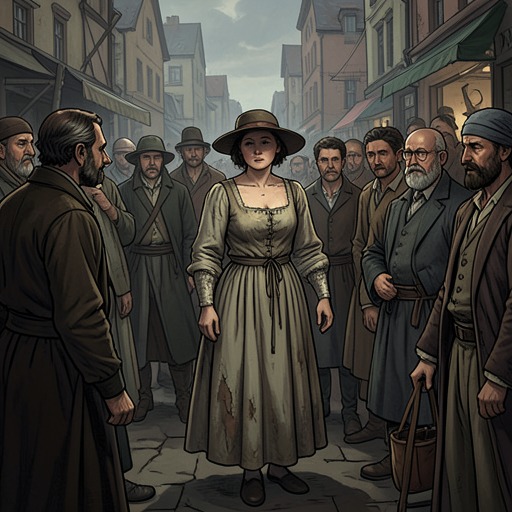
Ona’s Narfa is treated by many colonists as evidence that she cannot function in the world or reason reliably. Her perceived gentleness and supposed incapacity also afford her a limited freedom to speak: because others regard her words as meaningless, they do not always silence them. That allowance is sharply qualified by the fact that she has been attacked repeatedly. She sleeps alone, has no husband, and appears to prefer remaining unmarried. The same community that dismisses her judgment leaves her unusually exposed to harm.
The elders’ judgment becomes especially consequential when Ona is pregnant. In the hayloft, she keeps an empty feed pail beside her because she is experiencing nausea. Some women had tried hurriedly to arrange her marriage to Julius Penner, but Ona refused, reasoning that he deserved better than a woman with Narfa and that marriage to her would taint him with sin because she was not a virgin. The elders conclude that Narfa has made her incapable of reasoning, a verdict the narrator identifies as ironic. They also regard her as beyond redemption while holding that she has not sinned wilfully and will therefore be exempt from eternal damnation. The unborn child, conceived through the assaults euphemistically called the unwelcome visitors, is expected to be given to another colony family, possibly even the family of one of those visitors. Narfa thus accompanies judgments about Ona’s credibility, marriageability, moral status, and the future of her child.
Family History, Stigma, and Change
The colony’s explanation of Ona’s condition is bound up with the disputed account of her father’s death. According to Agata Friesen, supported by Ona, her father Kurt died by suicide; Peters gives a different account, saying that Kurt saw the devil and died of fright. Salome Friesen and Agata’s adult sons do not wholly support Agata’s version. Colonists say that Ona’s Narfa had been latent but manageable until her father died, after which they associate her with dreamy eccentricity, facts, and a chosen identity as an outcast, the devil’s daughter, and a burden supposedly given by God. August counters this image by describing her as a notably light and unobtrusive presence. The competing accounts expose how the community’s stories about Ona shape her reputation without settling what her condition means to her.
That reputation continues in the meetings. Klaas Loewen will not look at or acknowledge Ona; August observes that he treats her as a ghost because of Narfa, her unmarried status, and her pregnancy. August adds that being a ghost seems to suit Ona. The observation does not erase the harm of being disregarded, but it complicates the assumption that visibility and social recognition are always what she seeks. Later, when Mariche Loewen tells Ona that she will never know security because of her Narfa, Ona calmly agrees and says that this is liberating in a way. She distinguishes uncertainty about what love means from disbelief in love itself, and questions the security Mariche associates with it. In this exchange, the label that has been used to diminish her becomes part of a perspective she can acknowledge without accepting the promise of conventional protection.
Significance
Narfa links August and Ona without making their lives interchangeable. August’s account shows how distress can meet bereavement, imprisonment, homelessness, and separation from family; Ona’s shows how a community’s interpretation of distress can intensify gendered vulnerability and restrict a pregnant woman’s authority over her future. The condition is therefore neither a simple diagnosis nor merely a metaphor: it is presented through particular histories and through the treatment those histories invite from others. By recording Ona’s questions, stories, refusals, and calm disagreement, August’s minutes preserve evidence of thought that the colony’s judgment repeatedly tries to dismiss.