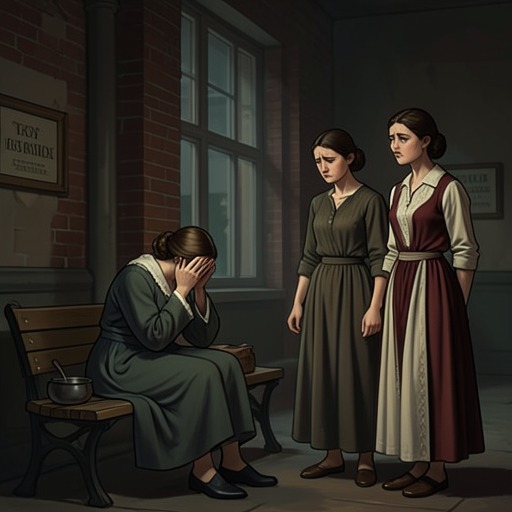
Nettie Gerbrandt
Women TalkingNettie Gerbrandt is a mother, bereaved survivor, and caregiver whose near-total silence shapes her place in the events around the women’s meeting. After an assault and the loss of her prematurely born son, she speaks only to children. The narrative does not turn this silence into a simple refusal: Nettie continues to care for others, and when a child faces an immediate problem, she finds a way to make herself heard.
Identity and circumstances
Nettie’s home becomes a place of care for Miep and the other little children of the Molotschna Colony while several young women attend to them. Her husband is away in the city with the men, and the children therefore depend on this household during the meeting. Nettie’s twin brother, Johan, is among the eight men on trial. She too was attacked, possibly by Johan, though the account leaves that identification uncertain.
Nettie gave birth prematurely to a boy so small that he could fit into a shoe; he died hours after birth. After this loss, she stopped talking except to the colony’s children. The women put her in charge of their care, a responsibility suited to the narrow channel of communication she has retained. Her silence is not presented as evidence that she has ceased to respond to the world: she remains attentive to the children and acts when their needs require it.
Miep, Salome Friesen’s young daughter, is unaware of the reason for pain in parts of her body or that she has a sexually transmitted illness. The account places this fact alongside Nettie’s care of the children, making the household’s ordinary work a setting shadowed by the assaults. Nettie’s role is practical and intimate, but it does not give her the ability to explain the harm the children have experienced.
Silence, care, and the loft
Nettie comes up the ladder to the loft to apologize for allowing Miep out of her sight and for Miep’s return to her mother. She makes the apology without words. Agata Friesen waves it away kindly and sends Nettie back to the other children, who may have been left alone; Miep will remain with Salome for the moment. Nettie nods vigorously and climbs down. The brief exchange shows the women accommodating her silence rather than demanding that she justify herself in speech.
Later, Nettie returns carrying Mariche Loewen’s youngest son, Julius, who is inconsolable. She places him in Mariche’s lap and gestures toward his nose, expressing bewilderment as best the narrator can interpret it. Agata asks her to make an exception to her silence and explain what has happened. Nettie considers the request while Julius cries. At last, facing the child rather than the women, she says that he has put a cherry pit into his nostril and that she cannot remove it without pushing it farther in.
This is a small emergency, not a general return to conversation. Nettie speaks because the women need information to help Julius, and she directs her words to him even as she explains the problem to the adults. Her speech remains bounded by the pattern the narrative has established: she can communicate with children, while the women must find ways to meet her across the silence. The episode gives that pattern a concrete consequence. Without Nettie’s explanation, the adults would not know what is wrong or why they should not try to remove the pit themselves.
The uncertainty around Melvin
Mariche believes Nettie may have changed her name to Melvin because she no longer wants to be a woman. Agata and Greta Loewen do not believe this. The possibility is reported as Mariche’s interpretation, not confirmed as Nettie’s own explanation or as a settled change of identity. Nettie does not speak in the cited scenes to clarify the matter, so the account preserves the distance between what others infer about her and what she herself says.
That uncertainty matters in a community where women’s choices are constrained and interpreted through the expectations of others. The women’s wider discussion challenges the authority of men who claim to interpret the Bible and use that authority to define wives’ submission. Salome Friesen argues that women cannot know precisely what the Bible says when they are unable to read it, and Agata’s case for leaving rests on protecting women and children while remaining faithful to pacifism. Nettie is not shown making these arguments; her story instead registers the personal cost of the violence that prompts them. Mariche’s speculation about a name cannot stand in for Nettie’s own testimony.
Narrative significance
Nettie’s appearances are brief but structurally important. The narrative first establishes the care she provides and the losses surrounding her, then shows her climbing into the loft twice: first to apologize silently, later to explain Julius’s predicament. The contrast makes her capacity to communicate visible without suggesting that a single spoken sentence undoes her withdrawal. Her words arrive in response to a child’s immediate need, while her grief and the larger uncertainty around her remain unresolved.
The children’s care also sets a different measure of responsibility beside the women’s debate over whether to stay or leave Molotschna. Agata argues that leaving can serve pacifism and protect the women and their children; Salome challenges the religious authority used to prescribe female submission. Nettie does not become a spokesperson for either position. Instead, her presence keeps the consequences of violence in view through the work of watching over children, including Miep, who cannot fully understand her own illness. She embodies both the limits imposed by trauma and the care that continues within them: unable to address the women freely, she still notices, carries, gestures, and, when necessary, speaks.