Ona Friesen—Mariche Loewen
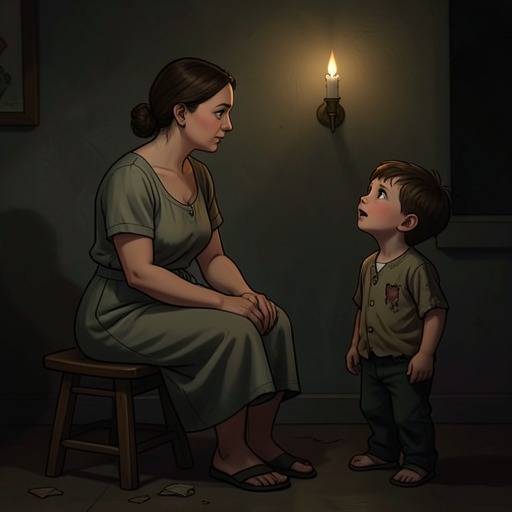
Women TalkingOna Friesen and Mariche Loewen’s relationship is tested by the women’s decision over whether to stay in Molotschna or leave. Their disagreement is not simply a contrast between caution and courage: it turns on what safety requires, who can realistically resist violence, and whether forgiveness can be genuine when the women are ordered to grant it. The argument sharpens a collective crisis into a personal confrontation, then returns the women to the question of how to act together.
A Decision Under Constraint
The women have only two days to organize a response. The remaining men, apart from those too old or infirm and the narrator, have gone to the city to post bail for the imprisoned attackers, hoping the men can return to Molotschna while awaiting trial. Peters says that, upon their return, the women will have the opportunity to forgive them, a condition presented as necessary to secure everyone’s place in heaven. If the women refuse, they will have to leave for an outside world they know nothing about. The apparent choice is therefore shaped by threatened expulsion, uncertainty beyond the colony, and the prospect of renewed proximity to the accused men.
Against this pressure, Ona asks what the women would be fighting for before they weigh the advantages and disadvantages of staying. Mariche answers that the purpose is clear: safety and freedom from attacks. Their exchange establishes a shared underlying concern even as they differ over the means. Mariche names protection as the objective; Ona insists that the group first examine whether staying and fighting can actually deliver it.
The Argument Over Staying
The conflict becomes more pointed when Ona asks whether Mariche truly wants to stay without fighting. She grounds the question in Mariche’s experience of Klaas Loewen’s aggression and in the need to protect her children or get out of danger. The challenge joins political strategy to domestic vulnerability: for Mariche, the proposal to resist cannot be separated from the difficulty of standing up to violence within her own household.
Mariche responds with anger and turns the scrutiny back on Ona. She challenges Ona’s standing to judge what kind of wife and mother another woman should be, since Ona is neither, and attacks her as a dreamer and as a woman stigmatized for Narfa. When Mariche later asks how Ona dares to judge her, the debate has moved beyond tactics to authority: who is entitled to interpret another woman’s choices, and what experience qualifies someone to speak about safety, marriage, and motherhood?
That challenge is sharpened by Ona’s own position. She is pregnant after the assaults, and colony women had hurriedly tried to arrange a marriage for her when her pregnancy became clear. Ona rejected the proposal, arguing that the prospective husband deserved better and that marrying her would taint him because she was not a virgin. The elders’ conclusion that Narfa made her incapable of reasoning further marks her as someone whose judgment the community discounts. Mariche’s insult draws on that stigma, but the scene also shows the irony of a woman dismissed as irrational asking the group to reason carefully about its choices.
Forgiveness, Faith, and Perspective
Ona apologizes and explains that she too has been considering what is good. In her argument, freedom is better than slavery, forgiveness better than revenge, and hope for the unknown better than hatred of what is familiar. She does not present leaving as a rejection of compassion. Instead, she distinguishes the possibility of forgiving from the conditions in which forgiveness is demanded.
Agata develops this distinction into an argument for distance. Forgiveness, compassion, and love may be possible from a distance, she says, and leaving could provide the perspective needed to practice them rationally and lovingly. Staying, by contrast, risks placing the women in a state of war and making any forgiveness coerced rather than genuine. Leaving would also protect the women and children and teach the children to hold to pacifism, love, and forgiveness even when those values conflict with their fathers’ expectations. This reasoning reframes the women’s departure: it can be a means of keeping faith with their commitments rather than abandoning them.
The disagreement between Ona and Mariche thus takes place within a wider contest over what their faith requires. Agata argues that remaining in Molotschna could draw the women into violence and betray Mennonite pacifism. Ona’s appeal to freedom, forgiveness, and hope makes the same decision ethically consequential without treating safety and compassion as opposites. The women face a choice in which neither staying nor leaving is free of risk, but the demand to forgive cannot by itself make staying safe or forgiveness voluntary.
From Confrontation to Collective Action
Mariche’s attack does not erase the practical question Ona raises, and the evidence does not present their exchange as a settled reconciliation. Instead, the women continue toward a decision as a group. At last, the question becomes whether they agree to leave that night after dark, passing the Chortiza and Hiakjeke colonies unseen. The movement from argument to a specific departure plan shows the debate acquiring immediate consequences: the women must decide not only what they believe, but when and how to act under threat of being recognized.
Preparation makes the uncertainty of departure concrete. A map is wrapped around a large block of cheese and covered in brown paper; the safe is placed beneath the back seat of Greta Loewen’s buggy. Onions, soap, and pieces of wood are packed, the wood intended either to provide traction if wheels become mired or to kindle a fire. These supplies speak to a route whose conditions cannot be taken for granted and to the need to carry practical means of subsistence into an unknown future. The women’s choice is described as leaving, but the preparations show how much of that departure is compelled by the danger and ultimatum behind it.
Their dispute also belongs to a collective decision that will not preserve every family unit. When Greta asks whether Cornelius is ready and whether his wheelchair has been packed, Melvin answers that Cornelius will not join the women after all: his mother belongs to the Do Nothing group, and he has no choice but to stay with her. This outcome underscores the costs surrounding the women’s decision without establishing that Mariche herself joins either group. Ona and Mariche’s argument remains unresolved as a personal relationship, but its central question—how to pursue safety without surrendering the possibility of peace—has become part of the women’s departure plan.