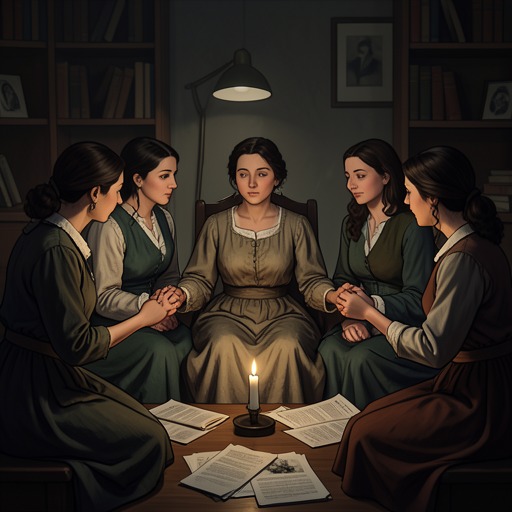
Ona Friesen—Monica Epp
Women TalkingOna Friesen’s bond with Monica Epp is a relationship of intellectual inheritance rather than kinship: as a girl, Ona learned in Monica’s informal lessons, and as an adult she carried that knowledge into the women’s meetings of Molotschna. Monica’s teaching survives not as a formal school or written curriculum, but through what Ona remembers, explains, and proposes when the colony’s women face decisions about their future.
The Secret Schoolhouse
Monica taught Ona and August Epp when they were children, before August left Molotschna with his parents. The lessons took place during milking in what Monica called her secret schoolhouse. It was not a physical building but a discussion: an improvised space for girls to learn beyond the limits of the colony’s ordinary instruction.
One remembered lesson concerned the body. During a discussion in the hayloft, Ona observes that the monthly renewal of outer skin coincides with the monthly replacement of the uterine lining. When Mariche asks how she knows, Ona looks toward August. He has not taught her this; she learned it from Monica long ago. Her correction makes the source of her knowledge explicit and places Monica’s teaching within a chain of women’s shared understanding.
From Remembered Knowledge to Public Proposals
At the women’s meetings, Ona offers a vision for changing how Molotschna is governed and taught. She proposes that women and men make decisions collectively, that women be allowed to think, and that girls learn to read and write. She also calls for a world map in the schoolhouse, so the community can understand its place in the wider world, and for a new religion developed from the old but focused on love.
August recognizes that these proposals repeat nearly verbatim lessons Monica had given the girls. In that moment, Ona looks toward him, trying to make contact across the years and communicate something remembered but nearly lost. The resemblance does not make Ona merely a mouthpiece for Monica: it shows how an earlier educational practice has become material for Ona’s own proposals in a new and urgent setting. What Monica shared in a small circle during milking returns as a possible framework for the whole colony.
Knowledge Against Exclusion
The inheritance also appears in the way Ona treats knowledge as a condition of agency. The women speak Plautdietsch, which August must translate into English before he can write their minutes. Because the women cannot read or write, their deliberations depend on a literate recorder even as they seek to make decisions for themselves. Ona asks August to record the meetings, then suggests that he write the pros and cons of the available choices on brown packaging paper. The women may not be able to read the lists, she explains, but the paper can remain in the hayloft as an artifact for others to discover.
Ona connects restricted literacy to the power to interpret religious authority. She points out that the women’s inability to read or write leaves them at a disadvantage when negotiating the interpretation of the Bible, which is handed down through men. Her questions about counseling and forgiveness likewise challenge decisions made by the elders on the basis of what women were supposedly able or unable to know. Monica’s remembered teaching offers a precedent for girls learning through discussion; Ona carries that precedent into a broader challenge to who may learn, interpret, and decide.
Continuity and Difference
Monica’s influence is especially clear when Ona’s words bring August back to lessons from childhood, but the relation is not presented as a complete record of what Monica taught or as proof that every one of Ona’s views came from her. The novel identifies particular lessons and proposals as echoes; it also gives Ona a speaking role in the present, where she applies knowledge to questions Monica’s lessons could not simply settle for her.
That continuity matters in a community where women’s speech is recorded by someone else and their literacy is limited. The written minutes preserve the meetings, but they cannot replace the face-to-face teaching through which Monica’s ideas first reached Ona. The relationship therefore joins memory to education and private instruction to collective possibility: Monica’s discussions survive because Ona can recall them, put knowledge into circulation, and press for conditions in which girls will not have to depend on a secret schoolhouse to learn.