Plan for Boys Under Fifteen to Leave with the Women
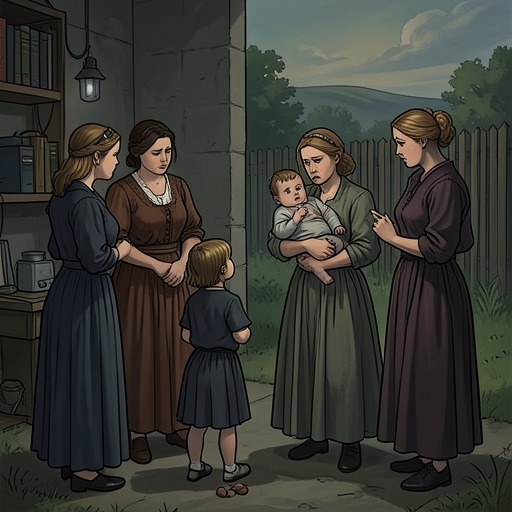
Women TalkingAgata Friesen’s plan for boys under fifteen makes the women’s proposed departure an act of protecting sons as well as daughters. It draws a boundary at baptism, asks the women to take responsibility for younger boys, and recognizes that they cannot simply compel children to leave; the plan is both a practical proposal and an argument about what care and faith require.
Age and Membership
Agata proposes that every boy under fifteen accompany the women. In the colony, fifteen is the age of baptism: boys baptized into the church are treated as full members and as men. Those older boys are in the city with the other men, while the boys below that threshold remain in the colony.
The distinction is therefore not only numerical. Baptism marks entry into adult membership, while younger boys are understood to require special care. Agata includes Cornelius and Grant among those remaining on the colony, alongside the under-fifteen boys, and argues that they too belong within the women’s protective responsibility.
Protection and Pacifist Reasoning
The proposal grows out of the women’s decision about whether to remain in Molotschna. Agata argues that staying would expose them to further violence and risk turning the colony into a place of conflict. In her reasoning, departure is not a rejection of Mennonite faith: it is a way to honor pacifism, protect the people entrusted to them, and avoid a coerced response toward their attackers.
She presents the care of children as part of that religious duty, not as a concern limited to daughters. The women’s responsibility, as she describes it, extends to all their children. She also joins maternal instinct to collective judgment and faith, asserting that their decision is informed by both feeling and deliberation.
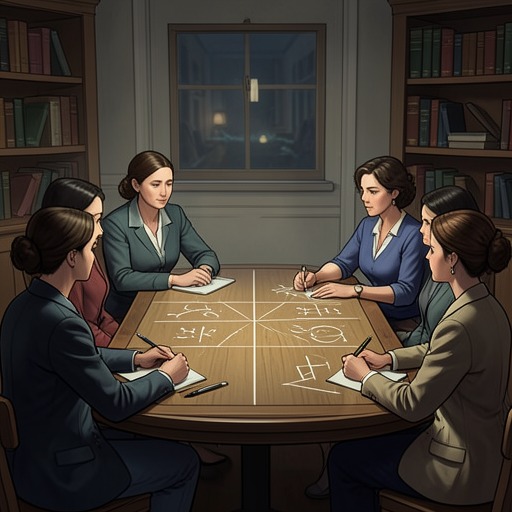
The question of scriptural authority is contested within the same discussion. Salome Friesen argues that women cannot know exactly what the Bible says when they are unable to read it, and that their understanding of a duty to submit to husbands comes through what their husbands have told them. Her point challenges the use of male interpretations to determine whether women may leave, and helps frame the plan as a decision the women must reason through for themselves.
Persuasion Rather Than Force
Mariche Loewen raises the practical difficulty of boys refusing to go: the women cannot carry fourteen-year-olds away. Agata accepts the limit. They cannot force the boys to leave, she says; instead, they will explain the discussion and why they believe departure is best, then try to influence their sons.
The plan thus distinguishes protection from possession. The women claim responsibility for the boys’ welfare, but their stated method is explanation and persuasion rather than physical compulsion. That distinction matters in a group already facing a decision imposed under severe pressure: the men are seeking bail for the imprisoned attackers, and the women have only two days to decide whether they will forgive them or leave the colony.
The discussion also recognizes that children can present risks without ceasing to be children. August Epp answers that thirteen- and fourteen-year-old boys could pose a threat, while emphasizing their immaturity, capacity for empathy, and ability to learn. His comparison of them to young yearlings underscores their unsettled strength without treating them as beyond guidance. This makes the women’s plan a protective judgment about age and responsibility, not a claim that every boy is already an adult or an aggressor.
Departure and Its Limits
The women agree to leave after dark, hoping to pass the Chortiza Colony and Hiakjeke Colony without being seen. Their plans include a map wrapped around a block of cheese and covered in brown paper, a safe stowed beneath the back seat of Greta Loewen’s buggy, and supplies including onions, soap, and pieces of wood for traction or kindling. These preparations make the decision to leave concrete, while the plan for younger boys specifies whom the women hope to bring with them.
The proposed protection cannot include everyone on equal terms. Cornelius will not join the departing group after all: his mother is among the Do Nothing women, and he has no choice but to stay with her. The outcome exposes a limit in the women’s collective plan: age and need may identify someone as requiring care, but family circumstances and the decision to remain can still determine whether that person leaves. The under-fifteen plan is therefore an aspiration and a guiding rule for the group, not a guarantee that every vulnerable person can be brought along.