Salome Friesen
Women TalkingSalome Friesen is Agata Friesen’s younger daughter and a mother whose care for her children becomes inseparable from her resistance to the rules of Molotschna Colony. She has attacked one of the accused men with a scythe, obtained medicine for her three-year-old daughter Miep when the colony’s bishop denied treatment, and argued that protecting children must take precedence over obedience to male authority. Her anger is not merely personal: in the women’s meetings, she gives urgent and uncompromising language to the dangers that the colony’s leadership expects women to endure or forgive.
Identity and Family
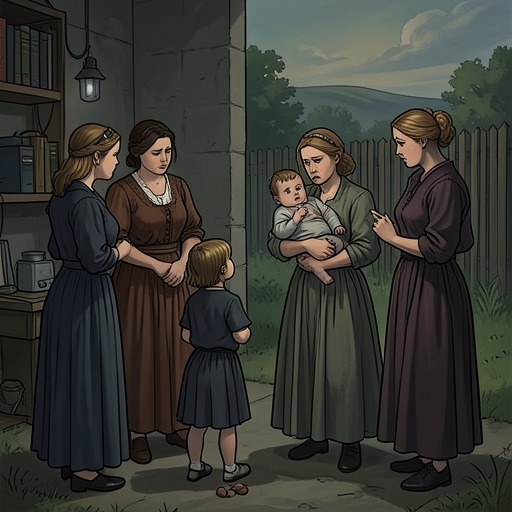
Salome is one of Agata’s daughters and Ona Friesen’s younger sister. Her family responsibilities are immediate and practical. During the women’s deliberations, she explains that she must bring food to several elders and administer antibiotics to Miep, whose treatment she has arranged herself. Miep had been assaulted, but Peters refused medical care, fearing that a doctor would spread word of what had happened. Salome walked twelve miles to another colony to obtain antibiotics from a temporarily stationed mobile clinic, then concealed the medicine in Miep’s strained beets because the child would not take it otherwise.
The novel also associates Salome with Aaron, whom she must leave behind for the time being if the women depart. His absence is not an abstract cost: it is a source of grief that Agata acknowledges, and the prospect of separation makes Salome’s choice more difficult without changing her determination to protect the children who can leave with the women. Salome’s responsibilities therefore pull in different directions—toward the child in her arms, the son she will leave temporarily, and the larger group of children whose safety is at stake.
Resistance and Maternal Protection
The immediate crisis has already turned dangerous before the women assemble. Molotschna is self-policed; after Peters initially planned to confine the accused men locally, their lives appeared to be at risk. Salome attacked one of them with a scythe, while another accused man was killed by angry male relatives. The elders then called in the police and sent the accused to the city. Salome’s action stands within this escalation, but her later arguments make clear that her opposition is not simply a demand for retaliation. She insists on protection from further harm and rejects a system that makes the women responsible for forgiving the men who threaten them.
Her defense of Miep gives that position its most intimate and forceful form. When the discussion turns to whether women must secure forgiveness from male religious authorities, Salome argues that protecting children cannot itself require the women’s permission from the men whose conduct endangers them. She challenges the idea that a loving God would require silence in the face of attacks on children, and questions why divine protection has not prevented the harm. Her argument turns religious language back on the authority that invokes it: the children’s vulnerability, rather than the elders’ demand for obedience, becomes the test of moral responsibility.
Salome also widens the discussion from individual danger to the colony’s organization. She says that women are not treated as full members: even adolescent boys may give them orders, influence their fate, interpret scripture, lead worship, and take part in decisions about excommunication. Her account connects that exclusion to the prospect that women’s labor and childbearing will be valued only while useful to men. The outburst gives the meeting a vocabulary for a structural grievance that cannot be answered by asking each woman simply to forgive or remain.
The Decision to Leave
Salome is among the clearest advocates of departure. When Mejal Loewen asks for at least one or two disadvantages of leaving to be written down, Salome answers that there are none. Holding Miep, she imagines no counterweight sufficient to make staying preferable. The force of her position comes from its circumstances: she has had to make a long journey for medicine, and she is being asked to trust the same leadership that denied her child treatment. Leaving appears to her not as a comfortable alternative but as the necessary means of protection.
Her commitment does not mean the choice is painless. When Salome raises the problem of boys aged thirteen and fourteen, she asks why they are excluded from the women’s plan when younger boys may accompany them and older boys have already gone to the city. She fears that the accused men might return to a colony without women and girls and target these boys instead. Mejal Loewen supports the question, and August Epp answers that adolescents can pose risks but are still children who can be taught with direction, love, and patience. Salome’s concern thus tests the limits of a plan organized around age categories: safety cannot be secured simply by leaving a vulnerable group behind.
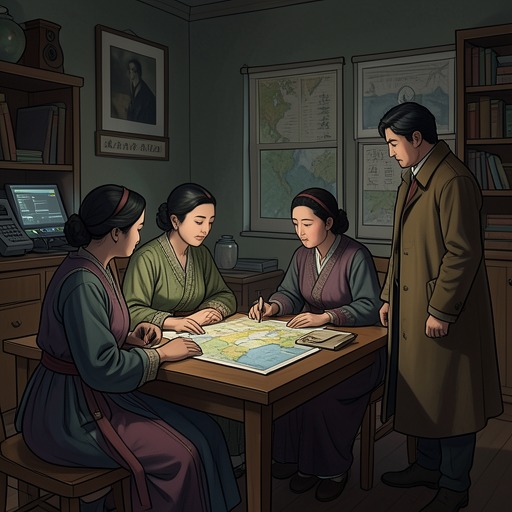
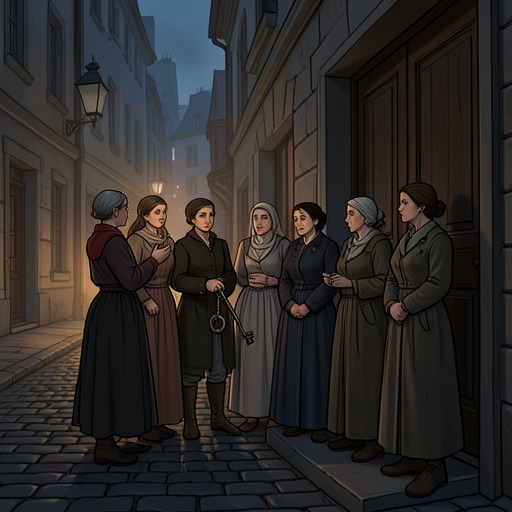
The practical preparations make the decision concrete. The women agree to leave after dark, avoiding notice as they pass the Chortiza and Hiakjeke colonies. August Epp has placed the map, the cooperative safe, food, soap, wood for traction or kindling, and other supplies in Greta Loewen’s buggy. These details place Salome’s resolve within a collective undertaking: departure depends on secrecy, provisions, and a route through uncertain territory, not on conviction alone. The plan is still being made in the scenes described; the decision to leave has not yet become a completed journey.
Relationships and Narrative Significance
Salome’s relations with the other women are marked by both friction and solidarity. She and Mejal Loewen often disagree, but when Salome grieves over leaving Aaron, Mejal crosses the plywood table to embrace her. Agata Friesen also puts an arm around Salome and frames the painful separation as a reason for the mothers to build a better community. These gestures do not dissolve the losses or disagreements; they show how care among women helps sustain a decision the existing community has made perilous.
Salome’s speeches also expose the limits of the narrator August Epp’s position. He records her anger, her work of caring for Miep, and her criticism of the colony, while the women must decide whether his account of the adolescent boys is sufficient to include them in their plans. In this way, Salome is not simply an emblem of rage or a mother defined by suffering. She is a participant who presses the meeting to make its principles answerable to children’s actual vulnerability, and who insists that faith cannot be reduced to submission to the men who claim to interpret it.