Salome Friesen—Miep
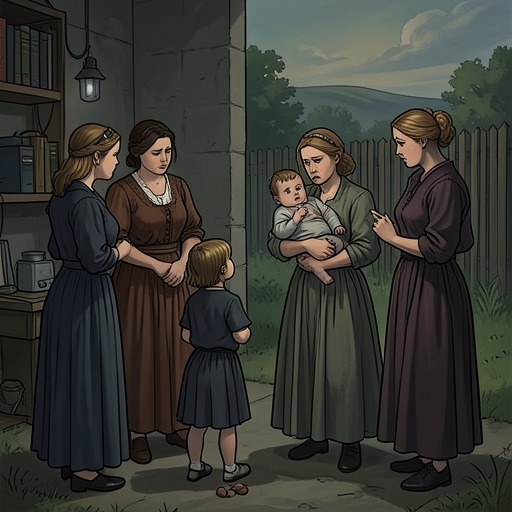
Women TalkingSalome Friesen’s bond with her youngest daughter, Miep, brings the colony’s crisis into the intimate scale of caregiving: medicine hidden in food, a frightened child reaching for her mother, and a mother insisting that a child’s safety outranks the authority of men who have failed to protect her. Miep is three years old and has been assaulted more than once; Salome responds not only with tenderness but with determined action against the institutions that deny her daughter care.
Identity and Circumstances
Miep is Salome Friesen’s youngest daughter. Her grandmother, Agata Friesen, is also named Miep; the child’s name is a nickname. The family relationship places Salome’s care within a wider bond between generations: Agata remains deeply affected by the specific details of what happened to her granddaughter, while Salome takes responsibility for Miep’s immediate needs.
The attacks on Miep occurred amid a series of assaults on girls and women in Molotschna Colony. For years, many people in the colony attributed the nighttime attacks to ghosts or Satan. The assailants were eventually identified as eight local men, many of them relatives of the women they attacked. Miep’s age makes her dependence on adults especially stark: she cannot arrange medical care or protect herself, and her welfare rests on whether those with authority choose to act.
Medical Care and Salome’s Actions
Miep was violated on two or possibly three occasions. Peters denied her medical treatment, citing the risk that a doctor would gossip about the colony and that knowledge of the attacks would spread. Salome did not accept that refusal as the final word. She walked twelve miles to a neighboring colony, where a mobile clinic was temporarily stationed, and obtained antibiotics for Miep.
Getting the medicine was only part of the work. Miep would not swallow the antibiotics, so Salome hid them in strained beets. This small, practical detail shows care as an ongoing task rather than a single dramatic gesture: Salome must obtain treatment, find a way to administer it, and fit that work around her other responsibilities. During the meeting, she notes that she must give Miep her medicine while also taking food to some of the colony’s elders. She offers to bring spelt bread she baked that morning so the women can eat as they continue their deliberations. Care for her daughter and service to the colony occupy the same strained schedule, though the community’s refusal of treatment has made the first responsibility particularly urgent.
Salome’s response also includes a more forceful confrontation. After discovering that Miep had been attacked more than once, she went to the shed where the accused men were being held and attempted to kill them with a scythe. Peters then called the police, and the men were arrested and taken to the city. The episode exposes the consequence of leaving protection to a mother whose attempts to secure ordinary medical help had already been obstructed: Salome’s protective action becomes the immediate cause of the men’s removal from the colony and into police custody.
Miep at the Women’s Meeting
Miep’s needs do not remain outside the women’s deliberations. She climbs the ladder into the loft and calls for Salome after hearing the women yell. Frightened and crying, she asks her mother to change her diaper. Agata explains that Miep had been out of diapers for nearly a year but had recently asked to wear them again. The account records this change without assigning it a diagnosis or explanation; it shows a young child asking for care in the midst of circumstances she cannot control.
Salome picks Miep up, strokes her hair, whispers to her, and kisses her. Ona Friesen puts an arm around Salome’s shoulders while Salome cradles the child. The meeting briefly shifts from argument to a shared act of comfort: Miep seeks her mother, Salome responds physically and gently, and another woman supports Salome as she holds her daughter. Agata suggests adjourning for the day, while the women consider how to preserve their work for a later meeting. The scene makes the cost of deliberation tangible without reducing Miep to an argument: the child is present, frightened, and in need of her mother.
Protection, Authority, and Conflict
Salome’s defense of Miep informs her larger challenge to the colony’s male leadership. She rejects the idea that women must seek forgiveness from men for protecting their children, particularly when those men include people from whom protection is needed. Her argument turns on the basic failure of authority to keep children safe: a religious order that invokes care for children cannot be treated as adequate if it permits attacks on them and then discourages medical attention to avoid public knowledge.
That stance sharpens when Salome declares that she will use any means necessary to prevent harm to her child. Her words are a statement of resolve, not a description of another event. They carry the force of the earlier scythe incident, but also make clear that her anger is directed toward preventing further harm. In the women’s discussion, the private bond between mother and daughter becomes part of a collective question: whether protecting children can require women to disobey the men who claim authority over them.
Narrative Significance
Miep’s relationship with Salome is presented through concrete acts and interruptions rather than through an abstract account of motherhood. The antibiotics concealed in beets, the long walk to obtain them, the child’s return to diapers, and Salome’s embrace in the loft establish both the vulnerability of a three-year-old and the persistence of her mother’s care. These details also show how the colony’s decisions reach into domestic life: the denial of treatment and the threat of further violence are not separate from the women’s meeting but among the conditions that give it urgency.
Salome’s protectiveness does not remain confined to her own household. Her appeal to protect children, and her refusal to accept male authority as the sole source of moral judgment, connect Miep’s immediate safety to the women’s broader effort to decide how they will respond to violence. The relationship therefore joins the intimate and the political: Salome’s care is tender in her actions toward Miep and uncompromising when the institutions around them fail to provide safety.