Salome Uses a Drug to Prevent Informing and Take Aaron Along
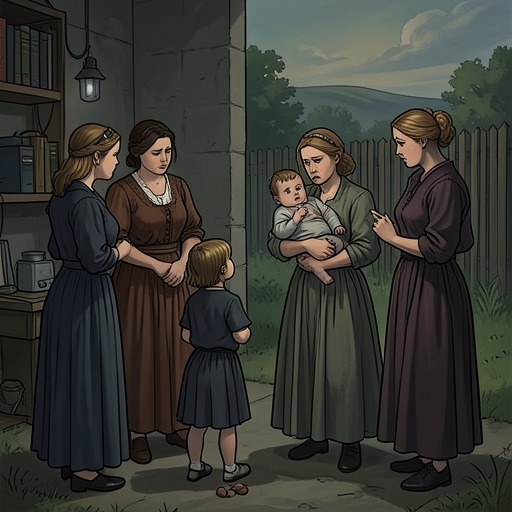
Women TalkingSalome Friesen’s use of Belladonna anesthetic spray serves two linked purposes during the women’s departure from Molotschna Colony: it delays those who might expose the plan, and it ensures that her son Aaron leaves with her. The action is not presented as a simple escape tactic. Salome also uses the spray on Aaron without obtaining his agreement, making the same means of protection a point of conflict between a mother’s judgment and her child’s choice.
Preventing the Plan from Being Exposed
Salome tells August Epp that she instructed Autje Loewen and Neitje Friesen to lure the Koop brothers into the loft by promising intimacy and to make enough noise to cover her entrance. Once inside, she used the spray to render the brothers unconscious. Her stated reason is practical: they would otherwise be able to go to the city and inform on the women. The girls’ part in the plan is deliberate, not incidental; their distraction gives Salome the opportunity to act without alerting the brothers to her presence.
The measure is timed to the departure. Salome sends Autje and Neitje to the buggies waiting behind the schoolhouse, and they leave the loft and run away from Molotschna Colony. Her plan does not require the brothers to be restrained indefinitely. She later asks August to keep watch over them and ensure they remain unconscious for seven or eight hours, long enough for the women to get away. The specific interval makes clear that Salome’s immediate objective is to gain time for the group, not to keep the men under her control beyond the escape.
Salome has also sprayed Scarface Janz. She tells August she had to do so because Janz planned to go to the city to tell the men. This second act extends the same preventive strategy beyond the Koop brothers: Salome identifies another route by which the women’s departure could be reported and temporarily blocks it. The episode thus shows her addressing several possible sources of disclosure while the women are preparing to leave.
Aaron Leaves with Salome
When August asks where Aaron is, Salome explains that she has found him and that he is already in a buggy, waiting. Asked whether she convinced him to leave, she says she did not: she used the spray on him too. This is a consequential distinction. Aaron is not described as having chosen the departure or having been persuaded by his mother; Salome takes the decision upon herself and makes his departure possible by ensuring he cannot refuse in that moment.
Salome explains her decision through the image of carrying a sleeping child away from a house on fire. The comparison expresses her view that staying in Molotschna Colony is dangerous enough to justify taking Aaron away without his consent. August tests that reasoning by asking what might happen if Aaron changes his mind. Salome answers that by then they will already be gone and says that he is her child. Her reply treats the urgency of leaving as overriding the possibility of later reconsideration. The scene does not resolve the disagreement by showing Aaron accept the plan; instead, his presence in the buggy makes Salome’s choice effective before he can decide again.
The Departure and Its Immediate Safeguard
Salome’s actions join care with control. She acts to prevent the women’s departure from being reported, but she also determines that Aaron must accompany her, even when he has not agreed. The parallel does not make the two decisions identical: the Koop brothers and Janz are incapacitated because Salome believes they will inform the men, while Aaron is taken because she believes he cannot safely stay. In each case, however, she uses the spray to remove an immediate obstacle to the departure rather than relying on discussion or consent.
Before leaving, Salome asks August to keep watch over the Koop brothers and gives him the container of Belladonna anesthetic spray. She instructs him to use it again if they wake too soon, while warning him not to let the elders find him with it. The handoff turns August from a witness into a temporary participant in maintaining the women’s lead. Salome entrusts him with both the means and the limited task: keep the brothers unconscious for the hours needed to get away, and avoid discovery by the elders.
Significance of the Action
The episode makes the departure depend on concrete acts of timing, concealment, and trust. Autje Loewen and Neitje Friesen create a distraction; Salome disables those she believes may report the plan; the buggies provide a way for the women to leave; and August is left to guard the time they need. The operation is collective, but Salome’s role is decisive: she anticipates exposure, acts against it, and then secures Aaron’s place in the departing group.
At the same time, the episode refuses to make protection uncomplicated. Salome’s conviction that Aaron cannot stay is clear, but his consent is absent, and August’s question about a possible change of mind keeps that absence in view. Salome’s urgency allows no time for a later decision before departure. Her actions therefore mark both the practical resolve needed to leave and the cost of making a protective choice on another person’s behalf.