Secret Play
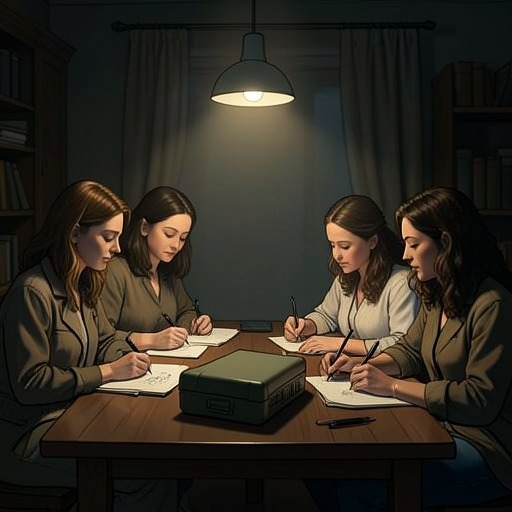
Women TalkingSecret Play is the story Ona tells of a squirrel and a rabbit playing in secret. The image gives the women’s minutes a purpose beyond their immediate use: even if the women cannot read the record, someone can take it from Molotschna, carrying their lives and testimony into a wider world. Play becomes a small, unplanned event that challenges the assumption that what cannot be formally possessed or understood has no value.
The animals and the act of seeing
Near the close of the narrative, Ona tells the recorder about a squirrel and a rabbit and their secret play. She wonders whether she was meant to see them, but the fact remains that she did. The moment is not presented as a lesson the animals intended to offer. Its force comes from the chance encounter: life has occurred beyond the observer’s plans, and witnessing it has made a difference.
That distinction matters to the story’s use of the image. The animals are not shown as symbols with a fixed, explained meaning; their hidden play gives Ona a way to think about what can matter without being assigned a public purpose. What is secret is not therefore unreal or worthless. The encounter becomes part of her understanding precisely because she saw it, even though she cannot claim that it was meant for her.
The minutes and their unexpected purpose
The story follows a question about the women’s written minutes. The recorder has asked what the minutes can do for women who cannot read them. Ona’s tale changes the terms of that question. Perhaps the minutes were not primarily intended for the women to read in Molotschna; perhaps their purpose all along was for the recorder to take them away. The shift turns a practical limitation into a question of transmission: a record can matter through the person who carries it, even when its makers cannot access it in the same form.
Ona’s conclusion draws the minutes close to life itself. The recorder responds with a smile and laughter, recognizing the reversal: the minutes seem to have no point if their value is measured only by whether their authors can read them, yet their journey outward gives them another purpose. Secret Play thus binds an incidental act of seeing to the act of preserving experience. The record is not merely a document about life; its keeping and carrying become part of the life at stake.
A private image amid unequal choices
The story’s resonance is sharpened by the women’s circumstances, which are not interchangeable. Ona is pregnant after the assaults in Molotschna, and some colonists hurriedly try to arrange her marriage to Julius Penner. She refuses, saying that her Narfa would taint him and that he deserves better. The elders regard her as beyond redemption and incapable of reason; they also intend for her unborn child to be raised by another colony family, perhaps even by the family of one of the assailants. Against these decisions made about her, the small image of animals playing beyond human instruction offers a contrast, not a solution: it preserves a moment that has not been assigned by the colony’s authorities.
The meeting also makes visible the differing vulnerabilities within the community. Salome Friesen asks why boys aged thirteen and fourteen cannot leave with the women, given that older boys are with the men and boys twelve and under may accompany the women. She fears that the younger teenagers could be targets if the accused men return. Mejal Loewen joins her in questioning the exclusion. The recorder answers that boys of that age can cause harm but are still children who can be taught, emphasizing direction, patience, and love. This argument places the young people’s capacity to learn against a rigid division by age and membership. Secret Play does not resolve that dispute; it offers a quieter counter-image of life unfolding beyond the categories imposed upon it.
The limits on choice appear again when the women prepare to leave. Cornelius will not join them because his mother belongs to the Do Nothing women and he has no choice but to stay with her. Autje and Neitje are distressed; the young people value Cornelius for his jokes, comedies, and creativity, and Agata hopes he and his mother may change their minds and join the women elsewhere. That hope, like the animals’ unseen play, remains open rather than assured. The story’s final importance lies in holding onto what has been witnessed and carrying it forward, even when the community’s decisions leave some lives outside the departing group.