The Metaphor of Women as Animals
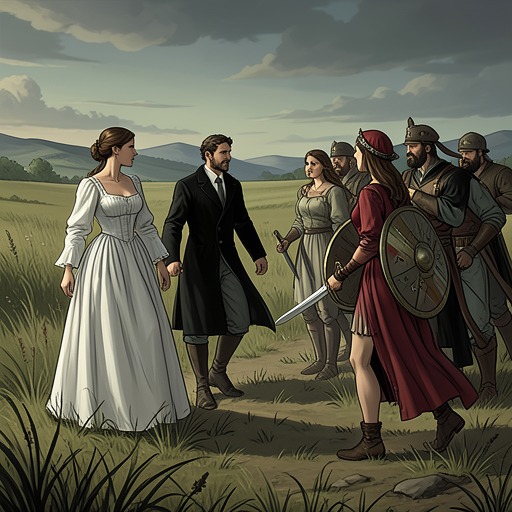
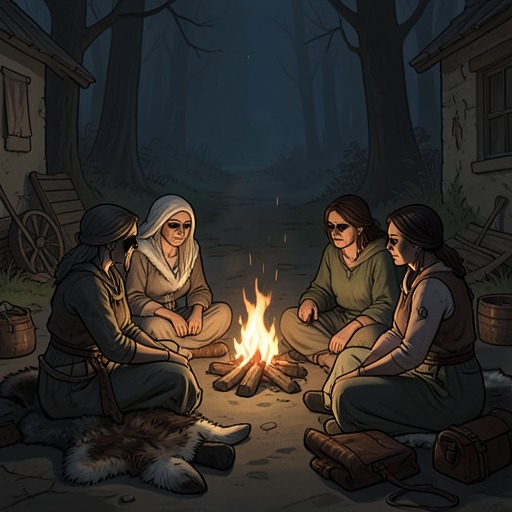
Women TalkingThe Metaphor of Women as Animals is a recurring argument through which the women of Molotschna Colony test what it means to be preyed upon, to resist, and to be recognized as fully human. It begins with Greta Loewen’s comparison between her horses’ flight from danger and the women’s possible response to violence. The comparison is quickly challenged, revised, and made politically sharper: the central issue is not whether women resemble animals, but why animals in the colony can be safer and better cared for than its women.
The horses and the choice to flee
Greta introduces the comparison through Ruth and Cheryl, her beloved horses. Ruth is blind in one eye and must be harnessed to Cheryl’s left. When the horses are frightened by one of Dueck’s Rottweilers on the mile road to church, their instinct is to bolt. Greta argues that they do not hold a meeting to decide what to do; they run, and running may keep them from harm. Her example turns an ordinary response to danger into a challenge to the women, who are gathered to decide how to respond to the attacks in their colony.
The women immediately hear different implications in Greta’s proposal. Ona Friesen asks whether Greta means they should run away; Salome Friesen asks whether she means they should kill their attackers. Neither possibility is settled by the horse analogy itself. It opens a dispute about whether escape, confrontation, or another course can count as a legitimate answer to danger, and about whether the women may choose for themselves rather than accept the decisions made by others.
Agata Friesen objects that the women are not animals. Greta answers that they have been preyed upon like animals and may therefore respond in kind. Agata complicates the analogy further: she has seen animals confronted by dogs, coyotes, or jaguars and attempt to fight back rather than flee. Greta acknowledges that animals do not always run. The comparison consequently refuses a single lesson. It cannot dictate the women’s decision, and even its account of animal behavior allows for both escape and resistance.
Violence and unequal protection
The analogy acquires its force against the history of attacks that prompted the meetings. Since 2005, women and girls in Molotschna have been assaulted at night after being rendered unconscious with belladonna anesthetic spray used on farm animals. For years, many people in the colony believed the attacks were the work of ghosts or Satan and understood them as punishment for sin. The discovery that eight attackers were men from Molotschna, many related to the women they assaulted, overturns that supernatural explanation. The women were not facing an unknowable force: people within their community had harmed them.
Greta later states the comparison in its most accusatory form: although women may not be animals, they have been treated worse than animals; Molotschna’s animals are safer and better cared for than Molotschna’s women. The shift is decisive. Rather than using animal behavior to define what women are, Greta uses the colony’s unequal treatment of women and animals to expose the condition imposed on women. The comparison makes neglect and danger visible by measuring them against the care animals receive.
Salome gives that charge a structural dimension. She describes women as excluded from membership and authority in a colony built on male power: men and boys give orders, determine women’s fates, vote on excommunications, interpret the Bible, lead worship, and punish. Her account connects the animal metaphor to a denial of civic and religious standing. Women are not simply vulnerable in moments of danger; they are positioned as obedient dependents whose voices do not carry the same authority as men’s.
Who can interpret women’s experience
The dispute also concerns whose account of harm is accepted. Ona questions the elders’ and bishop’s reasoning that women do not need counselling because they were unconscious during the attacks. If they could not understand what happened, she asks, what could they be required to forgive? Her argument exposes the contradiction in treating lack of consciousness as proof that no meaningful harm occurred. It also links the colony’s dismissive account of the assaults to a broader confusion between not knowing the world and being free.
That conflict over knowledge extends to religious interpretation. Salome identifies male interpretation of the Bible, handed down to women, as a deeper problem than mere gaps in understanding. Ona points out that women’s inability to read or write leaves them at a disadvantage when negotiating what the Bible means. The metaphor of animalization thus sits alongside a practical restriction on women’s ability to contest the language used to govern them: their experience may be lived in their bodies, while authoritative explanations remain in male hands.
Ona’s pregnancy makes that imbalance concrete in another way. She keeps an empty feed pail beside her in the hayloft because of nausea. After the colony recognizes that she is expecting, people hurry to arrange a marriage for her, but Ona rejects the proposal, citing her Narfa and the belief that marrying someone who is not a virgin would taint the prospective husband with sin. The elders regard her as beyond redemption and incapable of reasoning; they also decide that her unborn child will be raised by another colony family, possibly the family of one of the attackers. Her situation shows how women’s identities and futures can be assigned through judgments that diminish their own reasoning and agency.
The limits and consequences of the metaphor
Animal comparisons in the meetings do not supply a simple answer about what women should do. They provide a language for discussing danger when the community’s ordinary explanations have obscured it, but the women also challenge that language. Agata’s insistence that women are not animals and her examples of animals that fight back prevent Greta’s account from becoming a fixed prescription. The debate holds flight and resistance in view without pretending that one response fits every woman or circumstance.
The narrator’s comparison of thirteen- and fourteen-year-old boys to yearlings further complicates the boundary between animal imagery and human responsibility. He describes the boys as powerful, inexperienced, and capable of harm, but also as children who can be taught through direction, love, and patience. This is an argument against treating dangerous conduct as immutable: unlike a simple label of predator or prey, it leaves room for education and change. In that context, animalization can illuminate vulnerability, but it cannot replace judgment about people’s choices or capacity to learn.
The women’s debate takes place as they consider leaving, and its stakes include not only the adults’ safety but also the children who will be affected by their decisions. Salome and Mejal Loewen, despite often being at odds, come together to embrace Salome when she grieves the temporary separation from Aaron. Salome also asks why boys aged thirteen and fourteen cannot leave with the women, warning that they may be vulnerable if the accused men return. These moments resist treating women as a uniform group: mothers face the pain of separation, while the proposed response must account for children of different ages and circumstances.
The metaphor’s lasting force lies in the distinction between being compared to animals and being treated as less deserving of safety than they are. Ruth and Cheryl’s instinct to escape gives the women one possible image of self-preservation; the account of women’s treatment turns that image into an indictment of their colony. By arguing over the comparison rather than simply accepting it, the women make it a tool for examining who has protection, who has authority to interpret harm, and whether survival requires flight, resistance, or a future built elsewhere.