The soul of Molotschna
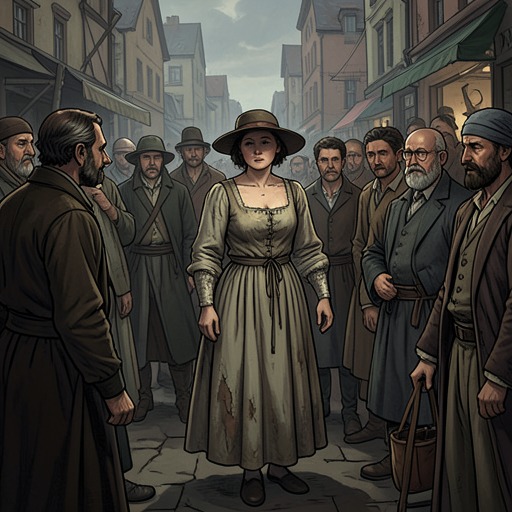
Women TalkingThe soul of Molotschna names more than a community’s inherited identity: it gathers the women’s argument that faith must be lived through peace, care, and thought, and August Epp’s vision of Ona Friesen as the person who can carry those values into the future. The expression holds together a threatened community and the possibility of a different legacy for its children.
Faith Tested by Violence
Agata Friesen argues that pacifism is not a reason to remain in the Molotschna Colony at any cost. If the women stay amid the threat of violence, she says, they risk making the colony a battlefield and compromising the Mennonite commitment to peace. Leaving, in her account, is the course more faithful to pacifism, love, and forgiveness: it avoids a coerced forgiveness and teaches children to hold to those values even when their fathers expect otherwise. Her reasoning gives the expression a practical meaning. The soul of Molotschna is not secured by remaining in place, but by refusing to let violence define the community’s conduct.
Agata’s position meets resistance. When she speaks, Mariche Loewen and Greta Loewen begin to object, and Greta raises her arms; Mejal Loewen eventually acknowledges the force of Agata’s case. The disagreement is not simply between faith and departure. It concerns whether the women can preserve their faith by leaving a situation in which they expect violence to shape their choices.
Interpretation and Independent Thought
The women’s decision also turns on who has the authority to explain scripture. Salome Friesen argues that women cannot know exactly what the Bible says when they are unable to read it, and that their belief in submission to husbands rests on what their husbands have told them the Bible commands. Her challenge exposes a gap between religious teaching and women’s access to the text used to justify their obedience. The women’s attempt to interpret their obligations for themselves becomes part of the moral life the expression evokes.
Agata describes the mothers’ decision to influence their sons as instinctive rather than revolutionary: they are their children, and the women have collectively judged what is best for them according to their faith and understanding of love and peace. She presents maternal instinct, intellect, and spiritual conviction as acting together. When Mariche asks about boys who refuse to leave, Agata says they will be entrusted to the Do Nothing women and their fathers, expected back the following day. The plan therefore includes both a collective choice and a limit: the women intend to teach and protect their sons, but do not claim that every boy will accompany them.
Ona as the Future’s Guide
The expression reaches its most personal form in August Epp’s imagined teaching life. Facing the prospect of living without the women, he imagines teaching the boys about Ona Friesen and placing her name at the head of every lesson guide. In that vision, Ona becomes his direction and map, and the children in schoolhouses across Mennonite colonies ask their teacher for another story about her. August imagines her remembered transformation from a figure branded the devil’s daughter into one he regards as God’s most precious child. Calling her the soul of Molotschna makes her not merely a subject of remembrance but the center of a future education.
August’s imagined lessons join Ona’s character to her love of facts, including her attention to the fact that dragonflies have six legs but cannot walk. He contrasts such knowledge with a world in which facts have been kept from the women and acquire the force of rare, precious gifts. In this passage, facts become a means of transmission: the children may inherit not only a story about Ona, but a habit of attention and a claim to knowledge.
Memory, Story, and Communal Legacy
August imagines Ona’s story entering the religious memory of Mennonite communities alongside the story of Saul’s conversion. The comparison gives her life the shape of a transformation that can be retold, while the schoolhouse setting makes that retelling part of ordinary communal teaching. This is an imagined future, not a report that the lessons or schoolhouses have come to pass; its importance lies in what August hopes the story will preserve.
The expression thus connects the women’s present ethical reasoning with a possible inheritance for their children. Agata’s defense of departure makes peace a lived obligation; Salome’s challenge makes independent interpretation part of faith; and August’s vision makes Ona the figure through whom those lessons might endure. The soul of Molotschna is presented not as a possession guaranteed by the colony’s existing order, but as a legacy that may survive through memory, teaching, and the freedom to know.