Women's Independent Interpretation of the Bible
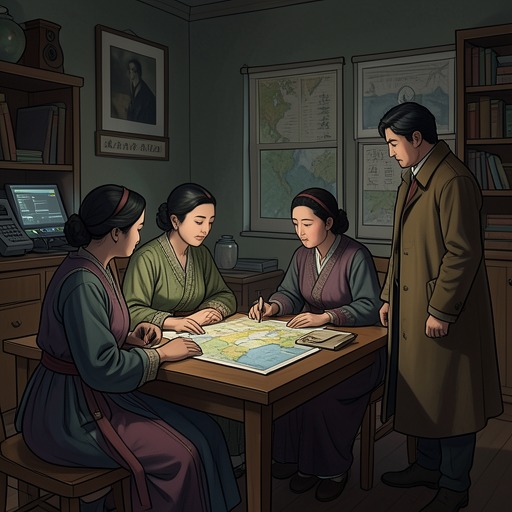
Women TalkingWomen’s Independent Interpretation of the Bible emerges in Molotschna as the women confront a religious order that teaches them what scripture requires while denying them the literacy needed to examine it for themselves. Their debate turns interpretation from an authority reserved to men into a collective practice of reasoning: the women test received teachings against their experience, their understanding of faith, and their responsibilities to their children. That change matters because forgiveness and obedience are being used to determine whether they may remain in the colony, even as their safety is at stake.
The Authority to Interpret
The question arises amid the assaults on women in Molotschna and the response imposed by the colony’s leaders. The women have been told they do not need counseling because they were unconscious during the attacks. Ona Friesen presses the contradiction: if they could not understand what happened, what exactly are they expected to forgive? She extends the question beyond the immediate demand, asking whether ignorance of the outside world makes a person free, or merely unable to recognize confinement. Her challenge connects religious language to the women’s limited access to knowledge: a command to forgive cannot be considered apart from who defines the injury and who is allowed to describe it.
A related dispute concerns the biblical exhortation that wives submit to their husbands. Mejal Loewen asks how the women can leave their men and still count as obedient wives. Salome Friesen answers that they cannot read the Bible themselves, so their understanding of its instructions has come from Peters, the elders, and their husbands—all men. The problem is not simply that some information might be missing. Salome identifies the male interpretation of scripture, and the way it is handed down to women, as the deeper issue. Ona Friesen agrees that illiteracy places the women at a serious disadvantage whenever the meaning of the Bible is contested.
Salome makes the consequences of that imbalance concrete through a hypothetical example. She asks whether Mejal would accept a husband’s claim that scripture authorized him to strike his wife for questioning him and to beat children for a mistake. The example does not settle the text’s meaning by itself; it exposes how easily a husband’s assertion can pass as biblical authority when women cannot check it. Salome’s point is that the women’s sense of obligation to submit rests, in part, on what their husbands have told them the Bible says.
Reading Faith Against Coercion
The meeting’s argument about interpretation is also an argument about forgiveness. Peters says the women will have the opportunity to forgive the accused men when they return, and that refusal will require the women to leave the colony. In this arrangement, forgiveness is not simply a personal or spiritual response: it is attached to belonging, while the women face a decision within a limited period. Ona’s question about what they can forgive when they were unconscious challenges the assumptions beneath this demand. It asks whether a duty can be meaningful when the women’s own knowledge of what happened has been discounted.
The women also weigh whether remaining in Molotschna would itself conflict with their religious commitments. Agata Friesen argues from pacifism: staying would leave them on a path toward further violence, whether directed at them or committed in response. In her account, departure is not a renunciation of faith but a way to avoid turning the colony into a battlefield. She further argues that leaving can preserve the women’s commitments to peace, love, and forgiveness without making forgiveness coerced, and can show their children that these values matter beyond the expectations of their fathers. Mejal Loewen accepts Agata’s reasoning.
This exchange gives the decision to leave a scriptural and ethical basis within the women’s own deliberation. Their reasoning does not claim that faith is irrelevant or that they have moved beyond it. Instead, they dispute the idea that obedience to male authorities is the only faithful choice. The women consider what their commitments require under the actual conditions they face, distinguishing a freely held religious principle from a demand enforced by the prospect of exclusion.
A Collective Practice of Meaning
The conversation shifts as the women begin to interpret religious language together rather than receive a settled meaning from men. When Mejal suggests that God might understand their departure as a time for love and peace, Ona responds with delight. The narrator recognizes the moment as perhaps the first time the women of Molotschna have interpreted God’s word for themselves. The significance lies not in a newly discovered text but in a changed relation to interpretation: women who have been excluded from reading and teaching scripture make a claim about what it means through discussion and mutual consideration.
Their emerging interpretation also changes how they name their feelings. Agata anticipates anguish, sorrow, uncertainty, and sadness, but argues that those feelings need not amount to guilt. Mariche Loewen sharpens the distinction: the women may feel guilty while knowing they are not guilty. This is not a simple promise that departure will feel easy. Rather, the group separates the pain of acting against the expectations imposed on them from moral wrongdoing. Their interpretation gives them a way to understand that conflict without treating male judgment as the final measure of their conscience.
Salome’s wider condemnation of Molotschna’s patriarchal order reinforces the stakes. She describes women as denied membership in a community where boys and men may issue orders, determine their fates, interpret the Bible, and punish them. Her protest frames scripture as part of a larger struggle over who may speak, decide, and belong. In that context, independent interpretation is not an abstract exercise: it challenges a system in which women are expected to obey religious rules whose meaning they cannot verify and whose consequences they bear.
Faith, Care, and Departure
The women’s shared reasoning remains tied to practical obligations. Agata describes their decision as a maternal responsibility as well as a religious one: they are to protect their children, remain faithful, and think. She rejects the idea that acting together for their children must make them revolutionaries, presenting instinct, intellect, and spiritual commitment as joined rather than opposed. This account broadens interpretation beyond a dispute over a single command. It asks what faith requires when care for children and the safety of the community cannot be reconciled with the instructions the women have been given.
The decision takes material form when Agata asks whether the women agree to leave after dark, so that they will not be seen passing the Chortiza and Hiakjeke colonies. They nod. The group’s interpretation has therefore moved from argument to a plan, though departure remains an act taken under pressure rather than a passage into certainty. Preparations include the map, the Co-op Safe, food, soap, and wood for traction or kindling, packed into Greta Loewen’s buggy. These objects make visible the distance between interpreting a religious obligation and carrying it out: the women must also prepare to travel into a world they have been taught they do not know.
The concept’s central significance is that religious understanding becomes a shared capacity rather than a privilege monopolized by male authorities. Ona Friesen’s questions, Salome Friesen’s challenge to inherited interpretations, Mejal Loewen’s uncertainty, and Agata Friesen’s defense of pacifism do not produce an effortless consensus. They make room for the women to examine what they have been told and to judge its claims against their circumstances. Their departure follows from that process: they can understand leaving not as a rejection of faith, but as an attempt to live its demands for peace, care, and conscience on their own terms.