Women’s Declaration
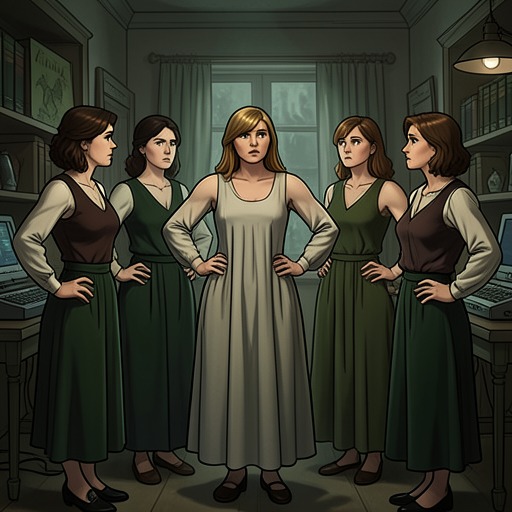
Women TalkingThe Women’s Declaration is a proposed program for remaking life in Molotschna, not merely a list of grievances or a plan to resist immediate danger. Formulated during the women’s meetings, it names the conditions they would seek if they stayed and fought: shared authority, women’s intellectual freedom, education for girls, knowledge of the wider world, and a faith shaped by women. Its significance lies in joining physical safety to the power to interpret, learn, and govern.
Origin and Political Purpose
Agata Friesen and Greta Loewen hastily organized the meetings in response to years of attacks on women and girls in Molotschna. The attacks had been attributed by many in the colony to ghosts or Satan; the perpetrators were eventually identified as eight local men, including close relatives of women they had harmed. The remaining men went to the city to post bail for the accused. Peters told the women that they would be expected to forgive the men when they returned, and that refusing would mean leaving the colony. With only two days to organize a response, the women considered three choices: doing nothing, staying and fighting, or leaving.
The Declaration takes shape when the women begin to consider what staying and fighting would actually mean. Ona Friesen asks what they would be fighting for, beyond the removal of danger, and proposes a manifesto specifying the conditions they would require after a victory and the work needed to achieve them. The move changes the discussion’s scale: a struggle for safety becomes a question about the kind of society the women would agree to inhabit.
Proposed Terms
Ona’s proposals are direct and structural. Decisions for the colony would be made collectively by men and women; women would be allowed to think; girls would learn to read and write; and the schoolhouse would display a world map so that the community could understand its place beyond Molotschna. The women would also create a new religion, developed from their existing faith but focused on love. These terms address political authority, education, access to knowledge, and religious interpretation together rather than treating them as separate reforms.
The map has a particular force within the program. It represents practical knowledge of a world from which the women have been kept apart, but it also makes that world visible in the schoolhouse, where girls could learn to locate themselves within it. Later, August Epp reports that he has procured a safe, dynamite, and a world map. The map’s presence among the supplies for departure gives material form to an idea first expressed as part of the Declaration’s imagined future; it does not, however, mean that the proposed reforms have already been achieved.
Authority, Knowledge, and Disagreement
Ona’s proposal answers a system in which women have little authority over their own lives or the colony’s religious decisions. Salome Friesen describes women as excluded from membership and treated as commodities, while men and even adolescent boys may exercise authority over their fates and interpret the Bible for them. Salome identifies the male transmission of biblical interpretation as a central problem; Ona adds that women’s inability to read or write leaves them at a serious disadvantage in any dispute about scripture. The Declaration’s demands for literacy and women’s participation in religious life therefore challenge not only educational restrictions but also the means by which authority presents itself as religious knowledge.
Ona also questions the elders’ claim that women must forgive assaults they were not conscious of and cannot understand, especially when the same authorities have decided they do not need counseling. Her questions expose a contradiction between demanded forgiveness and the women’s exclusion from the knowledge and support needed to judge what forgiveness could mean. In this context, a religion created by women and centered on love is not simply a new doctrine: it would change who has the right to interpret faith and define its obligations.
The proposal is not received without conflict. Mariche Loewen initially argues that there is too little time for Ona’s broader discussion, particularly because some men are expected to return to the colony. She later suggests that men could accompany the women only if they signed and followed the Declaration’s conditions. Salome, who has spent much time at odds with Mejal Loewen, finds support in Mejal during the meeting’s painful discussion of leaving sons behind; their solidarity underscores that the women’s political choices are bound up with family ties as well as collective principles.
Adoption and Limits
Agata eventually declares Ona’s statement sound and accepts it as the manifesto of what the women would want if they stayed and fought. She also insists that it can be added to over time. The Declaration is thus a working document rather than a finished constitution: it gives the women a shared account of their aims while leaving room for further thought. When Greta Loewen asks what would happen if the men refused the demands, Ona answers with a threat of lethal resistance. The exchange reveals the danger surrounding the proposed program, but that threat is not itself one of the Declaration’s listed reforms.
The women’s later deliberations put the document under pressure from the possibility of departure. Mariche’s condition that men may accompany the women only if they accept the manifesto makes adherence a measure of belonging, while Salome insists that safety and freedom remain the goals. The Declaration’s importance therefore persists even as the strategy shifts: it distinguishes the society the women hope to build from the authority they are leaving, and makes clear that a change of location alone would not fulfill their demands.