World Map
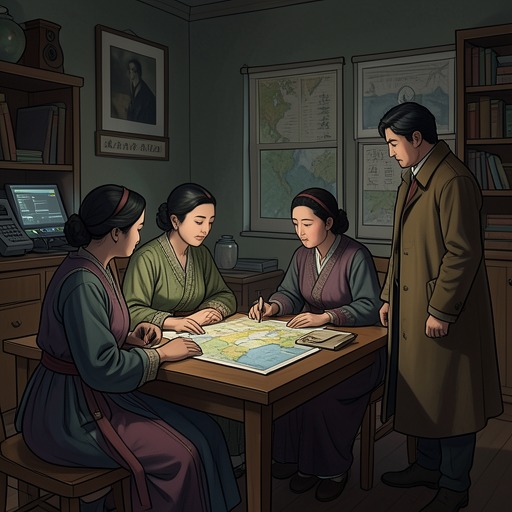
Women TalkingThe World Map begins as an answer to a question of belonging and becomes part of the women’s preparations to leave Molotschna. In a colony where women cannot read or write and have little knowledge of the world beyond it, a map would make the unfamiliar visible: not simply as somewhere else, but as a place in which they might find their own position and make decisions for themselves. By the time departure is being prepared, the map has moved from an idea in discussion to a physical object packed among the group’s supplies.
A map as a means of orientation
Ona Friesen includes a map of the world among her proposals for reshaping life in the colony. Her vision joins collective decision-making by women and men with girls’ education in reading and writing; the schoolhouse, she proposes, should display a map so that the girls can begin to understand their place in the world. The object therefore belongs to a wider argument about who may learn, interpret, and participate in shaping communal life. Its importance is not limited to representing geography: it would give women and girls a reference beyond the boundaries of the colony and the knowledge controlled by its existing authorities.
Agata Friesen makes the practical stakes explicit when she asks what the women would do, how they would live, and how they would support themselves if they left. They are unable to read or write, do not speak the language of their country, and cannot be sure whether their domestic skills would be useful elsewhere. She points out that they have no world map. In this context, the map answers neither every question nor every material need; rather, it marks how much the women have been denied the means to orient themselves before being required to choose between remaining and leaving.
Seeking and sharing the map
The narrator offers to obtain a map for the women. When Neitje Friesen asks where it could come from, the answer is Chortiza Colony. The narrator cannot explain how that neighboring colony came to possess one, citing the women’s safety, but says that the map might be borrowed briefly. Autje Loewen and Neitje, whose artistic ability is recognized, could then copy it onto packaging paper. Most of the women find the suggestion appealing; Mariche Loewen does not. The proposal links access to geographic knowledge with collective work: the map might be reproduced by the women themselves rather than remaining only an object borrowed from elsewhere.
The discussion also distinguishes a world map from a more immediately practical regional map. Salome Friesen asks whether Chortiza might have a map of the specific area, detailed enough to show highways, smaller roads, rivers, and rail lines. The conversation establishes this as a possibility, not as a confirmed second map or a completed plan. That distinction matters: a world map could help the women comprehend their broader place, while a local map might assist with the concrete problem of moving through unfamiliar territory. Neither object removes the risks of leaving, but both make the need for independent knowledge visible.
Knowledge under authority
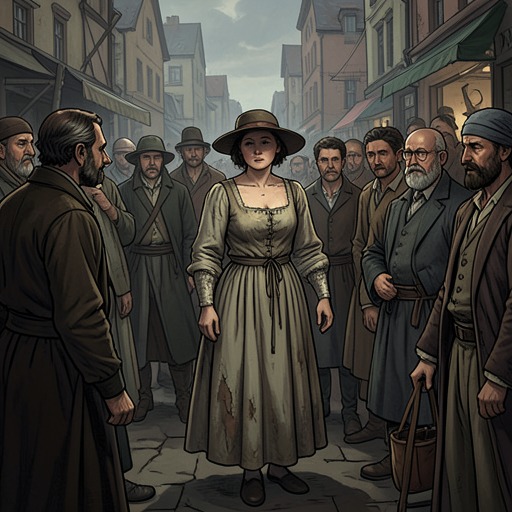
The women’s interest in the map takes shape against restrictions on learning and the interpretation of knowledge. Earlier, Peters had publicly presented Earnest Thiessen’s organic farming manuals as evidence of worldly influence; the elders disciplined Earnest and barred contact with colony members for eight weeks. The women laugh together at the thought of Peters discovering an illicit map nearby. Their amusement carries an awareness of the authority that treats unfamiliar knowledge as a danger, and of the consequences that can follow when access to it is challenged.
The dispute over the map is part of a larger struggle over who is allowed to explain the world. Salome Friesen identifies the male interpretation of the Bible, handed down to women, as a particular problem; Ona Friesen connects women’s inability to read and write to their disadvantage in negotiating those interpretations. The map does not resolve that conflict or give the women literacy by itself. It does, however, embody a different possibility: knowledge need not be confined to what male leaders authorize, and women can seek, exchange, and make use of information together. The wish to see the world is also a wish to take part in describing it.
Carried into departure
As the women’s discussion moves toward action, the map becomes one item among the provisions assembled for their departure. The narrator wraps it around a large block of cheese and covers it with ordinary brown paper. It is placed in the back of Greta Loewen’s buggy, beneath the rear seat, alongside a safe, onions, soap, and pieces of wood intended either to give the wheels traction in mud or to provide kindling. Dynamite and the map are also identified among the buggy’s packed contents, with the map and other unusual provisions kept in a hatbox at the front. The contrast is deliberate in practical terms: the women carry necessities for immediate survival alongside an object intended to help them understand where they are going.
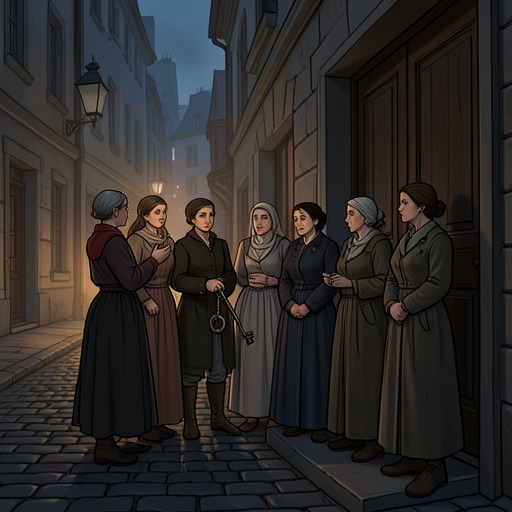
Agata Friesen asks whether the women agree to leave after dark, so they will not be seen when passing Chortiza Colony and Hiakjeke Colony. The map is packed for this departure, but the account does not state that the women consult it during the journey or that it determines their route. Its established role is more modest and more consequential: it has been obtained, protected among the supplies, and carried into a future beyond the colony. From Ona Friesen’s proposed schoolhouse display to the wrapped map in the buggy, it traces a movement from wanting access to the world toward preparing to enter it.