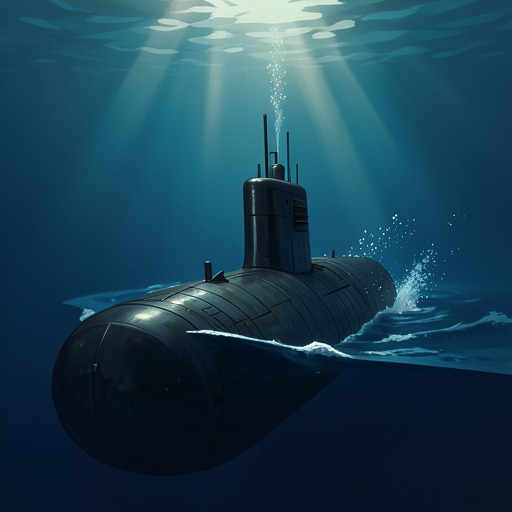
Admiral Xu Zhicai
World War ZAdmiral Xu Zhicai is presented as both witness and participant in one of the war’s most morally charged acts: the flight of a Chinese ballistic-missile submarine from a country being consumed by the living dead. His testimony insists that the crew were not traitors, yet every detail he recounts makes their escape look like treason, sacrifice, rescue, and catastrophe at once. Through Xu, patriotism stops being a simple allegiance to a government or territory and becomes a desperate attempt to preserve human civilization when the state itself can no longer protect its people.
Identity and Setting
Admiral Xu Zhicai gives his account at the Patriot’s Memorial in the Forbidden City, Beijing, a location that visibly frames the interview as a question of national loyalty. The narrator suspects that Xu has chosen the spot in case a photographer is present. Although no one after the war has seriously challenged the patriotism of Xu or his crew, he remains anxious about how foreign readers will judge them. He initially responds defensively and agrees to speak only if his side of the story is heard objectively, even after being told that there is no competing account. His insistence reveals a man arguing not merely for personal innocence but for the historical legitimacy of his entire crew.
Xu’s first statement establishes the central contradiction of his character. He says that they loved China and its people and remained loyal to their leadership, even though they did not necessarily love the people who ruled both. Their later actions therefore emerge from a split between nation and regime: the crew’s loyalty to their country survives even as obedience to the existing authorities becomes, in their view, incompatible with saving it. Xu is not portrayed as an adventurer seeking freedom. He is a naval officer trying to define service under conditions in which conventional service has become suicidal.
The Decision to Escape
By the time Captain Chen proposed escape, the outbreak had penetrated every city and village across China’s nine and a half million square kilometers. The army continued to claim that the crisis was under control and that each day represented a turning point, but Xu describes its confidence as arrogant and dangerously detached from reality. To him, the army’s improvised forces could be assembled from people in matching clothes, brief training, and inadequate weapons, yet such an army could not pacify a country overrun by the dead.
Captain Chen’s proposal initially seems inconceivable even to Xu. The vessel was not an ordinary boat but the Admiral Zheng He, one of only three ballistic-missile submarines and the newest Type 94. Xu describes it as the product of Russian assistance, black-market technology, anti-American espionage, and nearly five thousand years of Chinese history. It was the most expensive, advanced, and powerful machine China had ever built. Taking it would mean stealing one of the motherland’s greatest national assets, an act that could not be disguised as ordinary desertion. Xu accepts the plan only because Captain Chen’s force of personality and fanatical patriotism convince him that escape may be the sole remaining means of preserving civilization.
The crew had to maintain absolute secrecy. Their families were not informed, because any suspicion reaching the Ministry of State Security could have made the living dead seem like the lesser danger. Secrecy also forced the submarine to leave according to its normal patrol schedule rather than wait for relatives or other stragglers. Captain Chen wanted to delay for people who might have been only hours away, but he understood that waiting could destroy the entire plan. Xu sees the captain’s feelings in his eyes as the fires of Qingdao recede, making departure an act of controlled grief rather than a clean break.
Flight and the Attack in the Islands
The Admiral Zheng He first traveled toward its assigned patrol sector so that its movements would appear routine. After that, the crew had no fixed destination. A permanent refuge was impossible because the blight had spread around the world; no neutral country, however remote, could guarantee safety. Their escape was therefore not a voyage toward a promised homeland but a search for temporary survival in a planet without secure borders.
For several months, an island community seemed to offer a fragile substitute for home. Chinese families living there told the crew that the mainland government was barely holding the country together, while more than half the population was infected and the army’s reserves continued to disappear. Xu and the others gradually stopped thinking of themselves as fugitives. They began to imagine that the island might remain their home until the crisis ended, or until the world itself ended.
That illusion collapses during Xu’s shore patrol with Song. While listening to islanders discuss an unexplained disaster in China, Xu faces the lagoon and sees the sea suddenly glow. He turns in time to witness the Madrid Spirit explode. The natural-gas fireball rises into the night and incinerates life on the two nearest motus. Xu first assumes the blast was an accident, perhaps a corroded valve or careless deckhand, but Commander Song has seen the missile’s streak. A moment later, the Admiral Zheng He sounds its foghorn.
Xu immediately understands that the attack came from a Chinese submarine and that the Madrid Spirit was struck because its larger profile sat higher in the water. The revelation destroys his sense of security. The islanders are now in danger simply because the Admiral Zheng He remains nearby, and every second spent in place could invite another attack. Captain Chen appears to reach the same conclusion: the crew casts off, cuts power lines, counts heads, secures the hatches, dives, and assumes battle stations.
At ninety meters, the submarine’s towed-array sonar detects the hull noises of another vessel changing depth. The sound is not the flexible groan of steel but the sharp popping of brittle titanium. Only the Russian Federation and China operate titanium-hulled attack submarines, and the blade count identifies the attacker as one of China’s new Type 95 hunter-killers. Two are in service, so Xu’s crew cannot know which one is approaching. The uncertainty is not technical only; it carries the possibility that the enemy vessel contains someone the crew knows.
Captain Chen, His Son, and the Nuclear Burden
The approaching submarine has a devastating personal meaning because Captain Chen raised Commander Chen Zhi Xiao alone. He taught his son to be a good sailor, to love and serve the state, to obey orders without question, and to become the finest officer in the Chinese navy. The proudest day of Captain Chen’s life was the day Commander Chen Zhi Xiao received command of a brand-new Type 95 hunter-killer. The same kind of vessel now attacks the Admiral Zheng He.
Xu explains that this is why Captain Chen would do anything to avoid the Chinese fleet and why identifying the attacking submarine matters so intensely. The captain has already betrayed his oath and homeland by escaping. If the attack came from his son’s submarine, then his attempt to preserve civilization may have led him toward the murder of his own child. Xu’s account places political betrayal and family betrayal on the same line, where one cannot be resolved without confronting the other.
The Admiral Zheng He is eventually forced to act because China’s other strategic resources have vanished. Land-based silos are overrun, the air force is grounded, and the two other missile submarines are trapped at their piers while the dead swarm through their hatches. Commander Chen informs the crew that their submarine is the last nuclear asset available to the rebellion. Every delay costs lives and consumes ammunition that could otherwise be used against the undead.
Captain Chen accepts the order as a personal burden. As Xu shakes before the launch, Chen declares that the order and responsibility are his. The missile carries a single massive multimegaton warhead, originally designed to penetrate the hardened surface of the NORAD facility in Cheyenne Mountain, Colorado. China’s Politburo bunker was modeled closely on that installation, making the weapon suitable for striking the center of the collapsing Chinese power structure. The crew launches it, and Commander Chen later reports that Xilinhot has taken a direct hit. While the submarine moves beneath the surface, Xu hears that loyalist forces have surrendered and reunited with the rebels against the real enemy.
Grief, Recognition, and Ending
Xu learns only after the submarine emerges from beneath the ice pack that Chinese forces have begun implementing their own version of the South African Plan. The news confirms that the political and military order he once served is being replaced by a survival strategy shaped by the scale of the disaster. Their escape, once treated as an almost unimaginable theft, now appears within a wider historical movement in which old loyalties are forced to bend toward collective survival.
Captain Chen does not survive the emotional consequences. When Xu finds him in the attack center, the captain sits in his command chair with a cup of tea beside him. He watches the crew with the quiet smile of a father watching his children’s happiness, but the tea has gone cold and his exhaustion is unmistakable. Xu offers to bring another cup. Chen refuses, reaches for Xu’s hand, looks at him without recognizing him, and whispers that Zhi Xiao was a nice boy, a good boy. Still holding Xu’s hand, he closes his eyes forever.
This ending gives Xu’s testimony its deepest force. He has begun by defending the crew against the charge of treason, but the final image does not erase the cost of their actions or provide a legal absolution. Instead, it shows how national survival can demand acts that remain personally unbearable. Captain Chen saves what he believes can still be saved, yet his mind returns at the end not to strategy, patriotism, or victory but to the son whose command, and perhaps whose death, is inseparable from the decision.
Narrative Role and Significance
Admiral Xu Zhicai’s role is that of a public witness carrying private trauma into an official memorial space. His account is carefully shaped by the awareness of foreign readers, photographers, national reputation, and the need to prove loyalty. Yet the controlled argument repeatedly breaks into concrete memories: Qingdao burning behind the departing submarine, the Madrid Spirit’s fireball, the brittle sounds of the Type 95, the cold tea, and Captain Chen’s final misrecognition. The public defense of patriotism is thus undermined and deepened by intimate evidence of loss.
Xu also embodies the broader military transformation described elsewhere in the testimony. The war exposes the failure of institutions built around confidence, inherited doctrine, and prestige weapons, while survival depends on judging resources against actual threats. The same principle appears in the later development of the resource-to-kill ratio, the Standard Infantry Rifle, Cherry PIE ammunition, and the two-line advance doctrine: weapons and formations are redesigned around the undead rather than around previous wars. Xu’s submarine story shows the strategic version of that adaptation. A nuclear submarine ceases to be merely a symbol of state power and becomes a last vessel of civilization, even when using its weapon means destroying the state it was built to defend.
His testimony therefore refuses both easy condemnation and heroic simplification. Xu and the crew are neither uncomplicated deserters nor spotless saviors. They steal the Admiral Zheng He, abandon families they cannot wait for, flee a homeland they still love, confront a possible fratricidal attack, and fire a multimegaton missile into China. Through Xu, the narrative makes patriotism a tragic practice rather than a slogan: loyalty is measured by what one tries to preserve after the institutions of loyalty have failed, and by what one must mourn when preservation itself becomes destructive.