Andre Renard
World War ZAndre Renard is a former French national and veteran of the campaign beneath Paris during the Zombie War. Living alone in a small farmhouse in Quebec, he embodies the war’s unresolved aftermath: physically removed from France, emotionally closed to the living, and unwilling to let official language about heroes conceal the cost of victory. His account gives the Paris underground campaign its most severe human meaning, linking its labyrinthine setting to fifteen thousand dead or missing and to the final disappearance of his younger brother, Emil Renard.
Identity and Exile
Andre Renard lives in a small Quebec farmhouse whose lack of walls, barred windows, and locked door appears to make it vulnerable. When questioned about this, he merely chuckles and returns to his lunch. He has asked that his exact location remain secret, not because he fears the dead, but because he has little concern for the living. The contrast defines his postwar identity: the ordinary precautions of civilian society no longer seem important, while the memory of wartime death remains immediate enough to shape his entire relation to the world.
Renard immigrated to Quebec after hostilities officially ended in western Europe. The French government has repeatedly invited him to return, but he has refused. His exile is therefore not presented as an accidental displacement or a temporary retreat. It is a conscious refusal of national reintegration, separating him from the state that might celebrate his service and from the public narrative that would turn his suffering into patriotic inheritance. His farmhouse becomes an anti-monument: open, unprotected, and deliberately hidden rather than ceremonially preserved.
The Paris Underground Campaign
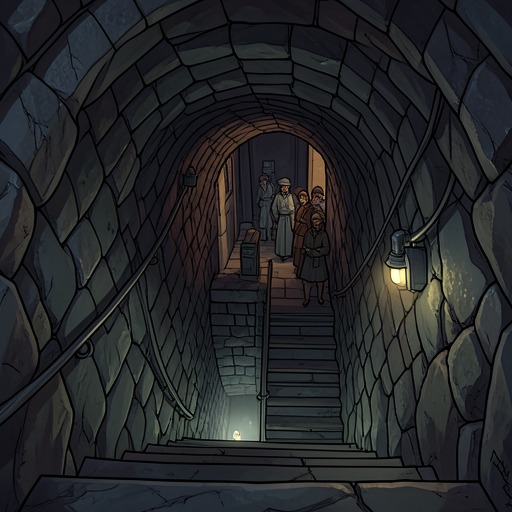
Renard rejects the familiar hierarchy by which veterans rank their experiences. He dismisses those who boast of mountain, jungle, or urban warfare and insists that none of those claims can compare with fighting beneath a city. Paris was especially dangerous because its surface rested over an immense network of Roman tombs, limestone quarries, World War II bunkers, Metro lines, telephone cables, gas mains, water pipes, and catacombs. The city’s celebrated skyline thus conceals a second geography, one whose density made ordinary military assumptions useless.
The catacombs themselves contained roughly six million bodies transferred from prerevolutionary cemeteries. Their skulls and bones were arranged into walls and patterns, sometimes interlocked to restrain loose remains. For Renard, these structures are not picturesque historical curiosities. The skulls seemed to laugh at him, turning the dead architecture of Paris into an oppressive presence that accompanied the living combatants. The setting collapses the distinction between battlefield and cemetery: the soldiers advanced through a city whose infrastructure, history, and buried corpses all became part of the enemy’s terrain.
During the Great Panic, civilians entered the tunnels because the rumor spread that it was safe underground. Renard does not simply condemn them. They lacked the civilian survival manual and Radio Free Earth, and he imagines how a better-organized group might have survived by bringing food and tools, sealing entrances, and preventing infected people from entering. The qualification matters. His anger is directed less at frightened civilians than at the disastrous conditions that turned improvisation into mass entrapment. An estimated two hundred and fifty thousand refugees eventually occupied the subterranean world.
Combat, Confusion, and Sacrifice
The campaign’s material conditions made even basic movement perilous. Night-vision goggles were almost nonexistent, sometimes limited to one pair per platoon, and spare batteries for electric torches were scarce. A squad might have only one working light, carried by the point man, its red beam cutting a narrow path through darkness. Radio calls and screams echoed through the passages, while the tunnels’ acoustics made direction uncertain. Soldiers could hear another squad under attack without knowing whether the cries came from ahead, behind, or through a neighboring passage.
Renard describes the resulting movement as a frantic progression of dashes, collisions with low ceilings, and crawling on hands and knees. A squad could reach an apparently urgent position only to find an empty chamber while the real cries for help continued somewhere beyond it. When soldiers finally arrived, they might discover only bones and blood. If the zombies were still present, vengeance could require killing reanimated friends who had become part of the attacking force. The encounter therefore carried a double reversal: rescue became disorientation, and comradeship became a reason for close combat.
Firearms could not be used normally because the air and gas made the tunnels dangerously flammable. Each fighter had to rely on whatever equipment seemed suitable, replacing standardized weaponry with improvised personal choices. In flooded sections, units sometimes retreated to defensive positions and waited for the Cousteaus, divers trained to work and fight in the submerged tunnels. Equipped with a searchlight, a shark suit when one was available, and at most two hours of air, the divers were officially supposed to use safety lines, though many refused because the lines tangled and impeded progress. Renard gives them a survival chance of one in twenty, the lowest ratio of any branch of any army, and connects that extraordinary risk to their automatic receipt of the Legion of Honor.
The cost of the operation was fifteen thousand dead or missing in only three months, even though the war was winding down elsewhere. Renard contrasts this with the slower clearance of London, which proceeded section by section over years and produced a lower casualty rate. His comparison is not merely tactical. It exposes a political demand for speed and spectacle where patience might have preserved lives, and it makes the Paris campaign a case study in how military glory can be purchased through preventable sacrifice.
Emil Renard and the Manufacture of Heroes
Renard’s bitterness reaches beyond the battlefield to the culture that demanded heroic losses. He recalls that France needed new heroes and new names and places to restore its pride after Algeria, Indochina, the Nazi era, and the traumas of the current war. The language of reclaiming confidence could therefore be understood by veterans, but understanding did not make it innocent. A nation’s need for symbolic recovery became entangled with its willingness to spend actual lives.
The Ossuary, Port-Mahon Quarry, and the Hospital became the campaign’s supposed shining moments, with the Hospital carrying the darkest significance. Originally built, according to legend, to confine mental patients who were left to starve behind concrete walls, it later served as an infirmary for the recently bitten. As more patients reanimated and the survivors’ humanity faded along with their electric lamps, the place became an undead vault holding the infected and possibly others as well.
An advance team broke through without realizing what waited beyond the barrier. Withdrawal, demolition of the tunnel, and renewed sealing were possible, but instead one squad faced three hundred zombies. That squad was led by Renard’s younger brother, Emil. Andre was among those listening as Emil’s radio transmission ended. His final words, “On ne passe pas!”, became not only a declaration of resistance but the last surviving trace of a brother whose death was absorbed into the national mythology of heroism.
Narrative Role and Significance
Renard’s testimony dismantles the triumphant version of the Paris campaign from within. He is not a detached historian: his contempt, comparisons, and repeated insistence on the war’s disproportionate cost make the account openly accusatory. Yet his anger is also analytical. He supplies numbers, equipment shortages, tactical constraints, civilian conditions, and alternative methods, allowing the reader to see how the disaster was made rather than treating it as an unavoidable legend.
His isolated farmhouse and his refusal to return to France complete that argument in physical form. The state can invite him home, but it cannot restore the dead, erase the tunnels, or make Emil’s final transmission into anything less than a human loss. Renard remains a witness who will not accept the exchange rate by which fifteen thousand casualties become a shining moment. Through him, the underground battlefield becomes a space where patriotic memory, military practicality, civilian survival, and grief remain permanently entangled.