Atlantic Ocean refugee routes
World War ZAtlantic Ocean refugee routes are the improvised maritime corridors created when millions of people fled infected land during the Zombie War. They represent both a desperate refuge and a vast record of civilizational collapse: tankers, cruise ships, barges, fishing craft, yachts, rafts, and obsolete military vessels crowd the ocean, while the same waters become a graveyard for refugees, ships, and marine life.
Emergence and Geography
The routes formed as people abandoned coastal cities and inland settlements without any reliable destination beyond the immediate necessity of escape. From the perspective of a submerged submarine operating in the remote reaches of the world’s oceans, the change was first detected acoustically. Sonar teams that had previously encountered only currents, fish, whales, and distant propellers began collecting thousands of contacts, many of whose signatures did not match their archives. The ocean, once selected precisely because ships were unlikely to be found there, had become one of the most heavily traveled spaces left to humanity.
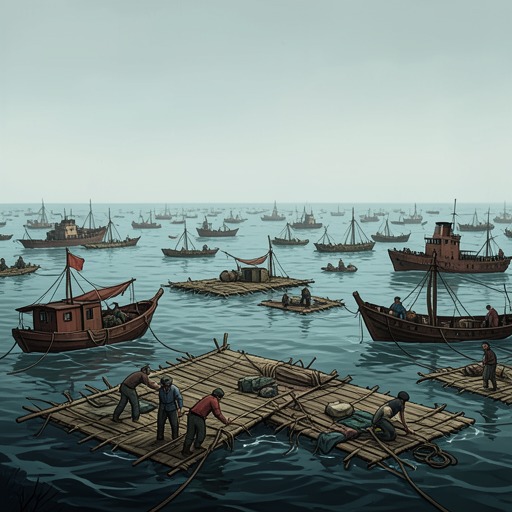
The movement was not organized as a single evacuation. It was a mass improvisation under panic. Tankers, freighters, cruise ships, tugboats towing barges, hydrofoils, garbage scows, dredgers, skiffs, ferries, lighters, inland craft, yachts, and cabin cruisers all appeared on the same sea. Small private boats lashed themselves together into enormous, directionless rafts, while other survivors built platforms from logs or tires. The variety of vessels reveals the social breadth of the flight, but their mismatched purposes also show how little preparation existed for a prolonged life offshore.
A Sea Filled by Survivors
When the submarine rose to periscope depth, its electronic-support mast was flooded with hundreds of radar signatures and its radio mast with a comparable mass of transmissions. The search and attack periscopes then showed what seemed like all of humanity putting to sea within the first hour: commercial ships, passenger vessels, workboats, and improvised platforms moving or drifting across the same ocean. Military vessels were present as well, but their behavior suggested that the old strategic order had lost priority. The USS Saratoga was seen under tow with its flight deck converted into a tent city; HMS Victory moved under a forest of improvised sails; and the Aurora, the World War I-era cruiser associated with the Bolshevik Revolution, was apparently still being kept alive with coal.
Other vessels were less symbols of survival than floating questions. A dry dock as large as an overturned skyscraper drifted without a tug, its deck filled with scaffolding that served as makeshift apartments. Some ships had exhausted their fuel and could no longer generate power. The people aboard them had escaped the immediate reach of the undead, but the ocean offered no guarantee of food, water, navigation, medical care, or eventual rescue. The routes therefore transformed safety into suspension: survivors were no longer trapped on land, yet they were often moving toward no identifiable harbor.
The Undead at Sea
The routes were dangerous not only because of hunger, thirst, sunstroke, storms, and mechanical failure, but because infection traveled aboard the refugee ships. The submarine encountered vessels where crews were still fighting for their lives and others where the dead were the only remaining crew. Near Dakar, Senegal, it observed the forty-five-thousand-ton luxury liner Nordic Empress. Bloodied handprints marked the ballroom windows, while the ship’s deck was covered with bones and flesh. Zombies periodically fell overboard, apparently responding to something distant, perhaps a low-flying aircraft or even the submarine’s periscope.
The crew considered using the submarine as bait, surfacing a few hundred meters away and luring the undead over the liner’s side so the ship might be cleared without gunfire. The captain rejected the proposal because no one knew how many zombies remained aboard or what infected refugees might have brought onto the vessel. His caution was confirmed when some of the bodies that entered the sea failed to sink. Reanimated corpses wearing life jackets floated, while others began to rise as decomposition gases accumulated. The first sighting of a floating ghoul revealed that water was not a barrier to the undead; it was another medium through which they could spread.
The scale of the danger expanded with every ship lost. Even if only ten percent of refugee vessels were infected, that fraction applied to several hundred thousand ships. Millions of zombies could therefore enter the sea, either falling from decks or pouring into the water when old hulls capsized in rough weather. After storms, the surface could be covered to the horizon by bobbing heads and flailing arms. The submarine’s attack scope eventually confirmed that one floating corpse could still struggle after being pierced beneath the rib cage, bringing the threat directly against a vessel that had assumed submergence offered protection.
Land’s Crowd and Sea’s Regression
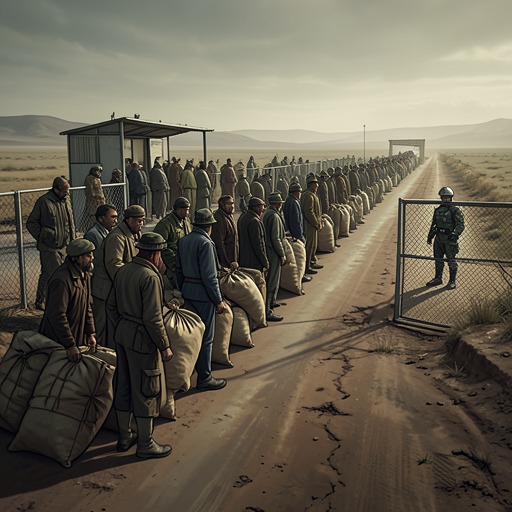
The maritime exodus parallels the refugee flight across land. On a Himalayan road, Sardar Khan remembered thousands trying to move along a narrow track without guardrails, climbing over abandoned vehicles and carrying suitcases, boxes, and even a desktop computer monitor. Monkeys moved through the human mass, escaping the undead by racing up poles and over vehicles. A bus tipped over under the pressure of foot traffic, and no one nearby stopped to help a woman partly emerging from a window with something clutched in her arms. The scene makes clear that the ocean routes were not an isolated phenomenon: everywhere, survival became a competition among bodies, animals, vehicles, and collapsing infrastructure.
Commander Song called the maritime movement “humanity’s great regression.” The phrase captures the routes’ central paradox. Humanity had developed ships, navies, ports, and global transport networks, yet the crisis reduced those systems to flight without destination. People returned to the sea because land had become more immediately lethal, not because they had developed a viable oceanic society. The routes were therefore both technological and primitive: an armada of repurposed infrastructure driven by the oldest possible calculation, that any chance was better than remaining within reach of the dead.
Ecological Consequences
The ocean also became a field of intensified human extraction. Michael Choi describes millions of hungry boat people and much of the world’s navy being converted into fishing fleets. Whales could be stunned by a torpedo detonated close enough to deafen and disorient them without causing direct physical damage; factory ships then approached and killed them. The sea’s ability to carry sound made the violence audible over great distances, turning naval technology into a tool of industrial hunting.
The consequences were catastrophic. California gray whales, which had recovered from near-extinction and had become sufficiently trusting to approach human paddlers, disappeared along with blue whales, finbacks, humpbacks, and right whales. A few belugas and narwhals may have survived beneath Arctic ice, and some orca pods remained, but pollution and the collapse of fish populations made their future uncertain. The refugee routes thus register two linked losses: people fleeing a world made unlivable by the undead, and the living marine world being consumed by the emergency economy of survival. Their significance lies in that contradiction. The ocean shelters human beings from the land while becoming, at the same time, a crowded passage, an infected battlefield, and an ecological graveyard.