Blue Zone
World War ZBlue Zone names the civilian strongholds that endured the Z World War after the great military withdrawal. These communities carved out defensible territory, learned to live within its boundaries, and depended on an evolving network of resupply, instruction, and mutual adaptation. The term therefore describes more than a location on a wartime map: it marks a transitional form of society, suspended between refugee camp, self-governing settlement, and forward military position.
Definition and Strategic Function
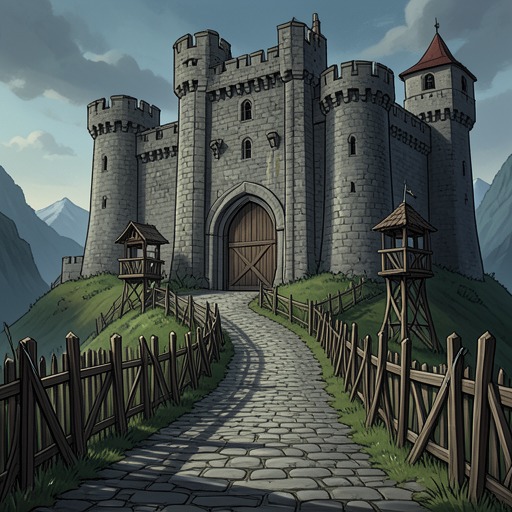
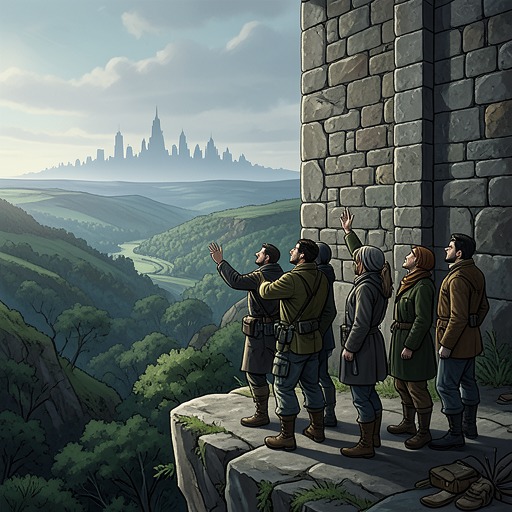
Blue Zones were civilian areas where survivors had managed to make a stand and establish a viable foothold. Unlike Red Zones, which were designated “Offensively Viable” because they contained factories, mines, and power plants guarded for possible future use, Blue Zones were defined by human persistence rather than industrial assets. Their immediate needs were defensive security, food, tools, medical support, and the organizational capacity to remain alive inside territory threatened by the living dead.
The Blue Zone system also reflected the logic of the Redeker Plan. Because the armed forces could not protect everyone, they were to consolidate into a defensible safe zone, while only a fraction of civilians could be evacuated to it. The rest of the population was to be held in isolated, defended areas as human bait, keeping the undead fixed in place and preventing them from following the retreating army. Blue Zones consequently occupied an ethically unstable position: they could function as communities of survival, but the larger strategy treated civilian populations as instruments in a military withdrawal.
Resupply and Local Self-Sufficiency
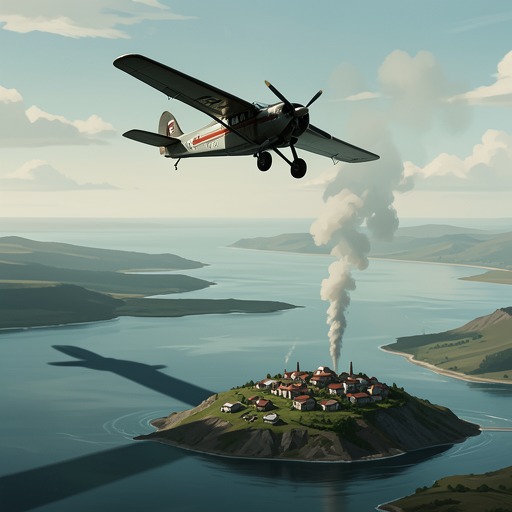
The Continental Airlift made the Blue Zones part of a vast logistical network. The operation maintained contact with scattered enclaves, processed their requests, coordinated with the Department of Strategic Resources, and prioritized the material sent in each drop. The scale of the undertaking made it the largest statistical operation in air force history, because every isolated community represented a separate set of needs and a separate transportation problem.
Planners tried to favor self-sustaining drops over dependency drops. Food and medicine had to be delivered repeatedly, whereas tools, spare parts, and equipment for making further spare parts could allow a settlement to sustain itself. The governing principle was that survivors needed the means to produce necessities, not merely temporary supplies. Yet the distinction could never be absolute. Autumn deliveries still included fish, wheat, salt, dried vegetables, and baby formula, because harsh winters made the survival of dependent populations impossible to treat as an abstract economic exercise.
The airlift also delivered people whose expertise could not be reduced to equipment: doctors, engineers, and other specialists. Blue Zones received Special Forces instructors who taught residents to defend their settlements and prepared them for a possible offensive. Many instructors parachuted into areas without airstrips and understood that they might never be collected. Some Blue Zones were eventually overrun, making the insertion of personnel a deliberate acceptance of extreme risk rather than a guaranteed reinforcement operation.
From Refugee Population to Fighting Community
The wider reconstruction effort treated refugee camps as reservoirs of labor and training. Physically able people without war-appropriate skills were assigned to unskilled work such as clearing rubble, harvesting crops, and digging graves; those with useful skills entered the Community Self-Sufficiency Program. The system answered a severe postindustrial labor shortage in which more than 65 percent of the civilian workforce had been classified F-6, with no valued vocation for the new conditions. Blue Zones depended on the same transformation: civilians had to become capable of repairing, producing, defending, and governing rather than waiting for the prewar service economy to return.
This process turned survival into organized production. The Community Self-Sufficiency Program quickly reduced requests for government aid and developed into the National Reeducation Act, shifting society from a zero-sum emergency economy toward war production. In Blue Zones, the political meaning of self-sufficiency was inseparable from its practical value. A settlement that could train its people, maintain tools, defend its perimeter, and make effective use of air-dropped materials became less a passive refugee concentration than an active component of the war effort.
The same militarization appeared at the tactical level. Before a major operation, troops encountered only a couple of dozen living dead on the route; sniffer dogs located them, and handlers eliminated them with silenced weapons so that larger numbers would not be drawn toward the staging area. Orange Day-Glo tape marked rows of shelter stakes at ten-meter intervals, creating a “garden” of range markers for zeroing weapons. This controlled preparation shows how the defensive knowledge developed in surviving communities was eventually integrated into a coordinated offensive culture.
A Networked Refugee Society
Blue Zones were not isolated in a purely geographic sense. The postwar Pacific Continent, stretching from Palau to French Polynesia, demonstrates the broader refugee culture into which surviving communities could enter. At Manihi, the former pearl economy had vanished: the pearls were gone, the oysters had been eaten, and the lagoon held hundreds of small private boats. Tents and ramshackle huts covered the islands, while improvised canoes moved between the reef and larger ships in deeper water.
That society was organized around trade. A boat with a distillery sold fresh water; one with a machine shop supplied mechanical labor; a liquefied natural gas carrier sold its cargo as cooking fuel. A floating power network eventually leased electricity from a reactor. The Pacific Continent thus offers a maritime counterpart to the Blue Zone: survival depended on linking specialized capacities, exchanging resources, and converting damaged infrastructure into new communal systems. Both forms of settlement replaced the vanished assumption that a single centralized economy would provide everything.
Security, Classification, and the Human Cost
The Blue Zone system also exposed the disciplinary underside of emergency governance. Populations were examined, classified, trained, supplied, and assigned according to their usefulness and risk. At Yeroham resettlement camp, detainees endured daily examinations of blood, skin, hair, saliva, urine, and feces before their medical clearance allowed them to leave. The camp offered resettlement and quarantine, but its tents, overcrowding, guards, barbed wire, and Negev heat made it feel like a prison. The Blue Zone ideal of protected civilian life therefore existed alongside institutions that governed people as bodies to be screened and sorted.
Dogs became central to this system. Initially, military and police dogs were used to identify infection, following the Israeli practice of sending people past dogs confined in cages. The animals’ terror response could become uncontrollable: some attacked civilians, handlers, or one another, and handlers lost hands, arms, and throats. Yet that same instinct was treated as a resource that probably saved millions of lives. The method illustrates how the emergency state transformed biological reaction into a screening technology, while later training attempted to integrate the dogs’ fear response into regular military discipline.
The logic of classification extended beyond combat. Neighborhood Security Teams were intended to patrol residents’ own streets, checking houses in pairs or larger groups and relying on the fact that the living dead would come to them rather than requiring pursuit across fences and backyards. Even disability became a point at which institutional assumptions had to be challenged: a disabled recruit in a wheelchair was initially discouraged from joining, although the program’s actual method of rolling through a neighborhood and inspecting houses did not require conventional mobility. The Blue Zone was therefore sustained not only by weapons but by arguments over who counted as useful, capable, or expendable.
Political Afterlife
When the continental United States had been secured, the administration declared victory even though the war continued elsewhere. The remaining work included assisting allies, clearing territories ruled by the dead, and confronting White Zones in mountain ranges, snowline islands, the ocean floor, and Iceland. A United Nations multinational force was created, and volunteers signed up in such numbers that some had to be placed on reserve or assigned to train younger recruits who had missed the drive across America.
This decision preserved the Blue Zone’s central political tension. The nation could return soldiers to private life once its own territory was secure, but security was never identical with peace. Attacks still occurred near lakes and beaches, while overseas campaigns proceeded more slowly and isolated regions remained uncleared. Blue Zones therefore stand as both the achievement and the warning of reconstruction: humanity learned to rebuild through local defense, mutual aid, specialist knowledge, and disciplined logistics, but the boundaries of safety remained provisional until every remaining White Zone had been addressed.