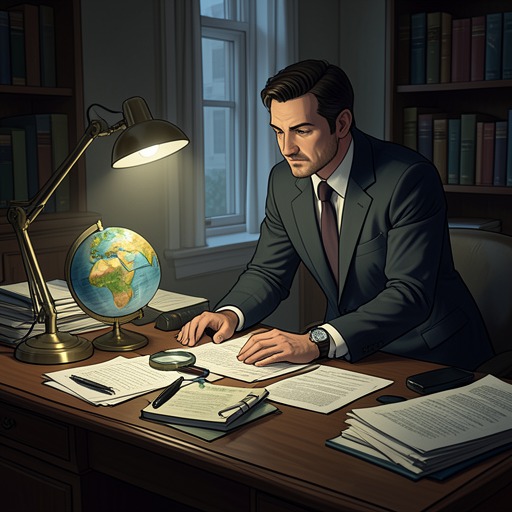
Bob Archer
World War ZBob Archer is the director of the Central Intelligence Agency and the host of the Langley interview. His testimony gives institutional shape to one of the war’s defining failures: the agency was neither an all-seeing guardian nor an all-powerful hidden government, and a carefully engineered Chinese deception persuaded it to mistake the outbreak’s warning signs for preparations for a conventional international war.
Identity and Setting
Bob Archer receives the interviewer in the director’s office at CIA headquarters in Langley, Virginia. The room is deliberately ordinary, resembling the office of a business executive, physician, or small-town high-school principal, with reference books, degrees, photographs, and an autographed baseball from Cincinnati Reds catcher Johnny Bench. Archer recognizes that the setting conflicts with the visitor’s expectations and appears to have chosen it partly to confront the theatrical image associated with the agency.
That contrast establishes Archer’s role before he explains it. He is not presented as a mysterious master of hidden operations but as the public-facing representative of an institution forced to account for what it failed to see. His office contains the conventional marks of authority, while his subject is the collapse of confidence in that authority.
The Limits of Intelligence
Archer identifies two popular myths about the CIA: that its mission is to search the entire world for any conceivable threat to the United States, and that it possesses the power to find every one of them. He explains that secrecy encourages paranoid speculation, because an unseen organization becomes a convenient explanation for coups, assassinations, nuclear proliferation, and unexplained violence. Before the war, the CIA was willing to cultivate the image of an omniscient octopus because enemies might fear it and hesitate to attack American citizens.
The same image became a liability when the dead began returning to life. The public and the agency’s own personnel asked why the CIA had not known about the outbreak before it reached homes and neighborhoods. Archer’s answer is that the agency, like every other official and unofficial American intelligence service, had finite resources and no capacity to monitor every location on Earth. Even the largest budgets could not place eyes and ears in every back room, cave, alley, brothel, bunker, office, home, car, and rice paddy.
For Archer, intelligence work therefore depends on prioritization rather than omnipresence. Agencies must concentrate on threats that are already clear and present instead of scattering their assets across every imaginable possibility. His analogy moves from a Soviet neighbor threatening a house, to an Arab in the backyard, to the People’s Republic of China arriving at the front door; only after that sequence does he invoke the walking corpse. The image captures the central error of the prewar response: conventional geopolitical danger occupied the field of vision so completely that an unprecedented biological and social threat remained outside the frame.
The Chinese Deception
Archer confirms that the plague originated in China, but he adds that the outbreak was accompanied by one of modern espionage’s greatest deceptions. The Chinese authorities knew that nationwide health-and-safety sweeps could not be hidden from American surveillance. Rather than conceal the sweeps, they concealed their purpose, placing the real operation in plain sight beneath a more familiar explanation: political repression and preparation for conflict.
The deception expanded into the entire Taiwan Strait incident. The victory of the Taiwan National Independence Party, the assassination of the PRC defense minister, the military buildup, threats of war, demonstrations, and subsequent crackdowns were all engineered by the Ministry of State Security. These events created a coherent alternative story in which China was preparing for a confrontation over Taiwan, while the real danger grew within China itself.
The strategy was effective because every alarming intelligence report seemed to confirm the false interpretation. Sudden disappearances, mass executions, curfews, and reserve call-ups could all be read as normal authoritarian preparations for war. American analysts became so convinced that World War III was about to begin in the Taiwan Strait that they diverted intelligence assets away from countries where undead outbreaks were already beginning. Archer’s blunt assessment is double-edged: the Chinese operation demonstrated extraordinary skill, while the CIA’s response represented one of the agency’s worst failures.
Bureaucracy, Misread Signals, and Consequences
Archer’s account places the CIA’s failure within a wider pattern of institutions interpreting catastrophe through familiar administrative categories. In China, health sweeps were disguised as security operations; elsewhere, military orders, political crackdowns, and emergency procedures were repeatedly understood according to established models of state conflict. The problem was not simply a lack of information. It was the tendency of organizations to sort unfamiliar evidence into the threat categories for which they already possessed procedures, budgets, and chains of command.
The consequences extended beyond the agency. While American intelligence resources were redirected toward an imagined conventional war, the actual plague gained time and space to spread. Archer does not claim that the CIA was powerless, and he allows that some suspicions about its covert capabilities may have had a basis. He rejects the larger fantasy that the agency could have prevented every crisis through total surveillance. The failure instead lay in misidentifying the crisis that demanded attention.
Narrative Function and Significance
Bob Archer’s interview is a corrective to both conspiracy thinking and institutional self-exoneration. He narrows the distance between the agency’s sinister public mythology and its ordinary human limitations, but he does not turn those limitations into an excuse. His testimony makes the disaster legible as a failure of perception, prioritization, and bureaucratic interpretation: the world received abundant signs, yet the signs were assembled into the wrong story.
His position also gives the narrative a powerful irony. The CIA had encouraged enemies to believe that it knew everything, only to discover that its own personnel had partly believed the same fiction. Archer’s explanation therefore functions as an autopsy of omniscience. The institution was not defeated because it lacked intelligence in the abstract; it was defeated because a rival power successfully supplied a false meaning for the intelligence it possessed.