Bohdan Taras Kondratiuk
World War ZBohdan Taras Kondratiuk is a Ukrainian armored-platoon commander and war hero whose account of the evacuation of Kiev turns a military retreat into a study of administrative collapse, moral abandonment, and improvised violence. Speaking from a windowless ward in Yevchenko Veterans’ Sanatorium in Odessa, Ukraine, he recalls the moment when soldiers trained to fight became traffic controllers, infection screeners, and finally executioners. His testimony gives the catastrophe a precise human scale: exhausted crews, an obsolete T-72, a bridge clogged with refugees, and a commander forced to interpret orders that no longer correspond to reality.
Identity and Circumstances
Bohdan is presented as a decorated veteran confined to a deteriorating sanatorium. He sits upright on a cot at the end of a room lit by dim fluorescent bulbs, with a hung sheet providing privacy because his status as a war hero entitles him to that small distinction. The ward is warm and dry, an unusual luxury during the Ukrainian winter, but it has no doctors and too little medication for patients whose respiratory illnesses are worsened by neglect. His setting places his testimony between survival and institutional abandonment: the state has honored him symbolically while leaving him to suffer in a system unable to provide ordinary care.
His first description of the crisis is a judgment on organization itself. He calls the period complete chaos, marked by the breakdown of order, control, and coordination. His company has just survived four brutal engagements at Luck, Rovno, Novograd, and Zhitomir, with Zhitomir singled out as especially traumatic. The men are exhausted by combat, rearguard actions, constant retreat, and the accumulating news that another town has fallen, another road has closed, or another unit has been overwhelmed. Bohdan’s authority therefore begins not in confidence but in depletion: he commands soldiers who have been asked to keep functioning after the structures that made their previous missions intelligible have already failed.
From Retreat to Evacuation
Kiev is supposed to be a secure rear-area center and the heart of a newly established safety zone. Bohdan expects the ordinary military sequence of rest, refitting, vehicle repair, replacement of losses, and care for the wounded. Instead, the safety zone is shifted again, this time toward the Crimea; the government has fled to Sevastopol; civil order has collapsed; and Kiev is being evacuated. The army, or what remains of it, is assigned responsibility for the escape route. The reversal exposes the gap between official plans and lived conditions. A place described as safe becomes a staging ground for abandonment, while a combat unit is redirected into a civilian emergency for which it has neither training nor equipment.
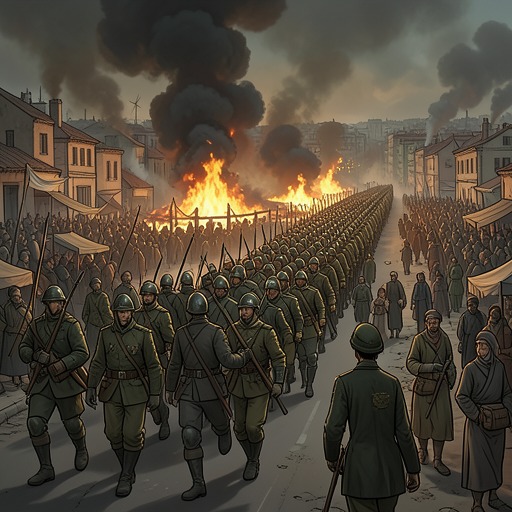
Bohdan’s company is sent to oversee the route at Patona Bridge, a landmark celebrated as the first all-electrically welded bridge in the world and once compared by foreign observers with the Eiffel Tower. The city had imagined restoring the bridge and renewing its former glory, but the project never came to fruition. Even before the crisis, traffic jams had made the bridge notorious. During the evacuation, it is crammed with cars and refugees: small Lags, old Zhigs, several Mercedes, and a huge GAZ truck overturned in the middle of the crossing. The promised barricades of concrete and steel are absent, and the armored platoon cannot move the truck despite trying to attach a chain to its axle and pull it away with a tank.
The mismatch between mission and capability becomes central to Bohdan’s experience. His soldiers are tank crews, not military police, and no military police appear. The supposed units at the other bridges are likewise improvised crowds of uniformed clerks, cooks, and other personnel suddenly placed in charge of traffic. They have not been given the riot gear, shields, armor, or water cannon they were promised. Their orders are to process evacuees by determining whether anyone has been tainted, yet the sniffer dogs required for reliable infection screening are missing. The soldiers are left with visual inspection, an inadequate method that turns both civilians and troops into participants in a dangerous guess.
The RVX Strike
The decisive moment arrives when four Sukhoi 25 Rooks fly over the bridge at treetop level. Bohdan initially assumes that the aircraft may be covering the approach or bombing the area behind the bridge, as had happened at Rovno. When the planes circle and then come directly toward the crowd, he concludes that the evacuation has been abandoned and that the bridge is about to be destroyed. He shouts for everyone to get off the bridge. Panic moves through the refugees as a physical wave: people push forward and backward, collide with one another, and jump into the water despite heavy clothing and shoes that make swimming difficult.
Bohdan is pulling people across and telling them to run when the bombs fall. He first thinks he can dive at the last instant and shield himself from the blast. The opening parachutes reveal the true nature of the attack: the aircraft are dispersing RVX, not conventional explosives. He immediately changes from flight to command. He races to the nearest tank, slams down its hatch, orders the crew to check the seals, and shouts for the crew to button up. The vehicle is an obsolete T-72 whose overpressure system has not been tested in years, leaving the crew dependent on hope that the steel hull will still protect them.
Inside the tank, the collapse of morale is as stark as the collapse outside. The gunner sobs, the driver freezes, and the twenty-year-old junior-sergeant commander curls on the floor clutching a small cross around his neck. Bohdan places a hand on the young man’s head and assures him that they will be fine, even as he keeps his eyes fixed on the periscope. The gesture shows his command style under pressure: reassurance is offered not because safety is known, but because someone must supply the confidence that the situation itself has removed.
Bohdan explains that RVX does not begin as a gas. It falls as rain, in tiny oily droplets that cling to whatever they touch and enter through pores, eyes, and lungs. Depending on dosage, its effects can be immediate. From the tank he watches evacuees tremble as the agent reaches the central nervous system. Their arms drop, their attempts to speak and move fail, and breathing becomes difficult. The account refuses to make chemical attack abstract: contamination is registered through failing limbs, obstructed speech, and the loss of bodily control.
At first Bohdan cannot understand why the high command would use chemical weapons, since such weapons have no effect on the undead. Then recognition arrives. The command has learned from Zhitomir, but not by abandoning chemical warfare; it has discovered a new use for Cold War stockpiles. RVX can separate infected evacuees from others and prevent them from carrying the infection behind the lines. The strike is therefore not a failed attempt to destroy the undead. It is a deliberate screening and containment operation carried out against a civilian mass, with the bridge converted into a lethal diagnostic instrument.
Command, Killing, and Withdrawal
Once the exposed refugees begin to reanimate, they regain their footing and shuffle toward the tanks. Bohdan calls for the gunner, who can barely answer. He kicks him in the back and orders him to sight the targets. After several seconds, the gunner steadies the crosshairs on the first woman and fires the coaxial machine gun. The other tanks follow. Bohdan’s intervention is immediate and coercive: he must overcome the crew’s paralysis before the reanimated reach them, and the same commander who tried to pull civilians to safety now directs fire into the crowd.
Twenty minutes later, the action is over. Bohdan knows that he should have waited for orders or at least reported the strike and its effects, but he can see six more flights of Rooks crossing the sky. Five are heading toward the other bridges, while the sixth is headed for the city center. He orders his company to withdraw southwest and keep moving. The decision is both tactical and ethical in its implications. He recognizes that the bridge attack is not an isolated mistake but a coordinated operation, and that remaining in place would leave his men exposed to further strikes or bind them to a command system that has already turned evacuation into mass slaughter.
The retreat itself is physically grotesque. Bodies lie around the tanks, including people who had managed to cross the bridge before the gas struck. As the company drives away, the bodies burst beneath the vehicles. This image completes Bohdan’s transformation of the bridge from celebrated civic monument into a mechanism of national ruin. The route that once represented engineering achievement and hoped-for renewal becomes a corridor where military machinery literally carries the consequences of state failure forward.
Memory, Responsibility, and Narrative Role
Bohdan’s testimony is not a straightforward defense of his conduct. It preserves the pressure of necessity while refusing to dissolve responsibility into obedience. His account shows soldiers receiving impossible assignments, lacking promised equipment, and confronting an attack whose purpose was concealed from them; yet the narrative also emphasizes the choices made once the truth became visible. He acts without waiting for orders, compels a terrified gunner to fire, and withdraws before formally reporting what happened. His authority is therefore inseparable from improvisation and culpability.
The image of the road gives his memory its moral structure. The survivors must continue along a steep and treacherous route while dragging the boulder of what they have done behind them. Bohdan’s own story embodies that burden. He remains a war hero, but heroism does not make the bridge massacre clean, nor does the command structure’s failure erase the part played by those who carried out its orders. His narration is valuable precisely because it holds those truths together: he was abandoned by institutions, he acted to preserve his company, and he participated in a system that classified civilians through poison and gunfire.
His final memory of Kiev is not the bridge but the Great Patriotic War Museum Complex. He recalls its courtyard of tanks and guns, the large Iron Cross made from hundreds of real crosses taken from dead Hitlerites, and the mural depicting Soviet soldiers as a connected wave of strength driving the Germans from the homeland. Above these symbols stands the stainless-steel statue of the Rodina Mat, more than sixty meters high, shield and sword raised in triumph. As Bohdan and his company run from the city, she is the last thing he sees. The contrast is severe: the museum celebrates organized national defense, while the evacuation reveals clerks in uniform, missing barricades, untested equipment, chemical rain, and tanks firing at the newly reanimated. Bohdan’s narrative role lies in making that contradiction visible. He is not simply a survivor of the Kiev evacuation; he is the witness through whom military glory is measured against the human cost of the institutions that claim to embody it.