Chongqing
World War ZChongqing is presented as both the devastated remnant of a national population center and a working model of postwar recovery. Once home to more than thirty-five million people, Greater Chongqing has been reduced to barely fifty thousand, without a central power grid or running water apart from the Yangtze River. Yet its cleared streets, local security council, and Kwang Jingshu’s continuing medical rounds show a society rebuilding through local responsibility rather than restored abundance.
Population Loss and Material Conditions
Greater Chongqing’s scale makes its postwar emptiness especially stark. The region’s prewar population exceeded thirty-five million, but reconstruction funds have been slow to reach it because the government has prioritized the more densely populated coast. The result is a city-region without a central electrical grid and without piped water, leaving the Yangtze River as its only stated source of running water. Even so, the streets have been cleared of rubble, suggesting that physical recovery has begun despite the absence of modern utilities.
The city’s reduced population is not merely a statistic. It establishes the magnitude of the catastrophe and changes the meaning of civic life: the surviving community is small enough for local officials and professionals to remain personally visible, while the missing millions remain present as an absence against which every act of reconstruction is measured. Chongqing is therefore neither restored metropolis nor abandoned ruin, but a partially functioning settlement making do with what remains.
Local Security and Medical Care
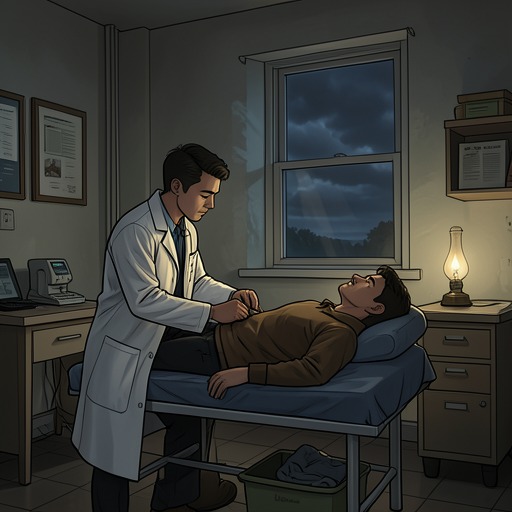
Postwar authority in Chongqing is represented by a local “security council,” which has prevented further outbreaks in the area. Its chairman, Kwang Jingshu, is a medical doctor who continues to make house calls despite advanced age and injuries sustained during the war. His work gives the city a human infrastructure that compensates, in part, for the collapse of centralized systems: health and safety depend on a known practitioner traveling through a damaged landscape rather than on a fully rebuilt public service.
Kwang Jingshu’s final recorded house call reinforces this role. He visits a young boy suffering from a respiratory illness, while the boy’s mother fears another case of tuberculosis. The doctor identifies it as an ordinary chest cold, and the mother’s visible relief and gratitude follow him down the dusty street. In a world where every fever can recall the old catastrophe, this diagnosis becomes a small but meaningful restoration of proportion. Chongqing’s recovery is shown not through a grand ceremony but through the return of an ordinary distinction between illness and apocalypse.
New Dachang and the Memory of Upheaval
The surrounding Chongqing account also connects the region to New Dachang, a remote village whose name preserves the memory of Old Dachang. The original town had existed since the Three Kingdoms period, with farms, houses, and trees believed to be centuries old. When the Three Gorges Dam was completed and reservoir waters rose, much of the old settlement was dismantled brick by brick and rebuilt on higher ground.
The rebuilt site was subsequently preserved as a national historic museum rather than restored as a living town. Its former residents could visit their saved heritage but could no longer simply inhabit it. The naming of a newly constructed hamlet as New Dachang therefore carries a double meaning: it commemorates a lost community while acknowledging that continuity may survive only through a name. In the Chongqing material, postwar reconstruction repeats this tension on a larger scale. Buildings, roads, institutions, and national identity can be renewed, but they cannot return the world that preceded the disaster unchanged.
Repression, Survival, and the Wider Crisis
Chongqing’s apparent local stability is set against the coercive measures used elsewhere during the war and its aftermath. Kwang Jingshu was arrested by the Ministry of State Security and held without formal charges; by the time he escaped, the outbreak had spread beyond China’s borders. His personal history thus links the city’s medical and civic endurance to the state’s suppression of inconvenient knowledge. Chongqing is not an untouched refuge. Its survival has passed through secrecy, imprisonment, wartime injury, and the delayed arrival of public truth.
The city also belongs to a global system of flight and displacement. Before the outbreak, smugglers in China moved people and goods through difficult overland routes, while the crisis transformed escape into a lucrative international business. Wealthy clients could obtain prebooked travel packages and first-class tourist visas, leave eastern China by air, reach cities such as London, Rome, or San Francisco, and disappear into foreign immigration systems. On land, infected travelers could reanimate during journeys toward Kashi, and later, as police forces became overwhelmed, smugglers encountered more infected people concealed in vehicles and crates. These movements show how Chongqing’s disaster was never geographically self-contained: population, money, infection, and information crossed borders together.
The same global emergency produced forced diversions, maritime peril, and mass resettlement. Refugees were directed north toward colder regions because frozen undead might offer a chance of survival; others attempted to swim toward ships, where rescuers faced both drowning people and underwater undead. In Cuba, five million refugees from the United States—nearly half the island’s indigenous population—were placed under the Quarantine Resettlement Program and initially worked twelve- to fourteen-hour days in former state sugar plantations. Such episodes illuminate the scale of the collapse that Chongqing has survived locally: the city’s fifty thousand inhabitants are part of a worldwide rearrangement of populations, authority, labor, and risk.
Ending and Narrative Significance
Chongqing closes the account with a child who has been born into a world that already includes the living dead. These children know not to play near water or go out alone after dark in spring and summer, yet they do not carry the same inherited fear of the war. Their ignorance of the old terror is described as a gift: not forgetfulness, but the possibility that life can again be organized around ordinary dangers rather than permanent catastrophe.
Kwang Jingshu’s concluding confidence that China and the world will rebuild gives Chongqing its decisive significance. The city is not evidence that recovery has been completed; its missing population, absent utilities, dusty streets, and unresolved memories make that impossible. It is evidence that recovery can begin under radically diminished conditions. Through local security, house-call medicine, preserved names, and the care of children, Chongqing becomes a place where national renewal is imagined as a patient accumulation of small acts rather than a return to the vanished past.