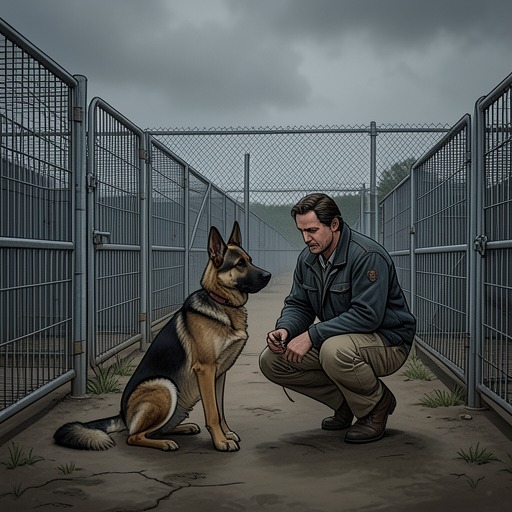
Darnell Hackworth–Maze handler–dog partnership
World War ZThe Darnell Hackworth–Maze handler–dog partnership embodies the Zombie War’s transformation of animals from military assets into recognized members of combat teams. Maze is a small, mixed-breed miniature dachshund whose value lies not in appearance but in toughness, intelligence, and specialized training. Darnell’s duty is to guide her toward objectives, restrain her instinct to fight, and bring her home; the relationship becomes reciprocal when larger escort dogs protect her, Darnell protects her from institutional neglect, and Maze’s continued presence gives visible form to the loyalty and grief that define handlers.
Formation of the Partnership
Darnell’s understanding of military dogs begins with the early use of dogs as infection detectors. Personnel were sent past dogs kept in cages, whose reactions could identify the infected. The method exploited the animals’ involuntary terror of the living dead, but it also produced catastrophic failures of control: police and military dogs sometimes attacked civilians, one another, or their own handlers, and many handlers lost hands, arms, or their throats. The instinct was dangerous precisely because the dogs had been bred to fight, yet the Israelis deliberately relied on it, and Darnell credits that instinct with saving millions of lives.
The later program attempted to turn that terror into disciplined cooperation rather than merely weaponizing it. Training began with pups born after the crisis, whose early exposure to the smell of death was treated as an induction rather than a guarantee of combat ability. In the selection exercise, pups were separated from Zack by wire mesh. The weaker group, called Bs, whined or howled and lost control; the promising As locked eyes with Zack, held their ground, bared their teeth, and growled. The distinction established the principle on which Darnell and Maze’s partnership rests: useful courage was not blind aggression, but aggression that could be shaped into a mission.
Maze in the Field
Maze’s work took place on long-range reconnaissance missions through wild terrain, where the danger came not only from Zack but also from feral K groups. Those animals, descended from abandoned pets and strays, had become killer packs that threatened patrols moving through low-infestation zones. Before escort dogs were deployed, many missions were abandoned because the routes were too dangerous. Maze therefore operated within a larger team structure, not as an isolated animal directed by a single handler.
Her escorts were Pongo, a pit bull and Rottweiler mix, and Perdy, an enormous mixed-breed dog described as part shepherd. Darnell trusted them because he had completed basic training with their handlers. Together, the escorts chased off feral packs fourteen times and fought directly twice. In one particularly violent encounter, Perdy seized a two-hundred-pound mastiff by the skull; the crack of the bite was audible through the harness’s surveillance microphone. The escorts also killed several Gs in transit, but their primary responsibility was to keep Maze moving toward her objective and ensure her return.
Maze herself was difficult to keep on task because she always wanted to fight. Her size did not make her harmless. Small dogs could trip the living dead, attack between their feet, or launch themselves at the knee pit, knocking a larger attacker onto its back. Maze preferred that maneuver. The teams had to teach the dogs to defend themselves without biting infected flesh, since a bite could be fatal; training also compensated for Zack’s physical advantages and poor balance. Maze’s effectiveness thus depended on restraint as much as courage: Darnell had to preserve the fighting instinct while preventing it from destroying the mission.
Mutual Care and Military Recognition
The partnership is shown most clearly through the practical problem of casualty care. Working dogs could fall or break bones, and when they were close to friendly forces their handlers could carry them to safety. Many recovered and returned to active duty. When a wounded dog was too far away for rescue but too close to Zack, handlers requested Mercy Charges: small explosive packs attached to the harness that would allow a dog to be killed rather than converted into a Fragmutt. The requests were refused as a waste of resources, a decision Darnell regards as morally grotesque because the army would tolerate a wounded soldier’s death more readily than the possibility of allowing a dog to become an enemy weapon.
That policy helped expose the cost of treating dogs as replaceable equipment. After a high-profile public execution of a handler, the army permitted handlers to go after their partners even when doing so endangered their own lives. More importantly, handlers came to be treated as half-assets and dogs as members of teams rather than machines that could simply be replaced when broken. Military statistics showed that handlers had the highest suicide rate of any service branch, exceeding even Special Forces, Graves Registration, and the personnel at China Lake. The grief was not incidental to the work: the capacity to bond with another species was the same capacity that made handlers vulnerable to unbearable loss and made their units exceptionally successful.
Darnell presents that bond as international rather than culturally specific. At Hound Town he met handlers from thirteen other countries, and all described the same attachment and the same devastation when a partner was lost. The partnership between Darnell and Maze therefore belongs to a wider human-animal institution formed under wartime pressure. Its intimacy is not sentimental decoration; it changes doctrine, rescue priorities, deployment practices, and the definition of military value.
Maze’s Body and the Partnership’s Later Phase
When the interview reaches its later moment, Maze is an old dog. Her muzzle is white, the fur on her ears and tail has worn down to leather, and she limps over to Darnell before he lifts her onto his lap. She weighs only eight or nine pounds and resembles a smooth-haired miniature dachshund, though her back is shorter than the standard breed. Darnell calls her Maze rather than her full name, Maisey, and asks whether she is doing all right while massaging her back legs and rubbing beneath her neck. Her milky eyes, sleep, and gentle licking of his palm replace the violence of the field without erasing it.
Maze’s mixed breeding also records the army’s rejection of the prewar preference for pure bloodlines. Purebred dogs were considered too neurotic and too burdened by health problems, consequences of breeding for aesthetic qualities. The new generation was mixed to improve both physical constitution and mental stability. Maze is therefore not merely an individual veteran but an outcome of wartime adaptation: her body carries the practical logic that produced the working-dog program, while her age carries its accumulated cost.
The partnership has an important boundary. Darnell’s handlers and escorts kept Maze on mission, reached the target objective, waited for her, and brought her home safely; they did not remove danger from her life. She and the other dogs suffered falls, broken bones, and the constant possibility of fatal contact with infected flesh. Even when the partnership succeeded, success meant gaining only seconds, avoiding a bite, or surviving the return journey. Its achievement is measured in repeated preservation rather than invulnerability.
Narrative and Thematic Significance
The interview frames Darnell as a shy, soft-spoken caretaker who runs a retirement farm with his wife for the remaining veterans of the military working-dog corps. Maze’s presence turns that institutional history into a small physical scene: an old, worn animal falls asleep on the lap of the man who once had to prevent her from fighting. When her leathery tail wags and she opens one eye, the narrative makes veteran status tangible without reducing her to a mascot.
The partnership also widens the war’s moral field beyond human combatants. Monkeys fleeing the living dead on a Himalayan road, feral dogs threatening reconnaissance teams, and F-lions hunting warm blood all show animals responding to the altered ecology of the crisis. Military dogs occupy a different position because humans train them, deploy them, and depend on them, yet their instincts remain partly independent of human intention. Maze is neither a machine nor a human substitute. Her value arises from a specifically canine perception and physicality, while Darnell’s responsibility arises from recognizing those qualities rather than treating them as interchangeable equipment.
The relationship’s deepest significance lies in the tension between attachment and utility. The army initially benefits from the dogs’ terror while denying the emotional consequences of that dependence. Only after handlers demonstrate that losing a partner can destroy them does the institution acknowledge the dog-handler team as a unit. Darnell and Maze thus reveal a paradox of wartime survival: the bond that makes an animal effective in combat also makes the human keeper capable of profound grief. The same attachment that exposes handlers to loss becomes the source of discipline, courage, and loyalty that allows the partnership to bring its small, determined subject back home.