Deep Glider 7
World War ZDeep Glider 7 is a twin-fuselage underwater craft operated by the Deep Submergence Combat Corps, a vehicle designed for the dangerous reconnaissance work that continues after the main fighting of World War Z. It allows a small crew to descend from a surface vessel, observe submerged swarms, collect information about individual targets, and return knowledge of their movements to a military system that is still expanding its operations.
Design and Deployment
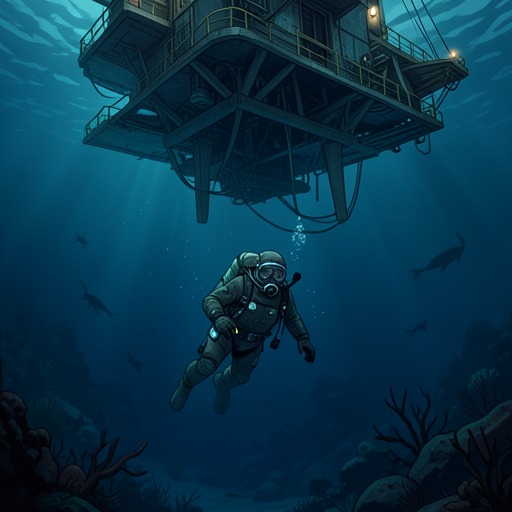
Deep Glider 7 resembles a twin-fuselage aircraft more than a conventional minisubmarine. The observer lies on his stomach in the starboard hull and looks through a thick, transparent nose cone, while the pilot occupies the port hull. The arrangement gives the craft the visual character of an aircraft translated into an underwater machine: two parallel bodies, a forward viewing position, and a crew divided between observation and control. The glider is lowered into the Pacific from the USS Holo Kai, a mother ship operating off the Hawaiian Islands. Its deployment begins in rough surface water rather than in calm laboratory conditions. When the craft strikes the whitecaps, the impact is jarring; then the view outside the observation dome changes from frothing white water to light blue as Deep Glider 7 submerges. That brief transition marks the vehicle’s passage from the exposed world of ships and waves into an environment where ordinary visibility, orientation, and scale no longer apply.
Crew and Method
Master Chief Petty Officer Michael Choi pilots Deep Glider 7 during the dive. Choi is described as one of the old-timers and perhaps the most experienced diver in the United States Navy’s Deep Submergence Combat Corps. His gray temples and weathered face contrast with an almost adolescent enthusiasm, a combination that makes the craft’s mission feel both highly professional and strangely adventurous. He checks the instruments, shifts his radio channels between the observer and the mother ship, and maneuvers the vehicle above the targets. The craft’s mission is not a conventional attack. The crew is trying to find the living dead, track them, and predict their movements so that coastal and maritime authorities can receive advance warning. The work responds to a continuing problem: an estimated twenty to thirty million living dead are still washing onto beaches or becoming entangled in fishermen’s nets, while offshore oil workers and transatlantic cable crews continue to encounter swarms. Deep Glider 7 therefore functions as a mobile observation platform within a permanent surveillance campaign. The narrator rejects the glamorous popular image of underwater combat. Scuba equipment, titanium shark suits, spear guns, explosive devices, and zombie river nets are treated as distractions from the actual purpose of the dive. Deep Glider 7 matters because it carries the crew close enough to make the living dead legible as data: a swarm can be counted, a target can be marked, and a body can be assessed for radiation or other useful information.
Descent and Contact
At the bottom, the landscape appears as a desert wasteland glowing white against permanent darkness. The remains of wire coral stand as broken stumps, trampled by the living dead. This seafloor is not presented as a hidden refuge untouched by the war; it is another damaged battlefield, where ecological destruction and human catastrophe overlap. A swarm of roughly sixty living dead walks out of the underwater night. Choi guides Deep Glider 7 above them while they reach toward the searchlights, their eyes wide and jaws slack. The crew uses a dim red laser to settle on a target before firing a small dart into its chest. Another dart follows. The vehicle’s protective distance and precise instruments make the scene resemble a scientific survey, but the targets remain physically horrifying and potentially dangerous. The craft’s technology does not erase the war’s violence; it reorganizes that violence into controlled observation. The instruments also reveal that the submerged bodies may preserve traces of their origins. Choi identifies one target as having a high radiation count and speculates that it came from the Indian Ocean, possibly from an Iranian or Pakistani vessel, or from the Chinese attack boat that sank off Manihi. Deep Glider 7 thus becomes a machine for reading the war’s dispersed history. The dead beneath the water are not an anonymous mass alone; their locations and radiation levels can connect them to earlier military movements, nuclear exchanges, and sunken craft.
Limits and Transition to Remote Systems
The dive belongs to a technological transition. The narrator is told that it is one of the last manned reconnaissance dives and that the following month operations will become entirely dependent on remotely operated vehicles. Deep Glider 7 represents the fading edge of direct human presence: a crew still enters the contaminated darkness, sees the swarm through its own observation dome, and participates in the targeting process, but that arrangement is already being replaced. The shift is controversial when remotely operated vehicles are used for combat. Deep Glider 7 is therefore caught between two military ideas. It is a protective machine that keeps human operators separated from the living dead, yet it also places those operators close enough to witness what the war has left behind. Its eventual displacement by remote systems promises greater safety and endurance, while raising questions about how much moral and psychological distance warfare can absorb before the human witness disappears from the scene.
Significance in the Postwar World
Deep Glider 7 makes the ocean an extension of the battlefield. Even after the major land campaigns have ended, the sea remains full of bodies that can wash ashore, obstruct maritime labor, threaten vessels, and gather into swarms. The craft embodies the book’s insistence that victory does not mean simple closure. The military’s war has not ended; it is still escalating through expanding operations, improved equipment, and the continuing attempt to map a dispersed enemy. Its underwater perspective also connects the living dead to the wider ecological losses of the postwar world. Michael Choi later describes whales as the great nonhuman losers of World War Z, killed when hungry refugees and naval forces turned the oceans into fishing grounds and used torpedoes to disable them. The California gray whale, once recovering and sufficiently unafraid of humans to allow close encounters, has disappeared along with blue, finback, humpback, and right whales. Deep Glider 7 does not directly cause that destruction, but its mission belongs to the same transformed ocean: a place where navigation, survival, military logistics, fishing, pollution, and the tracking of the dead have become inseparable. As an object, the glider is consequently both a tool and a symbol. Its transparent nose cone promises knowledge, but what it reveals is darkness, broken coral, radioactive bodies, and a war without a clean endpoint. It carries human observers toward the remains of catastrophe while preparing for a future in which machines will perform the seeing and perhaps the killing alone.