Denver
World War ZDenver is presented as one of the central American locations in World War Z, a place where memory, recovery, and military adaptation meet. It is the setting for the interviewer’s meeting with Todd Wainio, the site of a crucial battlefield improvisation involving the K-9 Corps, and, later, a peaceful Victory Park where the absence of new sightings allows survivors to celebrate. Denver therefore marks more than geography: it is a place where the war’s methods change and where the possibility of a future becomes publicly imaginable.
Setting and Recollection
Denver, Colorado, is introduced through a delayed train and a meeting at the station. While the western drawbridge is being tested, Todd Wainio waits on the platform beneath a mural of Victory, an image of soldiers watching dawn break over Manhattan from the New Jersey side of the Hudson River. The mural’s monumental scale contrasts sharply with Todd’s appearance. He seems small and frail beside the towering two-dimensional soldiers, while his expanding paunch, receding gray hair, and three deep parallel scars on his right cheek reveal a veteran aged prematurely by the war.
This setting makes Denver a place of retrospective testimony. Todd’s account does not begin with triumph but with the memory of Yonkers, the battle that exposed the failure of conventional military assumptions. He recalls the panic that preceded the fighting, the defensive lines placed on the ground rather than on rooftops, and the mistaken emphasis on “cover and concealment” against an enemy that could neither use artillery nor be frightened by ordinary displays of force. Denver’s calm station encounter thus frames a recollection of how military confidence collapsed before it could be rebuilt.
The Denver Battlefield Innovation
During the Denver push, soldiers confronted a tall building in which several hundred refugees had been trapped with the infection and had reanimated. Before infantry could storm the entrance, a military working dog ran to the roof of a building across the street and barked. The infected climbed toward the sound, saw the dog, and rushed after it, spilling over the edge of the roof. The tactic worked so effectively that it entered military doctrine under the name “Lemming.”
The episode demonstrates the practical intelligence of the K-9 Corps. The dog was not merely a detector or a passive instrument directed by a handler; it found an advantageous position and created a solution to an immediate tactical problem. After Denver, infantry units used the same method even when no dog team was available, with a soldier sometimes standing on a roof and calling toward an infested building. The city therefore becomes associated with the conversion of battlefield experience into repeatable doctrine: an improvised action is observed, named, and disseminated through the army.
Denver also belongs to a wider transformation in the use of military dogs. K-9 teams served in triage, identifying infection; as Lures, they led the infected into firing lines; as Decoys, they delayed or redirected their movement; and as scouts, they detected concealed or partially submerged threats before infantry encountered them. Their growls, barks, posture, and raised dander communicated information that trained handlers could read. The Denver Lemming tactic is the most memorable example because it turns the infected’s pursuit instinct against them, but it rests on a broader system in which dogs became essential instruments of reconnaissance, control, and survival.
From Improvisation to Doctrine
Denver’s battlefield lesson gains significance when placed beside the military reforms described elsewhere in the testimony. After earlier failures, the army moved away from expensive assumptions about overwhelming technological force and toward a resource-to-kill ratio associated with General Travis D’Ambrosia. Weapons and methods were judged by how efficiently they could destroy the infected. The Standard Infantry Rifle became valuable because it was accurate, reliable, adaptable across ranges, and difficult to disable; Cherry PIE ammunition shattered inside the infected’s skull and destroyed the brain without spreading contaminated gray matter or requiring wasteful bonfires.
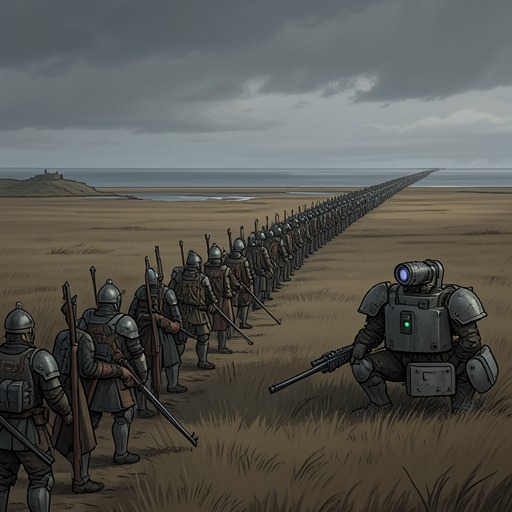
The same logic shaped infantry formations. In the new doctrine, soldiers stood in two straight ranks, one active and one reserve. The front rank fired while the reserve reloaded or supplied fresh weapons, allowing the line to maintain continuous pressure as long as ammunition lasted. The method rejected the drama of shock and awe in favor of repetition, discipline, and sustained killing capacity. Denver’s Lemming tactic belongs to this same culture of functional adaptation: it does not seek glory or symbolic domination, only a reliable way to place targets where they can be destroyed.
The reform spread beyond formal orders. Soldiers began asking why one weapon should be retained when another could kill more infected for the same cost, and they invented cheaper tools themselves. Denver thus represents the point at which experience becomes institutional memory. What begins as a dog’s tactical decision is absorbed into a playbook, while the army’s larger culture learns to value improvisation, especially among formations that had previously been underestimated.
Recovery and the Road to Victory
Denver later appears as a peaceful civic space. In Victory Park, the weather is perfect for a neighborhood picnic, and the fact that no sightings have been recorded that spring gives the gathering an additional reason to celebrate. Todd stands in the outfield waiting for a high fly ball that he says will never come. The scene reverses the emotional charge of his earlier memories: Denver is no longer merely a place from which the war is recounted, but a community able to inhabit public space without immediate fear.
The city also lies within the strategic memory of the “road to New York,” the long American campaign that took three years. Three Army Groups—North, Center, and South—advanced across the Great Plains and Midwest before separating at the Appalachians, with the wings moving toward Maine and Florida while Army Group Center crossed the mountains. The advance proceeded slowly because of foot transport, terrain, weather, remaining enemies, and the deliberately methodical battle doctrine. Two solid lines moved across the country, leaving no ground unchecked.
Force Appropriate Response governed encounters along that route. A small number of infected did not halt an entire Army Group; a dedicated unit stopped only the necessary section, platoon, or company, while troops from the secondary line filled the gap. Denver’s association with the continental push therefore connects local innovation with national reconstruction. Its battlefield lesson helped define the practical war, while its later picnic embodies the social result: a population beginning to reclaim ordinary life after the infected have been driven back.
Narrative Significance
Denver’s importance lies in the contrast between its scenes. At the station, Todd’s scars and frailty carry the cost of the conflict; in the remembered battlefield, a dog’s initiative reveals that survival depends on learning faster than the enemy can adapt; in Victory Park, the absence of sightings permits celebration without denying the road still ahead. The location holds together injury, intelligence, and recovery.
It also complicates the idea of military heroism. The decisive Denver action is not a grand charge by a celebrated commander. It is a practical maneuver performed by a dog, recognized by soldiers, and converted into doctrine. That movement—from instinct to observation, from observation to naming, and from naming to institutional practice—captures the war’s central lesson. Victory comes not from restoring the old military world, but from accepting that the old assumptions have failed and building a slower, more economical, more adaptable system in their place.