Department of Strategic Resources
World War ZThe Department of Strategic Resources, or DeStRes, is the wartime American agency created to transform a nominal safe zone into a survivable society and an effective war machine. Directed by Arthur Sinclair, Junior, it confronts starvation, disease, homelessness, industrial collapse, broken transportation, and the living dead pressing against and infiltrating the Rocky defensive line. Its decisive contribution is to redefine victory as a problem of people, tools, production, and distribution: the United States survives not by preserving its prewar military habits, but by learning what it can actually afford to build, move, maintain, and use.
Creation and Mandate
DeStRes is established after the retreat to the Rocky Mountains, when the supposed safe zone is revealed to be mainly rubble and refugee camps. Millions are hungry, sick, homeless, or displaced; industry has been shattered; transportation and trade have evaporated; and the dead remain both an external attacking force and an internal threat. Sinclair describes the department's name as an accidental echo of “distress,” a fitting association for an agency born inside a national emergency. Its task is immediate and practical: get people clothed, fed, housed, and back to work before the defensive line merely postpones collapse.
Sinclair takes charge with little preparation for the scale of the assignment. He conducts briefings and inspection tours, studies books ranging from Henry J. Kaiser to Vo Nguyen Giap, and tries to recover lessons from the New Deal that he had previously rejected while working on Wall Street. His father's government career, once distant from Sinclair's own values, becomes an unexpected intellectual resource. The department's governing principle is therefore not inherited ideological certainty but rapid institutional learning: whatever knowledge, talent, or method can help fuse a fractured landscape into a modern war machine must be recovered and applied.
Labor and Social Reconstruction
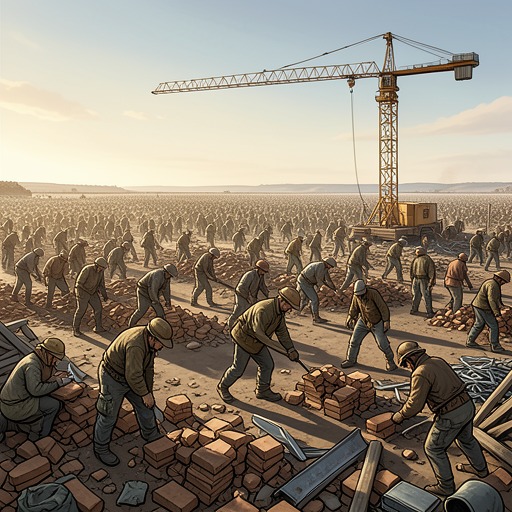
DeStRes first attacks the refugee-camp crisis. Hundreds of camps stretch from small parking lots to settlements covering miles across the mountains and coast, all demanding government aid while resources diminish. Sinclair orders the camps emptied by classifying people according to their usable skills and physical capacity. Those judged physically able but lacking a valued vocation become unskilled laborers, clearing rubble, harvesting crops, and digging graves; those with war-appropriate abilities enter the Community Self-Sufficiency Program, where instructors teach sedentary, overeducated civilians the practical knowledge needed to survive independently.
The program becomes an immediate success. Within three months, requests for government aid fall markedly, allowing the country to move from a zero-sum survival economy into full war production. The National Reeducation Act grows directly out of this effort and becomes one of the largest and most radical job-training programs in American history. DeStRes does not merely assign labor to emergency tasks; it changes the meaning of useful work. Former office workers acquire trades, local production replaces dependence on distant systems, and citizens can see concrete results in the objects they make and the services they provide.
Sinclair recalls a former advertising-agency licensing employee who becomes a chimney sweep because Seattle's homes have lost central heating and the winters have grown longer and colder. Similar examples express the department's social objective: people describe making shoes, sweaters, and food themselves, and take pride in contributing directly to victory. This localized economy reduces pressure on the central government while giving survivors a visible relationship to their own labor. For Sinclair, that sense of contribution also helps preserve his sanity while he manages the harsher side of the job.
Resources, Industry, and Recycling
For DeStRes, tools mean more than weapons. They include the industrial and logistical means by which weapons are constructed, and Sinclair insists that no military plan can be separated from its material chain. The Allies won the Second World War through superior manufacturing capacity, natural resources, and logistics: they could produce more bullets, food, and medical supplies, then move both raw materials and finished goods where they were needed. During the Zombie War, the strategic situation is reversed. The living dead control most of the world's landmass, while American production must depend largely on what can be harvested in the western states.
The department therefore makes California's agricultural base a strategic asset, restructuring it despite resistance from citrus growers and ranchers. It also treats prewar abundance as a mine of recoverable material. The clothing, kitchenware, electronics, and automobiles accumulated across the United States become a reserve that can be collected, catalogued, dismantled, stored, and shipped to factories. In the Los Angeles basin alone, automobiles outnumber the prewar population by three to one, and an industry of more than one hundred thousand employees works three shifts, seven days a week to reclaim their parts. Recycling is not an afterthought but a substitute for overseas access, fuel, and conventional supply lines.
The department's control over resources gives it indirect authority over military research and development. Although the armed forces can formally authorize their own programs, many projects rely on civilian contractors whose supplies DeStRes controls. Sinclair consequently becomes the practical gatekeeper for expensive weapons systems. He challenges the continued production of M-1 Abrams tanks and Stealth aircraft by pointing out that the tank requires jet fuel the country cannot spare and that an enemy without radar does not justify Stealth aircraft. His standard is the largest return on limited investment: weapons must be judged by what they consume, what they can kill, and what other production their resources displace.
Military Adaptation and Technological Choices
The department's conflict with the uniformed services is persistent. Officers protest the cancellation or mothballing of prestigious systems, while Sinclair argues that conventional assumptions have become liabilities. The shortage of ammunition exposes the same failure at the tactical level: sophisticated weapons are useless without enough rounds to sustain operations. DeStRes thus becomes associated with a resource-conscious military culture that values durable, repeatable, mass-producible tools over impressive but wasteful systems.
Sinclair admits that his judgments are not infallible. He initially opposes the Air Force's D-Corps because the negligible helium supply makes hydrogen the only cost-effective lift gas, and he fears creating a fleet of modern Hindenburgs. He must also be persuaded by the president to reopen the experimental cold-fusion project at Livermore, on the argument that planning for a distant future assures people that a future exists. His most painful error is Project Yellow Jacket, a proposed wonder weapon whose designers promise victory within forty-eight hours of deployment. The plan calls for millions of micro-missiles, each about the size of a .22 rimfire bullet, scattered from transport aircraft and guided by satellites into the brains of zombies across North America. Sinclair approves the project, then regrets the resources poured into it and the production that might have been achieved instead.
The relationship with General Travis D’Ambrosia finally gives DeStRes a military partner capable of translating resource discipline into doctrine. As chairman of the Joint Chiefs, D’Ambrosia develops the resource-to-kill ratio and a comprehensive strategy based on it. Sinclair trusts his recommendations on the new Battle Dress Uniform and the Standard Infantry Rifle, and the principle spreads beyond headquarters. Soldiers begin comparing weapons by what one system costs against how many targets another can destroy, while troops improvise cheaper and more effective tools themselves. The department's influence thus becomes cultural as well as administrative: rank-and-file soldiers learn to think like logisticians.
The Standard Infantry Rifle illustrates this convergence. It is accurate, reliable, resistant to mud, sand, and saltwater, and adaptable through interchangeable parts and barrels for long-range, midrange, or close combat. Its folding spike provides a last-resort weapon when the Lobotomizer is unavailable. Its standard Cherry PIE ammunition shatters inside a zombie skull and burns the brain without spreading infected matter, eliminating the need for wasteful bonfires and allowing whole bodies to be buried after the required duty. The rifle and ammunition embody DeStRes's ideal: simple, durable, versatile equipment designed for sustained operations rather than prestige.
The department also helps redirect existing technology toward the specific physiology of the dead. The Zeus laser, originally designed to clear mines and unexploded bombs, is mounted on a specialized Humvee and used against zombies. Its beam can burn through a bomb casing or heat an explosive until detonation; against the undead, higher settings punch through the forehead while lower settings boil the brain until it bursts through the body's openings. Zeus is technologically dazzling but, in Sinclair's comparison, merely a popgun beside MTHEL. The lesson is not that advanced technology is useless, but that its value depends on tactical fit, production cost, and the scale of the threat.
Logistics and Strategic Reach
DeStRes coordinates the Continental Airlift, the immense operation that sustains isolated pockets of human resistance across the continent. The remaining settlements appear as islands in a sea of zombies: Red Zones contain factories, mines, and power plants guarded by custodial teams; Blue Zones are civilian enclaves that have established local defenses and means of survival. Each requires resupply, and the airlift must maintain contact, process requests, coordinate with DeStRes, and procure and prioritize material for every drop. Sinclair calls it the statistically largest undertaking in Air Force history because its difficulty lies as much in organization as in aircraft and fuel.
The airlift prioritizes self-sustaining drops over dependency drops. Food and medicine are necessary but require regular delivery, while tools, spare parts, and equipment for making spare parts allow a settlement to fish for itself rather than continually receive fish. Seasonal reality limits the purity of that principle: every autumn, the aircraft still deliver fish, wheat, salt, dried vegetables, and baby formula because winters are severe and communities cannot be allowed to die while learning self-sufficiency. DeStRes therefore balances long-term independence against immediate survival instead of treating either objective as absolute.
The department also sends specialists when manuals cannot substitute for expertise. Doctors and engineers are dropped into isolated communities, while Special Forces instructors teach Blue Zone residents to improve their defenses and prepare for possible offensives. Many enclaves lack airstrips, so the instructors parachute in with no expectation of retrieval; some Blue Zones are eventually overrun. The operation exposes the human cost of logistical support, but it also shows DeStRes extending knowledge, not merely material, across the surviving continent.
Institutional Significance
DeStRes represents the conversion of catastrophe into an organized system of reconstruction. Its reach extends from refugee classification and job retraining to agricultural restructuring, industrial recycling, weapons procurement, airlift coordination, and the modification of military and space technology. Even the adapted Jules Verne Three supply vehicle and ASTRO orbital refueling platform belong to the same logic: survival depends on repurposing existing infrastructure under conditions for which it was never designed.
The department's importance lies in its rejection of the prewar separation between civilian welfare, industrial policy, and military strategy. Refugees are labor; discarded automobiles are raw material; a mine-clearing laser becomes an anti-zombie weapon; a supply pod becomes a manually piloted spacecraft; and airlift priorities determine which isolated communities remain alive. DeStRes makes these connections explicit and institutional. In the wider history of the Zombie War, it marks the moment when the surviving United States stops trying to preserve an obsolete system and begins constructing a society proportioned to its actual resources, enemies, and future.