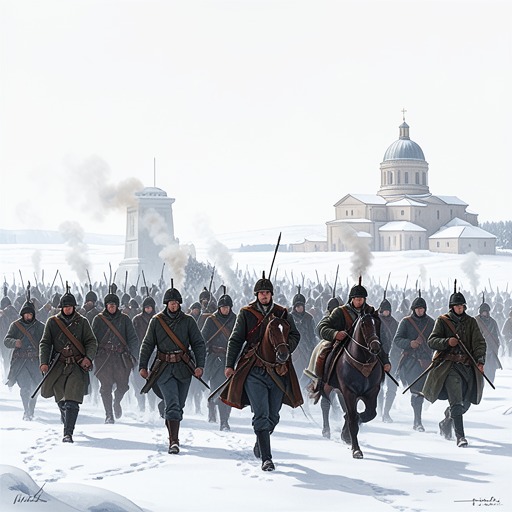
Father Sergei Ryzhkov
World War ZFather Sergei Ryzhkov is a Russian military chaplain whose wartime response to infected soldiers becomes the founding gesture of Final Purification, a doctrine that helps remake postwar Russia as a religious state. His story moves from the bleak mechanics of an exhausted army to a moment of revelation, then into the darker aftermath of a faith that may have been institutionalized as violence.
Identity and Wartime Setting
Father Sergei Ryzhkov lives in a Siberian shantytown within the Holy Russian Empire, where there is no electricity or running water and the huts stand behind a wall cut from the surrounding trees. His body bears the history of the war: his walk reflects numerous injuries, all his fingers have been broken, and most of his teeth have been knocked out or destroyed by decay. The battered physical presence of the old cleric makes his survival inseparable from the national catastrophe he describes.
Before becoming a central religious figure, Father Sergei served as chaplain with the Thirty-second Motor Rifle division, a Category D unit equipped with the oldest matériel in the Russian arsenal. His soldiers carried PPSH submachine guns and bolt-action Mosin-Nagant rifles, wore their grandfathers’ rough, moldy, moth-eaten wool tunics, and lacked modern protection against bites. The division suffered heavily in urban combat, with faulty ammunition adding a mechanical hazard to the danger posed by the undead: some rounds had been stored in exposed crates since before Stalin’s death, and a weapon could produce a fatal “Cugov,” clicking uselessly when a ghoul was already upon its user.
Father Sergei presents the Russian war effort as brutal, improvised, and materially inferior to the forces of other countries. Russian units did not possess the tight formations or economical one-shot doctrine associated with General Raj-Singh’s army. Instead, they relied on DShK heavy machine-gun fire, flamethrowers, Katyusha rockets, and the treads of T-34 tanks. The method was inefficient and wasteful, but the inherited military-industrial stockpile that outsiders had mocked as a national folly became one of the resources that preserved Russia.
The Field Hospital and the Birth of Final Purification
Father Sergei’s decisive crisis occurs shortly after the battle for Kostroma and only weeks before the official assault on Moscow. He visits a field hospital to give last rites to infected soldiers. Some are badly mauled; others remain healthy-looking and lucid. One seventeen-year-old boy has not been bitten. Instead, the broken forearms of a zombie, torn away beneath the treads of an SU-152 self-propelled gun, have stabbed through his tunic and into his abdomen. Five other infected soldiers lie beside him.
The chaplain follows the routine that has come to define his wartime ministry. He tells the soldiers that he will pray for their souls, collects their letters for their families, gives them vodka, and distributes cigarettes supplied by their commanding officer. These gestures are modest and nearly bureaucratic, but they place him beside men who are already treated as condemned. The soldiers have learned that officers may kill them, or that they may have to kill themselves before infection takes control.
The established practice is unbearable to Father Sergei. Officers who execute infected soldiers are lost to the army, while soldiers who kill themselves commit suicide and therefore imperil their souls according to the chaplain’s understanding. At the hospital, the soldiers place their rifles beneath their chins and agree to pull the triggers together. The oldest begins counting. Before he reaches three, Father Sergei shoots the seventeen-year-old in the forehead. The other soldiers stare at the bullet hole, then at the smoking pistol in his hand.
Father Sergei interprets the act as divine speech. He believes God has commanded “No more sinning” and has entrusted priests, rather than officers or infected soldiers themselves, with the release of souls trapped inside diseased bodies. His solution converts killing from military necessity or forbidden suicide into a religious duty. The act that later becomes known as Final Purification is therefore born from a collision between infection control, battlefield exhaustion, and the moral language of salvation.
Doctrine, Authority, and Political Ambiguity
Father Sergei tells the division commander that the new practice will prevent further deaths among officers and spare infected soldiers the sin of suicide. The message spreads from military chaplains to civilian priests throughout Russia. What begins as one chaplain’s intervention at a field hospital becomes a national religious movement, one that he says surpasses even the Iranian revolution of the 1980s in fervor.
He also presents Final Purification as the explanation for Russia’s postwar transformation. In his account, decades of communism followed by materialistic democracy had left Russians with little faith, knowledge of religion, or need for what they once called “the opium of the masses.” The war creates a population desperate for direction, courage, and hope, and Father Sergei claims that the new doctrine supplies all three. Russia emerges from the conflict as a nation of faith and continues rebuilding its state on that foundation.
Yet the doctrine’s public meaning is contested. When asked whether the philosophy was perverted for political purposes, Father Sergei does not acknowledge the possibility. When pressed about priests organized into death squads and assassinations carried out under the premise of purifying infected victims, he says he does not know what is being discussed. The evasiveness is especially significant because the interviewer directly links those accusations to Father Sergei’s eventual falling-out with Moscow and his presence in Siberia. His refusal neither disproves nor confirms the allegations; it leaves the religious state suspended between genuine conviction and political weaponization.
The Final Image and Narrative Significance
The interview ends before Father Sergei can explain his relationship with Moscow. A ragged child arrives at his door, mud staining his pale, frightened face, and shouts while pointing up the road. Father Sergei immediately understands the urgency, excuses himself, and prepares to leave. Before doing so, he opens a large wooden chest and removes both a Bible and a World War II–era pistol.
The paired objects compress his character into a single visual contradiction. The Bible represents pastoral care, sacred authority, and the promise that Final Purification can be understood as the saving of souls. The pistol recalls the hospital killing and suggests that the same hand may still be required to decide who is to be released, defended, or destroyed. His faith is not presented as separate from violence but as a vocabulary through which violence acquires purpose.
Father Sergei’s account also mirrors the wider systems of bodily classification that shape the war. Refugees are screened through cages of dogs and subjected to blood, skin, hair, saliva, urine, and fecal examinations; civilians are sorted into labor categories; survivors are selected or sacrificed according to strategic calculations; and soldiers and dogs are trained to respond to the dead. In this world, infected bodies become objects of medical, military, and religious administration. Father Sergei’s contribution is to place that administration inside a ritual of purification, turning the boundary between life and death into a matter of priestly authority.
His significance lies precisely in the unresolved tension between mercy and domination. He acts to prevent infected soldiers from dying alone or killing themselves, but his doctrine also creates a model in which religious officials may claim the power to kill on behalf of God. The ruined priest in the Siberian hut is therefore both witness and architect: a survivor of the war whose single act of compassion, or perceived command, becomes the founding myth of a state where salvation and coercion can speak in the same voice.