Final Purification
World War ZFinal Purification is a wartime Russian rule that made priests responsible for killing infected soldiers before they could reanimate. It emerged from a crisis in which military discipline could compel almost any sacrifice except one soldier’s deliberate killing of another, then converted that unbearable contradiction into a doctrine of religious duty. What began as an attempt to spare officers and infected soldiers from mutually destructive choices became the foundation of a national religious fervor and, according to later allegations, a system that could be extended into organized assassination.
Battlefield Origin and the Failure of Military Mercy
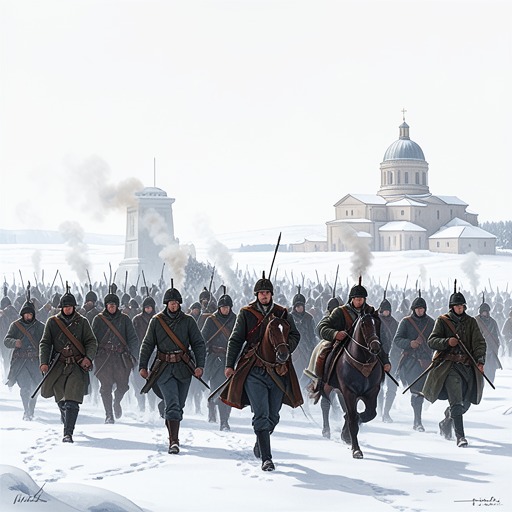
The rule arose during the Russian offensive against the living dead, when commanders discovered that conventional discipline offered no acceptable answer to infection. Russian forces lacked the L pills used elsewhere, so the only way to prevent an infected soldier from turning was a bullet. Yet soldiers could not bring themselves to shoot comrades with whom they had shared food, shelter, danger, and mutual rescue. The act recalled the decimations that had once imposed obedience on the armed forces, and asking one soldier to kill another risked crossing a line that could provoke another mutiny.
Responsibility was initially assigned to officers and senior sergeants, but the arrangement damaged the command structure it was meant to preserve. Leaders had to look into the faces of young men for whom they were responsible and execute them even when the infected were still lucid. The consequences included dereliction of duty, alcoholism, and an epidemic of suicide among field commanders. During the first week of the first campaign, one division lost four experienced leaders, including three junior lieutenants and a major. One platoon leader deliberately sought increasingly dangerous combat and died attacking a dozen ghouls with only a bayonet. Major Kovpak disappeared after an exceptional record of service, and although the official account called it a failed reconnaissance mission, his comrades believed he had deserted under the pressure. The so-called Second Decimation threatened to halt the war effort.
The alternative was imposed on the infected themselves. Soldiers bitten in battle began gathering at field hospitals and synchronizing their suicides, finding a grim comfort in not dying alone. The practice appeared merciful beside forced execution, but it made the infected responsible for an act condemned by the chaplain who would soon define Final Purification. The rule therefore answered two failures at once: the officers could no longer bear to kill their men, and the men could no longer be permitted to kill themselves.
The Chaplain’s Founding Act
The doctrine took shape after the battle for Kostroma, shortly before the assault on Moscow. At the field hospital, a chaplain encountered six infected soldiers, including a seventeen-year-old who had been disemboweled by the shattered forearms of a zombie crushed beneath an SU-152. The chaplain performed the customary rites, collected the soldiers’ letters to their families, gave them alcohol, and distributed cigarettes from their commanding officer. When the soldiers placed rifle muzzles beneath their chins and began counting, he shot the youngest in the forehead before the group could complete the act.
The chaplain understood the shooting as a divine command. He believed God had forbidden further sin, including the suicide of infected soldiers, and had assigned priests the burden of releasing trapped souls from diseased bodies. In this formulation, the execution was no longer merely a medical precaution or a military order. It became a sacramental act, with the cleric cast as shepherd and the infected body treated as a vessel from which a soul had to be freed. The doctrine’s emotional force came from its reversal of responsibility: soldiers would not have to murder one another, officers would not have to destroy the men under their command, and the infected would not have to damn themselves.
The chaplain explained his action to the division commander, and the message spread from military chaplains to civilian priests throughout Russia. The act became known as Final Purification. Its language of sin, souls, service, and release gave the nation a moral vocabulary for an emergency that had previously been described through infection, combat, and containment. A bullet could end a body; the doctrine claimed that a priest could save what remained beyond the body.
From Emergency Rule to National Faith
Final Purification was presented as the first step in a religious revival that would exceed the Iranian revolution of the 1980s. The rule’s immediate purpose was narrow and practical, but its consequences were national. Russia emerged from the war as a nation of faith, and its state reconstruction was described as resting on that renewed religious foundation. The doctrine thus did more than regulate infected soldiers. It helped convert wartime necessity into an account of national rebirth.
That transformation depended on a ritual boundary between the living and the contaminated. The infected were still recognizable as soldiers, sons, and comrades, yet they were also bodies whose future threatened the community. Final Purification preserved their status as souls while denying their bodies the right to continue living. It made the priest the authorized mediator between person and plague, compassion and violence, human life and the danger of reanimation.
The rule also belongs to a wider wartime pattern of classification and bodily inspection. At the Taba crossing, refugees were made to pass one at a time before caged dogs; those whose scent provoked the animals were taken away in unmarked vans, while other wounded people were sent to real ambulances. At the Yeroham resettlement and quarantine camp, detainees endured daily examinations of blood, skin, hair, saliva, urine, and feces, with health clearance outweighing the careful preparation of passports. The same crisis that turned priests into executioners turned dogs, doctors, camps, and paperwork into instruments for deciding who could enter the protected population. Final Purification is the religious form of that broader sorting process.
The Rule’s Political Shadow
The doctrine’s protective rationale did not eliminate its authoritarian potential. It concentrated the power to define death, infection, and spiritual legitimacy in institutions claiming exceptional authority. Elsewhere, the response to the undead similarly exposed people to confinement, forced selection, and abandonment: Paul Redeker’s plan reserved evacuation for a small fraction of civilians and used the people left behind as living bait to hold the undead away from a safe zone. In the United States, officials knowingly allowed Phalanx to function as a placebo because admitting the truth about reanimated dead would have produced panic, riots, economic damage, and political collapse. Final Purification belongs to this same landscape of emergency governance, but its distinctive claim was that organized killing could be morally purifying.
The rule’s later history is contested. When questioned about reports that the philosophy had been perverted for political purposes, including the organization of priestly death squads and the assassination of people under the premise of purifying infected victims, the former chaplain denied understanding the accusation. The evasive response leaves the allegation unresolved within the testimony, but it makes the danger unmistakable: once priests are recognized as legitimate agents of death, the boundary between killing the infected and killing those declared dangerous can be redrawn by political authority.
Significance and Legacy
Final Purification resolves a genuine wartime dilemma while preserving the violence at its center. It prevents infected soldiers from being abandoned to reanimation, shields ordinary soldiers from the psychological burden of execution, and removes a destructive responsibility from commanders. Yet it does so by sanctifying the killing rather than questioning the conditions that made killing necessary. Its apparent mercy is therefore inseparable from its power to discipline bodies and consciences.
The rule also exposes the unstable meaning of purity in the postwar world. Societies screened refugees with dogs, confined them for medical examination, stigmatized survivors such as Tomonaga Ijiro as socially unclean, and treated bodies as evidence of contamination or usefulness. Final Purification extends that logic into religious language. It promises that the soul can remain worthy even when the body must be destroyed, but the same promise can make destruction appear righteous. Its legacy is consequently double: it is remembered as a method of preventing infection and as the founding ritual of a faith-based state whose language of purification could authorize violence far beyond the battlefield.