Force Appropriate Response
World War ZForce Appropriate Response, usually abbreviated FAR, is a battlefield rule developed for the long American campaign against the undead. Its decisive principle is proportional commitment: a single zombie or a small group should not halt an entire Army Group, while a larger concentration should receive a correspondingly larger response. By turning restraint into procedure, FAR made the slow continental advance possible without sacrificing continuity of the front.
Definition and Operational Logic
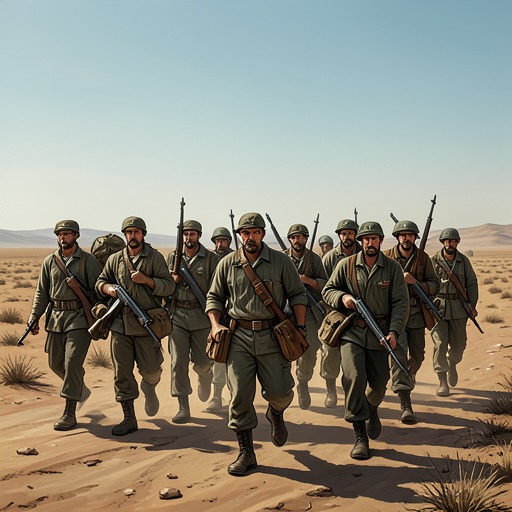
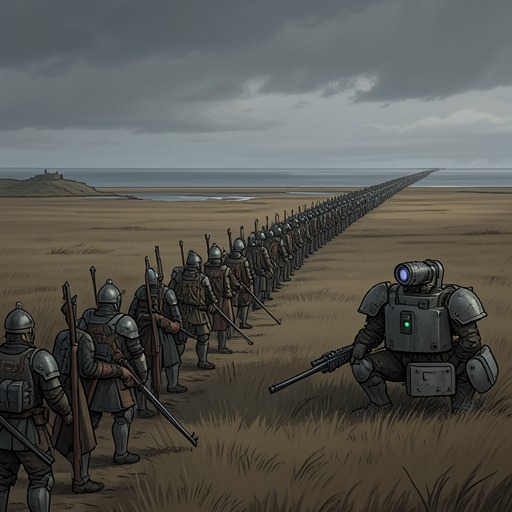
FAR governed the three-year advance known as the road to New York, in which the North, Center, and South Army Groups moved across the Great Plains and Midwest before separating at the Appalachians. The forces advanced in two solid lines, one behind the other, stretching from Canada to Mexico, and searched the ground methodically rather than leaving gaps. Whenever undead were spotted, the appropriate unit halted instead of stopping the whole formation.
The response could be as small as a section, platoon, or company, depending on the number of undead encountered. That unit would destroy the threat and sanitize the battlefield, while an equal force from the secondary line, positioned roughly a mile and a half behind the advancing troops, moved forward to fill the opening. The front therefore remained unbroken even while local units paused to deal with isolated targets. The procedure was a practical expression of proportionality: limited danger received limited force, and the army’s larger momentum was preserved.
Contrast with Earlier Military Thinking
FAR emerged from the failures exposed at the Battle of Yonkers. Earlier commanders had prepared elaborate ground-level positions behind sandbags and in fighting holes, despite the absence of a conventional enemy capable of using small arms, artillery, or air-dropped ordnance. They neglected elevated positions on shopping centers, garages, and apartment buildings that would have offered commanding views and protection. The defensive arrangements reflected Cold War assumptions rather than the biological and behavioral realities of the undead.
The deeper failure at Yonkers was not merely defective equipment or training. The undead could not be intimidated: they were biologically incapable of fear, so the traditional military aim of breaking an enemy’s spirit became useless. The army’s attempt to produce shock and awe instead generated panic among its own soldiers. FAR belongs to the subsequent reorientation of doctrine away from inherited assumptions and toward tactics suited to an enemy that could neither be frightened nor persuaded to stop.
Integration with Postwar Equipment and Doctrine
FAR worked within a broader system that emphasized reliability, sustained fire, and economical destruction. The Standard Infantry Rifle was accurate, resistant to mud, sand, and saltwater, and adaptable as a sniper rifle, midrange rifle, or close-combat carbine. Its NATO 5.56 Cherry PIE ammunition shattered on entering an undead skull and burned the resulting fragments, eliminating the need for wasteful mass bonfires and allowing intact bodies to be buried during routine duty.
The doctrine also depended on maintaining fire without creating unnecessary pauses. Infantry formed two ranks, one active and one reserve, so that soldiers could reload while the line continued firing. This arrangement, described as the centerpiece of the new battle doctrine, allowed the force to keep the undead falling as long as ammunition lasted. FAR supplied the corresponding rule at the larger organizational level: the firing line remained continuous, but only the portion of the army required for a particular contact was diverted to the encounter.
Its economic logic was reinforced by the resource-to-kill ratio associated with General Travis D’Ambrosia. Weapon systems and field practices were judged by how many undead they could eliminate for their cost, and soldiers began applying the same reasoning informally, comparing inexpensive tools with more elaborate alternatives. FAR thus linked battlefield movement to the wider military revolution: adaptable soldiers, dependable weapons, economical ammunition, and formations designed to preserve effort rather than squander it.
Execution During the Continental Advance
The method was painstakingly slow. Foot transport, terrain, weather, darkness, fog, and the need to inspect every inch of ground all constrained the advance. Once night fell, operations stopped until dawn regardless of confidence or apparent safety. Inland fog could halt the entire front for days, leaving soldiers waiting in near-zero visibility until a dog barked or a man shouted that contact had been made.
When a contact occurred, the advancing line behaved like a search team examining a crash site: it moved slowly and evenly, ensuring that no ground was missed. Older undead, whose bodies had deteriorated until bone protruded through exposed flesh, presented particular danger because some could no longer stand and instead crawled through mud or thrashed facedown. FAR treated these apparently diminished threats as reasons for local caution, not justification for abandoning the advance. A suitable detachment neutralized them, the secondary line closed the gap, and the larger formation continued forward.
Significance and Limits
FAR converted the lessons of catastrophe into an organizational habit. It rejected the notion that every contact deserved maximal firepower and replaced it with a disciplined calculation of threat, force, and continuity. In doing so, it helped transform an army that had once been paralyzed by an enemy immune to intimidation into one capable of reclaiming territory inch by inch.
The doctrine was not fast, elegant, or emotionally reassuring. Its three-year progress across the continent required soldiers to endure long pauses, difficult terrain, bad weather, and repeated encounters with enemies that could emerge from fog or crawl through the mud. Yet that slowness was part of its strength. FAR accepted the actual conditions of the war instead of forcing the war into an obsolete military model, and its success lay in preserving the line, conserving resources, and answering each threat with no more force than the campaign could afford.