Fortified Motorways
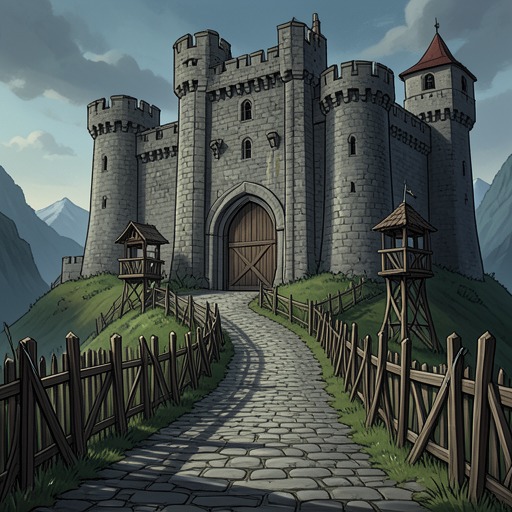
World War ZFortified Motorways are a British defensive infrastructure developed during the Zombie War, turning transportation routes into protected corridors through a combination of fortified positions, engineering, resource control, and organized movement. Their decisive importance lies in the way they convert isolated strongholds into a connected system: defense is no longer confined to walls, castles, or refugee enclaves, but extended along the roads that allow people, supplies, specialists, and eventually offensive forces to move through a devastated country.
Origins in Defensive Strongholds
The system grew out of improvised survival at defended sites. Across Europe, winter gave survivors a temporary advantage because frozen Zed Heads could be avoided or destroyed while defenders raided the surrounding countryside for supplies. In Britain, communities chose to remain in strongholds such as Beaumaris, while Conwy combined a castle with a medieval wall protecting the entire town. Conwy’s access to the sea later made it a springboard for forces retaking the country, demonstrating the strategic value of a defended settlement that could serve both as refuge and as a base for movement.
Windsor Castle provided the clearest model for a fully prepared defensive node. Before the war, it was the largest inhabited castle in Europe, occupying almost thirteen acres, with its own well and storage capacity for a decade of rations. Security measures added after the 1992 fire and subsequent terrorist threats included bulletproof glass, reinforced walls, retractable bars, and steel shutters concealed in windowsills and door frames. What had appeared to be a ceremonial or historical site thus possessed the physical characteristics of a modern fortress: water, food storage, hardened structures, and controlled openings.
Engineering, Energy, and the Road Network
Windsor’s most consequential asset lay beneath it. Crude oil and natural gas had been discovered several kilometers below the castle’s foundation in the 1990s but had never been exploited because of political and environmental objections. During the war, those objections disappeared. Royal engineers built scaffolding over the castle wall and extended it to the drilling site, extracting energy from beneath the fortress itself. This engineering achievement became the precursor to the Fortified Motorways, because it demonstrated that defensive infrastructure could also secure access to essential industrial resources.
The resulting system answered a central problem of the war: survival depended not only on resisting the undead, but on sustaining the production and transport of the materials required for resistance. The United States, for example, could no longer rely on resources from safe zones overseas. The living dead controlled most of the world’s landmass, refugees filled the merchant fleet, and fuel shortages had forced much of the navy into harbor. Britain’s fortified routes therefore belong to a wider strategic shift in which roads, fuel sources, factories, and defended communities were treated as parts of one war economy rather than as separate assets.
From Fortress Defense to National Mobility
The system also exposed the limits of purely static defense. Fortresses could protect populations, but the war could not be won if every surviving community remained isolated. The United States’ Continental Airlift later maintained contact with scattered Red and Blue Zones, coordinating demands and prioritizing deliveries across the largest undertaking in air-force history. Its preference was for self-sustaining drops—tools, spare parts, and equipment for making spare parts—rather than endless deliveries of consumables, although food, medicine, salt, dried vegetables, and baby formula still had to be supplied through difficult winters. Fortified Motorways represent the terrestrial equivalent of that principle: infrastructure designed not merely to deliver relief, but to make continued defense and recovery possible.
Their significance became international at the Honolulu Conference, where the British method was one of the military practices other nations were eager to study. The conference was intended to exchange warfighting tactics and technology and to restore some measure of international trade. It instead became the setting for a decision to abandon a purely defensive posture and begin retaking infested territory. The British roads therefore stood at the hinge between endurance and liberation: they were first conceived to preserve defended populations, but their broader value was as protected lines along which a reorganized military could move outward.
Logistics and the Resource-to-Kill Principle
Fortified Motorways belong to the same practical culture as the resource-to-kill ratio developed by General Travis D’Ambrosia. The postwar armies had to reject weapons and systems whose expense exceeded their usefulness against vast numbers of undead. The failure of Project Yellow Jacket showed the danger of seductive technology: its designers promised millions of satellite-guided micro missiles capable, in theory, of destroying every zombie brain in North America within forty-eight hours, and enormous resources were poured into the project before its opportunity cost became clear. By contrast, the new doctrine favored durable, reproducible, maintainable tools and routes.
That doctrine shaped weapons such as the Standard Infantry Rifle and Cherry PIE ammunition. The rifle was accurate, resistant to mud, sand, and saltwater, adaptable as a sniper weapon, midrange rifle, or carbine, and equipped with a folding spike for emergencies. Cherry PIE rounds shattered inside a zombie skull and destroyed the brain without spreading infected tissue, reducing the need for wasteful burning and allowing whole bodies to be buried during BS4 operations. Such equipment could function effectively only within a system able to manufacture ammunition, repair weapons, move units, and resupply defended zones. The Fortified Motorways are thus not simply roads with barriers; they are the physical expression of an economy organized around dependable movement and efficient killing.
Human and Institutional Consequences
The infrastructure required a transformed workforce. More than 65 percent of the surviving civilian workforce was classified as F-6, possessing no valued vocation in the new conditions. A postindustrial society filled with executives, representatives, analysts, and consultants had to retrain people as carpenters, masons, machinists, and gunsmiths. Roads and rail lines were in ruins, fuel was scarce, and the old commuter geography had separated technical knowledge into distant social enclaves. In the beginning, most travel took place on foot. Rebuilding transport corridors therefore demanded not only concrete, steel, and fuel, but the recovery of practical skills.
The same logic appeared in local security. Neighborhood Security Teams were intended as part-time volunteer patrols in which residents checked each house in their own district, with at least two members remaining outside whenever others entered a building. The program could include disabled citizens because the undead came to the patrols rather than requiring defenders to chase them over fences. This emphasis on local participation complements the Fortified Motorways: national corridors depended on communities capable of guarding their own immediate spaces, maintaining local production, and contributing trained personnel to a larger defensive network.
The system also relied on specialized human and animal labor. Dogs were first used for triage, identifying infected people by scent, often through the Israeli practice of making individuals pass cages containing the animals. Although the dogs’ terror response could cause handlers to lose hands, arms, or throats, that instinct saved lives and was later incorporated into more systematic training. Military working dogs were taught to turn their reaction to the undead into controlled service, just as human recruits had to endure the psychological burden of long-term Z-shock. Fortified routes, like fortified castles, were therefore sustained by institutions of classification, training, repair, and discipline.
Narrative and Strategic Significance
The Fortified Motorways embody the book’s movement from apocalypse as collapse to war as organized reconstruction. At first, survival appears to mean waiting behind walls, enduring winter, and scavenging enough to last until the dead become immobile. Gradually, defended places acquire connections, energy supplies, production capacity, and routes of communication. The old landscape of roads and castles is not restored unchanged; it is repurposed into a military geography in which every protected passage can support a larger campaign.
Their appearance at the Honolulu Conference is especially revealing. The British method is presented as a technology others want to see, but its deeper importance is organizational rather than spectacular. It joins defensive architecture to logistics and turns the question of who can survive into the question of how a society can move, resupply, and eventually attack. Against two hundred million zombies and an enemy unconstrained by the ordinary requirements that armies must be bred, fed, and led, the Fortified Motorways offer a human answer: disciplined infrastructure can substitute for lost abundance, connect scattered enclaves, and make a permanent counteroffensive imaginable.