General Raj-Singh
World War ZGeneral Raj-Singh, the “Tiger of Delhi,” is presented as both a military commander and a living legend whose authority is tested at the most morally and tactically impossible point of the evacuation. Wounded, exhausted, and surrounded by refugees and the approaching living dead, he refuses both reckless destruction and personal escape. His final intervention appears to save the mountain barrier at the cost of his own life, making him an emblem of leadership measured not by survival but by the willingness to bear responsibility for others.
Identity and Reputation
General Raj-Singh is introduced through the astonishment of Khan, who finds himself suddenly standing inches from the commander. Khan remembers him as physically enormous, perhaps because admiration magnifies the people it reveres, and calls him the Tiger of Delhi. The image is deliberately paradoxical: Raj-Singh seems gigantic in memory, yet he appears in a torn uniform, with a bloody turban, a patch over his right eye, and a bandage across his nose. One of his own men had struck him in the face with a rifle butt while forcing him onto the last helicopter out of Gandhi Park. His legendary status therefore does not rest on an untouched heroic image. It survives through visible injury, humiliation, and the evidence that he remained in the fight after being physically overpowered.
The account also counters the later accusation that Raj-Singh simply abandoned his men when the battle became unbearable. From the orbiting station, observers watched Indian troops attempt to rescue civilians trapped in Ambedkar Stadium, become trapped themselves, and retreat toward Gandhi Park. They saw the commander form his soldiers into a square, an old colonial-era formation that held for a time as the Zed Heads closed in. They did not initially know the commander was Raj-Singh, nor could satellite surveillance provide sound, but they witnessed him trying to organize resistance while his ammunition ran low. The blow that incapacitated him and his evacuation by helicopter were thus part of a desperate military withdrawal, not proof that he had ceased to resist.
The Mountain-Pass Crisis
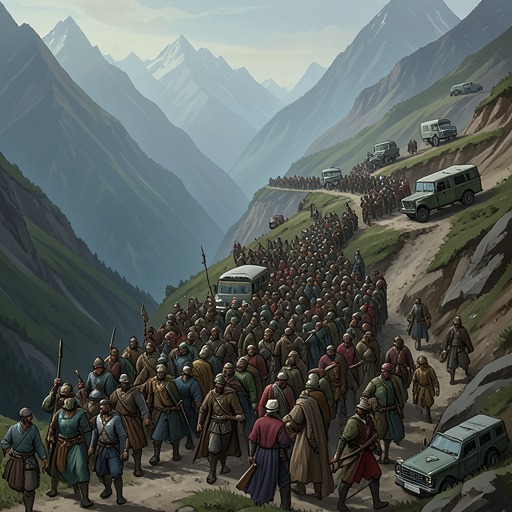
Raj-Singh’s defining scene occurs at a mountain road crowded with refugees while the living dead advance behind them. Mukherjee, responsible for the road’s demolition, argues over the radio that the charges cannot yet be fired: dozens of civilians would be hurled to their deaths, and thousands would be trapped on the far side. The officer issuing the order insists that the road will never clear because a swarm of perhaps millions is following the refugees. Raj-Singh enters at precisely this impasse, converting a dispute between operational urgency and immediate humanitarian responsibility into a command decision.
He addresses the soldiers as “Gentlemen” and explains that the road must be destroyed immediately. The remaining air force has already ordered the closure of all mountain passes, and a Shamsher fighter bomber is waiting overhead. If the soldiers cannot or will not complete the mission, the pilot is prepared to execute “Shiva’s Wrath,” the rumored code for thermonuclear weapons. The alternative would not merely destroy the narrow choke point. A nuclear strike could remove half the mountain and turn the pass into a broad, gently sloping ramp, creating an entrance into the safe zone rather than a barrier against the living dead. Raj-Singh’s decision is therefore made under two forms of annihilation: the refugees may die in the conventional blast, or the entire defensive geography may be ruined by an atomic attack.
Responsibility and Sacrifice
Mukherjee hesitates until Raj-Singh holds out his hand for the detonator. By taking it, the general accepts the burden of becoming, in Khan’s words, a mass murderer if the charges kill the people still on the road. The act is heroic precisely because it is not clean. Raj-Singh does not claim moral purity; he accepts command responsibility when every available option carries civilian death. He thanks Mukherjee and the others, whispers a prayer, and presses both firing buttons.
Nothing happens. He checks the batteries and connections and tries again, then a third time, but the detonator remains useless. The fault lies in the buried charges, positioned half a kilometer down the road in the middle of the refugees. The failure reverses the apparent certainty of command: Raj-Singh has accepted the decision, but technology and circumstance refuse to obey him. Khan immediately thinks that everyone will die and feels ashamed that his first impulse is to get far enough away to survive a possible nuclear blast. Against that self-preserving panic, Raj-Singh acts without hesitation. He orders the soldiers to escape toward Shimla and save themselves, then turns and runs into the crowd.
His movement into the refugees is not an attempt to hide. Khan and Mukherjee follow because they now want to protect their general and shield him from the mass of people, although the crowd rapidly swallows all three intentions. Raj-Singh disappears from sight as the refugees surge like a raging river. Khan is punched, shoved, and ignored when he identifies the situation as army business; even shots fired into the air attract no attention. Mukherjee tumbles over the side while struggling with another man for his rifle, and Khan cannot locate Raj-Singh despite calling his name and climbing onto the roof of a microbus. The general’s heroic presence is thus transformed into absence: the legendary commander cannot be seen directing events because he has entered the same uncontrollable human flood as everyone else.
The Road Destroyed
When Khan regains consciousness, he is alone on a deserted mountain path among discarded belongings. A charred cliff wall stands before him, and beyond it lies the severed road. The faint tapping he first hears is not water but the bodies of the living dead falling from the shattered edge and striking the valley floor. Their advance has become an undead waterfall: they continue moving forward, but the destroyed pass prevents them from crossing.
Khan infers that Raj-Singh must have set off the demolition charges by hand, reaching them at approximately the same time as the living dead. The detonator failed, yet the barrier was ultimately completed. The evidence does not provide a witnessed account of Raj-Singh’s final seconds, and Khan can only hope that the general was not bitten before triggering the charges. Still, the physical result is decisive: the mountain freeway is severed, the approaching swarm is denied access, and the safe zone remains protected. A statue later stands over the modern four-lane road, preserving the public memory of the sacrifice even though Khan’s immediate experience is dominated by uncertainty and guilt rather than ceremony.
The radio reports that follow—Vikasnagar and Bilaspur are both secure—give the destroyed road a strategic consequence beyond the single encounter. Raj-Singh’s action helps convert a chaotic retreat into a defensive line. His fate remains described through inference rather than confirmed observation, but the combination of the broken pass, the falling dead, and the later statue makes his presumed death the narrative’s most credible conclusion.
Narrative Significance
Raj-Singh functions as a corrective to simplified stories of military heroism. He is not represented as an invulnerable warrior who always controls the battlefield. He is wounded, removed from a previous fight by force, unable to make the detonator work, and finally lost inside a crowd he cannot command. His greatness emerges through these failures of control. At the decisive moment, he chooses the dangerous responsibility that others fear, then abandons the possibility of personal safety when the plan collapses.
His story also exposes the difference between watching and acting. The orbital observers can see battles in extraordinary detail—troops, civilians, formations, wounds, and the closing ranks of the living dead—but they cannot hear the arguments or intervene. From that distance, Raj-Singh’s conduct is vulnerable to hostile interpretation. Khan’s testimony restores the missing moral and tactical context: the commander fought, was injured, returned to danger, and ultimately acted to close the pass. General Raj-Singh therefore embodies the human factor within a military system of codes, aircraft, explosives, and satellite surveillance. The machines establish the conditions of the decision; the general makes himself answerable for its consequences.