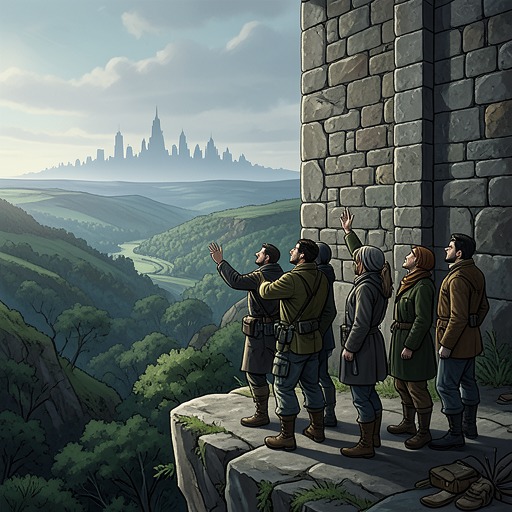
General Travis D’Ambrosia
World War ZGeneral Travis D’Ambrosia stands at the center of the war’s transformation from disbelief to organized resistance. As Supreme Allied Commander, Europe, he oversees the recurring “Sweep and Clear” operations at Vaalajarvi, Finland, where frozen zombies reanimate each spring and the United Nations Northern Force steadily reduces their numbers. Yet his authority is defined less by triumphal confidence than by remorse, caution, and an insistence that victory depended on learning how to fight a fundamentally new enemy.
Identity and Command
In the postwar interview, General Travis D’Ambrosia appears as a senior commander still carrying the weight of failure. At Vaalajarvi, he personally supervises operations expected to make the region completely secure within a decade, but his voice is soft and sad, and he struggles to maintain eye contact. He openly acknowledges that mistakes were made, that the armed forces were not prepared, and that the American people were let down. His command therefore carries an unusual moral dimension: he represents institutional power while refusing to present military history as an uncomplicated record of competence.
His earlier position as chairman of the Joint Chiefs placed him at the moment when military suspicion became official strategic thinking. After Israel’s declaration of Voluntary Quarantine, the chairman asked what would happen if the Israelis were right. The discussion was initially treated as a hypothetical exercise, with jokes and professional detachment preserving the appearance that the subject was too absurd for serious consideration. Gradually, however, the officers began speaking candidly about walking corpses. D’Ambrosia’s recollection describes this shift as a breaking dam: once the taboo collapsed, accumulated experience and private suspicions could finally enter open debate.
From Denial to Doctrine
D’Ambrosia’s defining contribution was the recognition that conventional military assumptions did not apply to the living dead. The continental enemy numbered approximately two hundred million zombies, a figure so immense that even experienced commanders struggled to visualize it. More fundamentally, the undead did not need to be bred, fed, or led. Every conventional army depended on recruits, supply, and command authority; the zombies required none of these. The inherited “book of war” was therefore useless, and a new one had to be written from the beginning.
That intellectual break shaped D’Ambrosia’s attitude toward the offensive. When the decision to attack was finally made, his first reaction was fear rather than excitement. He rejected the stereotype of the general as a bloodthirsty, dim-witted aggressor and emphasized the human cost of sending soldiers against an enemy with overwhelming numbers and no conventional vulnerabilities. His position was not reluctance for its own sake. It was the recognition that an offensive could be morally justified only after the armed forces had developed methods suited to the enemy’s physiology, behavior, and scale.
Resource-to-Kill Ratio and Military Economy
D’Ambrosia invented the resource-to-kill ratio and developed a comprehensive strategy around it. The principle redirected military thinking away from spectacular technology and toward the number of zombies a weapon could destroy for the materials, labor, fuel, maintenance, and logistical effort required to field it. His framework answered the central industrial problem of the war: the living no longer controlled most of the world’s landmass, while American production depended primarily on what could be harvested in the western states. Refugee transport crowded the merchant fleet, fuel shortages immobilized much of the navy, and overseas supplies could no longer be assumed.
The Second World War provided the comparison. The Allies had prevailed through superior manufacturing capacity, access to raw materials, and the logistics needed to move resources to factories and finished materiel to the front. During the Zombie War, the living occupied the position once held by the Axis: constrained, strategically isolated, and forced to make every resource serve the war effort. D’Ambrosia’s doctrine thus connected battlefield effectiveness to agriculture, industry, transportation, and repair rather than treating weapons as isolated instruments.
His influence extended to procurement. When he judged a weapons system vital, he advised the civilian leadership responsible for war production, and his recommendations were trusted on equipment such as the Battle Dress Uniform and the Standard Infantry Rifle. The resulting culture spread beyond headquarters. Soldiers began comparing weapons by what one system could accomplish against another at the same cost, and enlisted personnel devised tools that were more economical than anything bureaucrats had imagined. The doctrine became a habit of thought: improvisation and adaptation mattered more than prestige.
Logistics and the Continental Airlift
D’Ambrosia’s strategic world required a logistical system capable of sustaining scattered human enclaves. The Continental Airlift became the largest undertaking in air-force history in statistical terms, coordinating contact with isolated zones, processing their requests, consulting the Department of Strategic Resources, and procuring and prioritizing the materiel sent in each drop. The operation treated survival as an administrative and industrial problem as much as a military one.
The airlift favored self-sustaining drops over dependency drops. Tools, spare parts, and equipment for making spare parts were preferred to supplies that required permanent resupply; the goal was to provide fishing poles rather than merely deliver fish. Yet the doctrine recognized the limits of self-sufficiency. Every autumn, aircraft still delivered fish, wheat, salt, dried vegetables, and baby formula because winters were long and survival could not be postponed while communities learned to provide for themselves.
Specialists were also part of the supply chain. Doctors and engineers were dropped into zones whose needs could not be met by manuals, while Special Forces instructors taught Blue Zone populations to defend themselves and prepare for eventual offensive operations. Many instructors parachuted into places without airstrips and had no prospect of pickup. Some zones were eventually overrun, making their deployment an act of calculated risk rather than a guarantee of rescue.
Weapons, Errors, and Consequences
D’Ambrosia’s doctrine explains why simple, durable weapons became more valuable than supposedly decisive technological miracles. Project Yellow Jacket promised micro-missiles, each roughly the size of a .22 rimfire bullet, scattered from transport aircraft and guided by satellites toward the brains of zombies across North America. The project’s advocates claimed that it could theoretically win the war within forty-eight hours of deployment. The resources consumed by the scheme later became a source of regret, because they might have produced more practical equipment.
The contrast between Yellow Jacket and the standard infantry rifle captures the war’s larger strategic education. The rifle was mass-producible, accurate, resistant to jamming, and adaptable through interchangeable parts and barrels for long-range, midrange, or close combat. Its NATO 5.56 Cherry PIE ammunition shattered inside a zombie’s skull and destroyed the brain without spreading infected tissue, eliminating the need for wasteful bonfires and permitting whole bodies to be buried during BS4 operations. Such systems embodied D’Ambrosia’s preference for repeatable, economical lethality over technological glamour.
His influence also reached the rank and file through a culture of practical invention. Marines, in particular, disproved the stereotype of thoughtless aggression by improvising tools and tactics, a habit shaped by their need to procure assets through the navy and compensate for limited attention to land warfare. The result was an army that belonged as much to ordinary people as to institutions, including soldiers whose previous lives had been civilian, religious, or otherwise far removed from military identity.
Narrative Role and Significance
General Travis D’Ambrosia functions as the narrative’s military conscience and strategic interpreter. He does not erase the failures of preparation, nor does he celebrate the offensive as an easy act of courage. Instead, his testimony shows how recognition, logistics, and institutional learning transformed an impossible-seeming conflict into a campaign that could gradually reclaim territory. At Vaalajarvi, where annual operations reduce the undead population year by year, the future appears not as a miraculous restoration but as the consequence of sustained, unspectacular work.
His arc is therefore one of disciplined recognition. The crucial reversal is not the moment when the living dead first appear, but the moment when professionals stop pretending that the threat is hypothetical. From that admission follow a new doctrine, an economy organized around resource-to-kill ratio, a continental airlift, revised weapons, and an offensive undertaken with full awareness of its cost. D’Ambrosia’s significance lies in making victory inseparable from humility: the living survive because their commanders finally learn to abandon the war they expected and build the war they actually have to fight.