Generation Z
World War ZGeneration Z is the postwar name for the generation that survived the zombie catastrophe and assumed responsibility for its aftermath. Its defining significance is moral as much as demographic: this cohort did not create the original danger, but it belongs to the society that allowed the danger to become a worldwide menace, and it is therefore judged by whether it can restore a livable future rather than merely claim victory.
Definition and Generational Burden
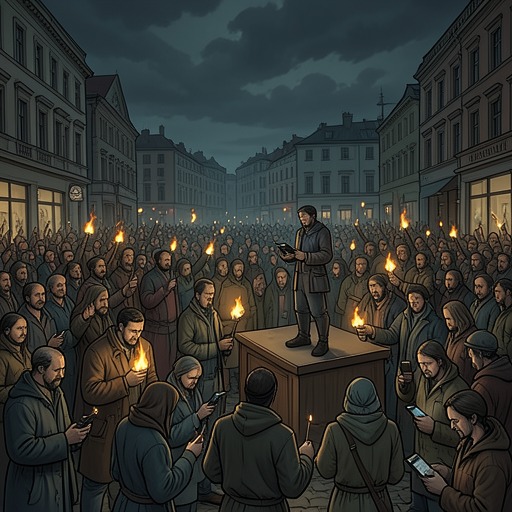
Generation Z is introduced at Troy, Montana, where responsibility is framed collectively rather than assigned only to politicians, businessmen, generals, or an impersonal machine. The speaker identifies the American system with herself and argues that living in a democracy means accepting a share of the blame. The formulation turns the generation into a civic subject: its members are not permitted to regard the disaster as somebody else’s failure, because the institutions and assumptions that enabled it belonged to their world.
This burden is set against an older American family history. The grandparents’ generation endured the Great Depression and World War II and then helped build what the speaker calls the greatest middle class in human history. The parents’ generation, identified with the baby boomers and the “me” generation, is presented as having squandered that inheritance. Generation Z follows them, inheriting not a stable prosperity but the consequences of collective complacency, institutional failure, and a catastrophe that has already crossed national and social boundaries.
The World Generation Z Inherits
The scale of that inheritance is made concrete by the war’s logistical and military crisis. The living dead control most of the world’s landmass, while American production depends largely on what can be harvested in the western states. Refugee traffic fills the merchant fleet, fuel shortages have placed much of the navy out of service, and the country must reconstruct an industrial system under conditions in which raw materials, factories, transport, and military demand are inseparable.
The military challenge is equally unprecedented. Two hundred million zombies confront the surviving population, and conventional strategic assumptions no longer apply. Human armies must be bred, fed, and led; the living dead require none of these conditions. Generation Z therefore inherits not simply a war but the need to invent a new military grammar, one that treats supply, endurance, and repeatable production as more decisive than prestige weapons or inherited doctrine.
The generation’s practical culture is visible in the turn toward resource discipline. The Standard Infantry Rifle is valued because it is accurate, reliable, resistant to mud, sand, and saltwater, and convertible between sniper, rifle, and carbine configurations. Its NATO 5.56 Cherry PIE ammunition shatters inside a zombie skull and fries the brain without spreading infected tissue, reducing both battlefield risk and the need for wasteful burning. These tools embody a broader postwar lesson: survival depends on dependable systems that can be manufactured, maintained, and used repeatedly.
Institutions, Technology, and Adaptation
Generation Z’s rebuilding effort is not anti-technology; it is hostile to technology detached from material reality. Project Yellow Jacket promises millions of satellite-guided micro-missiles capable, in theory, of reaching every zombie brain in North America within forty-eight hours. The project consumes resources that could have supported more useful production, becoming a cautionary example of how spectacular solutions can displace durable ones.
By contrast, the resource-to-kill ratio developed by General Travis D’Ambrosia provides a governing principle for choosing weapons and strategies. The culture of this principle spreads beyond official planners: soldiers compare what one system costs with how many more targets another system could kill, and rank-and-file troops begin devising economical tools of their own. Generation Z is thus associated with improvisation and adaptation, not because its members possess a magical technical superiority, but because necessity forces them to measure every device against labor, materials, transport, and battlefield effect.
The same logic shapes the Continental Airlift. The operation must maintain contact with scattered survivor enclaves, process their requests, coordinate with the Department of Strategic Resources, and prioritize materiel for drops across a fragmented continent. Supplies are divided between dependency drops, such as food and medicine, and self-sustaining drops, such as tools, spare parts, and equipment for making more spare parts. The principle is to provide fishing poles rather than fish, although autumn deliveries of wheat, salt, dried vegetables, baby formula, and other essentials remain necessary because harsh winters make self-sufficiency an aspiration rather than an immediate guarantee.
Generation Z also inherits a willingness to repurpose advanced systems under extreme conditions. The Jules Verne Three is modified from a disposable supply vehicle into a manually piloted craft, while ASTRO is adapted into an orbital refueling station for military and civilian satellites. Underwater forces move from the unreliable shallow-water M-9, whose ammunition implodes at operational depth, to the more efficient M-11. These examples show a generation using inherited technology through modification, repair, and substitution rather than treating prewar designs as sacred or complete.
Responsibility and Self-Definition
The central declaration of Generation Z is that stopping the zombie menace is not enough. The generation did stop it, but the speaker immediately rejects triumphalism because the same generation also allowed the menace to become a menace in the first place. Victory therefore creates a second obligation: reconstruction, accountability, and the sustained removal of the conditions that made catastrophe possible.
That double judgment culminates in the phrase “Generation Z, they cleaned up their own mess.” It functions as a hoped-for epitaph rather than a boast. The wording preserves the admission of guilt while granting the possibility of moral repair. Generation Z is neither absolved nor condemned without remainder; it is defined by the work between those two positions, by accepting consequences and continuing to rebuild after the celebratory moment has passed.
Narrative and Thematic Significance
The concept gives the book a generational scale without reducing history to a simple succession of heroes and villains. At Troy, Montana, the speaker looks down at children, shifting attention from the survivors’ suffering to the people who will inherit the repaired or unrepaired world. In Chongqing, Kwang Jingshu makes a house call to a child whose respiratory illness proves to be only a chest cold, and the mother’s relief offers a small, immediate image of ordinary life returning. Such scenes place Generation Z between catastrophe and continuity: its achievement is measured not only in defeated zombies or rebuilt weapons systems, but in whether children can again grow up amid routine medical reassurance rather than permanent emergency.
The concept also binds together the book’s military, economic, technological, and ethical strands. It names a cohort forced to understand that production, logistics, public responsibility, and emotional endurance are parts of the same survival problem. Its legacy remains deliberately unfinished. The generation’s most credible claim is not that it was innocent or exceptional, but that, having inherited a world in ruins, it stayed long enough to begin making that world habitable again.