Go north
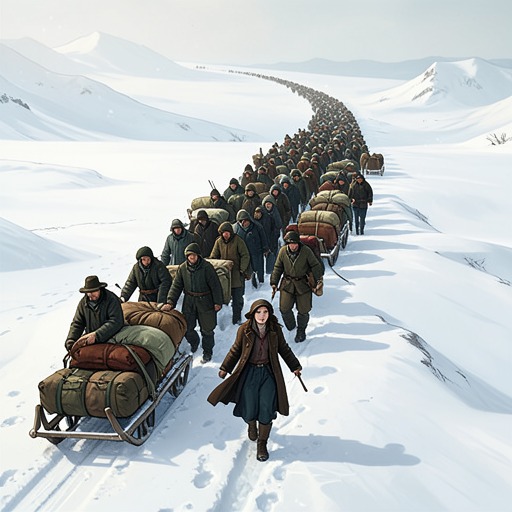
World War Z“Go north” was the defining public instruction of the Great Panic’s early civilian response: because the living dead froze solid in extreme cold, northern flight appeared to offer the only widely available protection. Its decisive significance lies in the gap between that fragment of sound advice and everything omitted from it. People were told to move, but not where to go, what to carry, how to travel, or how to survive once they arrived.
Definition and Emergency Use
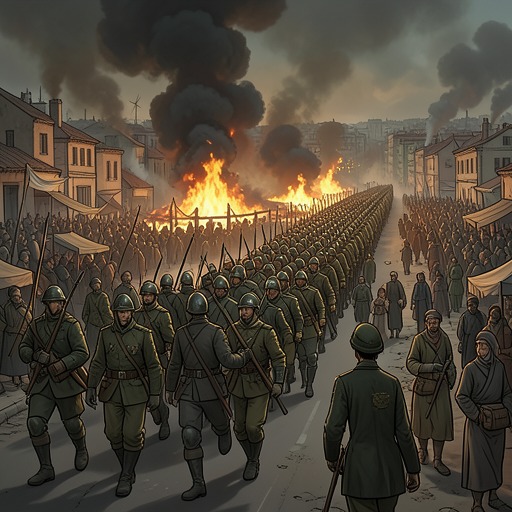
The phrase circulated as a repeated media directive after the government began withdrawing west following the Battle of Yonkers. In the recollection of Jesika Hendricks, television channels offered little beyond live or recorded zombie footage and contradictory statements from competing experts. The one point on which the broadcasters agreed was that private citizens should go north, since freezing temperatures could immobilize the undead. The instruction appeared not as a carefully explained evacuation policy but as a catchphrase crawling across the bottom of the screen: “Go north. Go north. Go north.”
That repetition gave the phrase an authority disproportionate to its content. It reduced a complex survival problem to a direction, allowing officials and commentators to appear decisive while leaving families to improvise the rest. The words were actionable enough to provoke movement but incomplete enough to magnify danger. In this form, “Go north” became less a map than a command without logistics.
Family Decision and Misapplied Hope
For Jesika Hendricks’s family, the phrase became the immediate reason to abandon home. In August, two weeks after Yonkers and three days after the government’s westward withdrawal began, her father decided that the family would leave that night. A nearby outbreak involving six undead feeding on a homeless man had been contained by police, but the incident intensified the household’s fear. Her father, who had never handled a firearm before, was suddenly learning to load a new rifle while Jesika’s mother nailed boards over the windows.
Jesika’s mother argued that their home was already above the snowline and could be fortified and stocked until the first autumn frost. Her husband rejected that cautious plan because the Great Panic had made waiting seem fatal. He imagined the journey as an extended camping trip, speaking of mooseburgers, wild berries, fishing lessons, and a pet rabbit, even though he had spent his entire life in Waukesha and had never been camping. The phrase therefore operated at two levels: it conveyed a genuine defensive principle, but it also entered private life as a slogan capable of overriding local knowledge and practical judgment.
Migration, Diversion, and Unequal Risk
The northern movement was not simply spontaneous. Jesika Hendricks later understood that the government could not feed, screen, and protect every refugee who followed the army west behind the Rocky Mountains. Diverting people north offered at least a chance of survival once the temperature fell and the undead froze. She could understand the strategic rationale, including the fear that armed troops might otherwise have to stop refugees at the mountains by force. What she could not forgive was the irresponsible communication: people were denied the information that might have allowed them to remain alive on the journey.
This distinction makes “Go north” an expression of both protection and abandonment. It pointed civilians toward a theoretically safer environment while withholding the knowledge required to reach and inhabit it safely. The phrase distributed risk downward. Authorities retained the ability to describe the movement as a survival measure, while families bore the consequences of choosing routes, supplies, timing, and shelter with almost no reliable instruction.
The wider war repeatedly exposes the same conflict between movement and containment. Air smugglers in China transported wealthy clients through prebooked tourist packages, while infected travelers risked reanimating far from home. On overland routes through the old Soviet republics, infected people were initially rare because the blight acted too quickly for them to survive long journeys; later, as infestations multiplied and police forces were overwhelmed, infected travelers became common. At sea, refugees swam toward ships and were attacked by underwater undead, while rescuers continued returning to shore. These contrasting routes show that movement itself was never safety: it was a gamble shaped by wealth, geography, infection timing, and access to organized protection.
The Political Language of Survival
The phrase also belongs to a larger vocabulary in which governments converted emergency decisions into morally charged commands. Redeker’s plan proposed concentrating surviving armed forces in defensible safe zones while abandoning selected civilians in isolated, defended areas as human bait, keeping undead hordes fixed away from the retreating army. The brutal logic was that every undead besieging those survivors would be one less attacking the defenses. “Go north” is less openly murderous, but it shares the structure of an order that presents population management as necessity while concealing who will bear the cost.
Other testimony makes the danger of obedience explicit. A Russian commander told soldiers who expected execution that they would receive a chance to practice democracy by voting which member of each group of ten would be killed, then forcing them to carry out the execution themselves. A West German officer, ordered by General Lang to withdraw from Hamburg and indirectly expose civilians to mass murder, refused because conscience stood above obedience, though he ultimately withdrew rather than sacrifice his young soldiers to a treason charge. In Russia, a chaplain’s interpretation of divine command led to what became known as Final Purification, presenting clerical execution of infected bodies as the proper release of trapped souls. Across these cases, survival language can mobilize people, discipline them, or make violence appear inevitable.
Afterlife of the Expression
“Go north” outlasts the moment that produced it because the phrase captures how ordinary people remember institutional failure. Jesika Hendricks does not deny that cold could stop the undead or that diverting refugees might have been unavoidable. Her grievance is that the public received the destination without the means. The words offered a direction but no durable social contract: no clear route, no supply plan, no screening procedure, and no honest account of the hazards ahead.
Its legacy is therefore double-edged. As practical advice, going north could help civilians survive until winter. As public communication, the repeated slogan encouraged panic, uprooted households that might have endured in place, and transformed a complex national emergency into a chant. The phrase’s power comes from that contradiction: it was not wholly false, but its partial truth was enough to send millions moving into an unknown landscape.