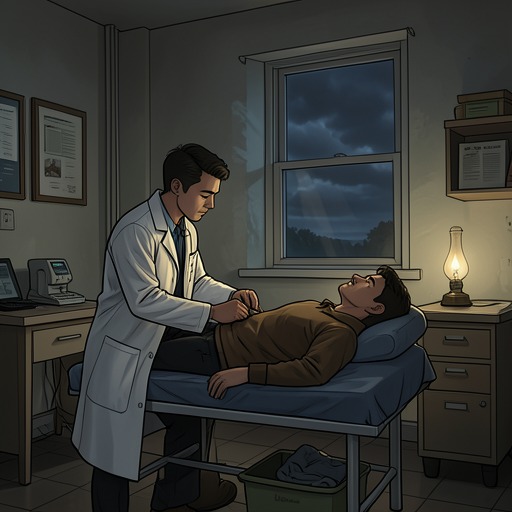
Gu Wen Kuei
World War ZGu Wen Kuei is a physician at the Institute of Infectious Diseases at Chongqing University and an old army comrade of Kwang Jingshu. His importance lies less in conventional heroism than in recognition: he is among the first people to understand that an apparently isolated illness is part of a far larger catastrophe. His warning reaches Kwang only minutes before the state’s armed apparatus descends on the village, turning medical expertise into an act of resistance.
Identity and Background
Gu’s professional identity is established through his work in infectious diseases and his long friendship with Kwang Jingshu. When Kwang calls, the two men begin with ordinary conversation about their health and grandchildren, maintaining the social rituals appropriate to old comrades. Gu initially jokes about the hygiene of rural people, but the tone changes as soon as Kwang describes the bites, fever, the infected arm, and the boy involved in the outbreak. Gu’s smile disappears, and his face stiffens: the symptoms have crossed from anecdote into recognition.
Their shared past reaches back to the 1969 border clashes with the Soviet Union. In an earthen bunker on the Chinese side of the Ussuri River, less than a kilometer downriver from Chen Bao, Gu and Kwang once worked together to remove shrapnel from a young soldier while artillery landed around them every seven seconds. The patient’s intestines were torn open, falling earth threatened the wound, and gunfire at the entrance might have come from either Chinese or Russian forces. The scene establishes Gu not merely as a laboratory specialist but as someone whose medical judgment was formed under battlefield pressure.
Recognition of the Outbreak
After hearing Kwang’s account, Gu asks to see the infected people. He directs Kwang to move the phone’s camera over the patients and then closer to their wounds. The call is abruptly interrupted when Gu’s video image cuts out, suggesting that his warning has already placed him under pressure or surveillance. He does not waste time explaining a diagnosis. Instead, he gives a sequence of emergency instructions: Kwang must remain where he is, record the names of everyone who has contacted the infected, restrain those already infected, and clear and secure any room containing a patient who has entered a coma.
Gu’s questions reveal the gravity of what he has seen. He asks whether Kwang is armed, then promises that support will arrive within several hours. The supposed medical response appears almost immediately: fifty men arrive in army Z-8A helicopters wearing hazardous-material suits and claiming to represent the Ministry of Health. Kwang recognizes them as the Guoanbu, or state security apparatus, rather than ordinary health officials. The authorities shackle and gag the patients, remove the boy in a body bag, draw blood from the villagers, and photograph them stripped for examination. Gu’s warning therefore precedes not treatment but containment, secrecy, and coercion.
Gu’s knowledge also connects the outbreak to a wider mechanism of transmission. The early spread may not have depended solely on bites or illegal immigration. In the first stages, infected organs could have entered the international transplant market before anyone understood the disease. China’s established trade in organs from executed political prisoners created a route through which infected hearts, kidneys, corneas, pituitary glands, blood, eggs, and sperm might have crossed borders. Gu’s expertise makes visible the danger created when medical infrastructure and exploitation continue operating during an epidemic.
The Repeated Reassurance
Gu is remembered as a chronic worrier, a neurotic curmudgeon who habitually interprets a headache as a brain tumor and impending rain as a ruined harvest. His pessimism is presented as a strategy for controlling events: by anticipating disaster, he tries to remain prepared for it. That is why his one reassuring phrase carries unusual force. In the bunker, while the artillery falls and the wounded soldier seems close to death, Gu tells Kwang, “Don’t worry, everything’s going to be all right.” Against expectation, the Russians do not cross the river, and the two doctors save their patient.
Kwang later teases Gu about the extraordinary severity required to extract “a little ray of sunshine” from him. Gu replies that conditions would have to become far worse before he said it again. Years later, when Kwang asks whether he is armed, Gu again answers with the same reassurance: “Don’t worry, everything’s going to be all right.” The repetition is not comforting in its second context. Because Gu’s optimism is so unnatural, the phrase becomes a coded alarm. Kwang understands that Gu is not predicting safety; he is signaling that the situation is vastly worse than an isolated outbreak.
The phrase functions as a private language forged by wartime experience. In 1969, Gu used it when ordinary medical work continued amid artillery, darkness, and possible enemy infiltration. In the new crisis, he uses it when the infection has triggered an organized security response. The same words therefore bind two moments of extremity while reversing their apparent meaning: the first reassurance coincides with survival, while the second announces the approach of disaster.
Relationship with Kwang Jingshu
Gu and Kwang’s relationship is built on professional trust, shared danger, and familiarity with each other’s habits. Kwang can identify the significance of a pause, a change in tone, and a phrase Gu has not used since the Soviet border clashes. Gu, in turn, trusts Kwang to understand an incomplete warning without requiring a full explanation. Their exchange is intimate precisely because it is restrained; Gu does not need to name the catastrophe for Kwang to grasp it.
Gu’s warning gives Kwang enough time to place a call to his daughter in Guangzhou. Kwang advises her to accompany her husband abroad and take their granddaughter with them for as long as possible. The signal is jammed just as the first helicopter appears, leaving the family warning unfinished except for the same repeated sentence, “Don’t worry, everything’s going to be all right.” Gu’s intervention thus extends beyond Kwang’s immediate survival: it prompts an attempt to protect the next generation, even though the state’s communications control cuts the warning short.
The friendship also exposes the difference between personal loyalty and official authority. Gu acts through medical knowledge and a private telephone call, while the government arrives through helicopters, restraints, blood draws, and forced examinations. His warning cannot stop the authorities, but it helps Kwang recognize what they are doing and why their arrival is dangerous.
Narrative Role and Significance
Gu is a threshold figure between ordinary medicine and global catastrophe. His first reaction is informal and skeptical, but professional recognition rapidly overrides social ease. The deadened video image, the rehearsed instructions, and the arrival of armed men show a crisis in which knowledge is both urgently needed and politically controlled. Gu’s expertise identifies the threat, yet the institutions surrounding that expertise use secrecy and force rather than transparent public health measures.
His importance is heightened by his absence from the later account. Kwang is arrested by the MSS and held without formal charges; by the time he escapes, the outbreak has spread beyond China’s borders. Gu’s fate is not stated, but his last warning remains active in the narrative as a fragment of foresight. He belongs to the book’s pattern of testimony in which a small gesture, a technical observation, or a repeated phrase later reveals the scale of a disaster that official systems tried to conceal.
Gu also embodies the moral ambiguity of specialized knowledge. His observations expose how organ trafficking, state secrecy, and international commerce could convert hospitals and transplant networks into vectors of infection. Yet his defining act is protective rather than exploitative: he uses his understanding to alert Kwang, and through Kwang to reach a family beyond the immediate scene. His rare reassurance becomes both a farewell and a warning, carrying the emotional residue of one rescued soldier into a world that can no longer be saved by saving only one patient.