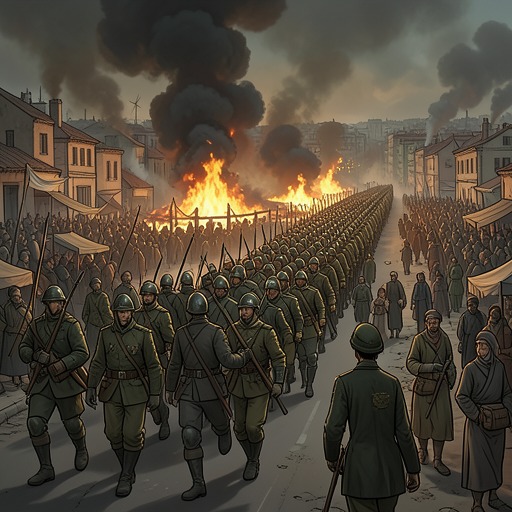
Hamburg
World War ZHamburg is presented as a heavily infested port city during the first phase of the Zombie War, a place where ordinary systems of movement, shelter, command, and rescue have failed simultaneously. Its decisive significance lies in the moral and logistical crisis concentrated there: thousands of civilians are gathered in improvised refuges while the army, short of ammunition and steadily retreating, is ordered to withdraw without warning them. Hamburg is therefore not merely a battlefield. It is a test of whether military discipline can survive when obedience itself becomes a means of condemning civilians.
A Port Under Siege
Hamburg has been overwhelmed by the living dead. They fill the streets and buildings and pour from the Neuer Elbtunnel, pressing through gaps in the barricades “like bloated, bloody worms.” Civilian vehicles have been used to blockade the tunnel, but the improvised barrier cannot seal every opening. The port offers no reliable escape: ships have already departed, the harbor is in chaos, and refugees who traveled from as far away as Saxony are stranded after hoping to flee by sea.
The city’s remaining population is concentrated in desperate pockets. More than a thousand refugees are trapped at the Reynolds Aluminiumwerk, with at least three times that number at the Eurokai terminal. They have no food and no clean water, and they wait for rescue while the dead swarm outside and an unknown number of infected people remain inside. Hamburg’s industrial and maritime infrastructure, normally associated with connection and supply, has become a set of sealed compartments in which the living wait for the next breach.
The Harbor and the Garrison
The harbor is choked with corpses that are still moving. Soldiers use antiriot water cannons to blast the zombies into the water, conserving ammunition while clearing the streets. The tactic works only until pressure in the hydrants fails, revealing how completely the defense depends on fragile urban infrastructure.
The garrison has also suffered a command breakdown. Its commanding officer dies after a freak shooting accident: a soldier fires at a zombie almost on top of him, and the bullet carries diseased brain tissue into the colonel’s shoulder. Before dying, the officer transfers sector command to his subordinate, whose first official duty is to put him down. The episode makes infection terrifyingly transferable and renders even a successful defensive shot potentially fatal to the people firing it.
Command is established in the Renaissance Hotel, whose fields of fire and available space allow it to house the unit and several hundred refugees. Soldiers who are not holding barricades attempt to convert similar buildings into fortified shelters. With roads blocked and trains inoperative, the commander decides that civilians must be concentrated wherever protection and firepower can be maintained. This is an effort to preserve a defensible community, but it also creates fixed populations that cannot easily be moved once the wider front collapses.
The Order to Abandon the Civilians
The crisis becomes irreversible when the garrison receives an order to retreat. Withdrawal has been continuous since the beginning of the Panic, but the new rally point signals a change in military procedure. Instead of using civilian place names over open channels, division transmits coded map-grid coordinates from a map not used since the end of the Cold War. The destination is Schafstedt, north of the Nord-Ostsee Kanal, effectively near Denmark from the soldiers’ perspective.
The most consequential instruction is that the soldiers must leave the civilians in place and must not tell them that the withdrawal is taking place. The officer requests confirmation, then asks again, suspecting a map error or a change in codes. Confirmation comes directly from General Lang, commander of the entire Northern Front: the orders are genuine, and the remaining Hamburg Garrison must proceed north immediately. The horror is not that the order is unclear, but that it is perfectly clear. The officer can accept the existence of the living dead more readily than the requirement to follow commands that will indirectly cause mass murder.
The soldiers obey, though the unit is not portrayed as emotionally untouched. They fight among themselves but carry out their duty. Their retreat exposes the contradiction at the heart of the garrison’s role: the same force that had organized buildings as shelters and promised protection must now become the mechanism of abandonment.
Departure and Immediate Consequences
The civilians respond with rage and disbelief. From the buildings they shout at the departing soldiers, demanding to know where they are going and calling them cowards. The officer promises that the troops will return the next day with more men and tells the refugees to stay where they are, but the promise is not believed. One woman calls him a liar and accuses the soldiers of letting her baby die.
Most civilians do not follow because the streets are too dangerous, but some seize the armored personnel carriers and try to force their way through the hatches. The soldiers knock them off and close the vehicles. As the column moves away, people trapped in buildings throw lamps and furniture onto it; one soldier is struck by a bucket of human waste, and a bullet clangs against the hatch of the commander’s Marder. The retreat thus becomes a physical confrontation between armed evacuation and desperate civilian resistance.
Outside the city, the withdrawing troops pass the last Rapid Reaction Stabilization Units. Those units have already been badly mauled and, though the officer does not yet know it, have been classified as expendable. Their assignment is to cover the retreat and prevent too many zombies or refugees from following the main force. They are ordered to hold until the end, making Hamburg the point where a defensive operation gives way to deliberate sacrifice and the abandonment of both civilians and rear-guard soldiers.
Hamburg in the Larger War
Hamburg exemplifies the resource crisis that shapes the wider conflict. The living dead control most of the world’s landmass, while American war production is restricted to materials harvested within the western states; refugee-packed merchant ships, fuel shortages, and dry-docked naval vessels further constrain the surviving powers. Against that background, the Hamburg garrison cannot be understood as a self-contained force with unlimited ammunition, transport, or reinforcements. Its choices are governed by the same scarcity that later produces the resource-to-kill ratio and the preference for reliable, mass-producible weapons such as the Standard Infantry Rifle and Cherry PIE ammunition.
The location also clarifies why the Continental Airlift and the division of territory into Red and Blue Zones become necessary elsewhere. A city whose roads, railways, port, and water pressure have failed cannot be sustained by conventional movement alone. The later emphasis on self-sustaining drops, tools, spare parts, and specialist personnel responds to precisely this kind of breakdown, in which consumables may keep people alive briefly but cannot restore a functioning social base.
Hamburg’s lasting narrative force comes from the collision between operational logic and human accountability. The garrison’s retreat may be framed as part of a larger military withdrawal, yet the civilians experience it as betrayal, and the expendable rear guard makes the cost of that decision visible. The city stands as a concentrated image of the Zombie War’s central dilemma: survival may require organized sacrifice, but no map coordinate or command structure can make the abandoned people disappear.