Israel’s Voluntary Quarantine
World War ZIsrael’s Voluntary Quarantine marks the moment when Israel answered the spreading outbreak by suspending ordinary mobility and redefining refuge as a controlled medical privilege. The policy separated those admitted from those excluded, subjected arrivals to invasive examinations, and made the state’s claim to protect life inseparable from its power to classify, detain, and remove people. Its significance lies not only in Israel’s survival strategy but in the political blindness it exposed elsewhere: the warning was visible, concrete, and repeatedly discounted until the emergency could no longer be treated as someone else’s problem.
Declaration and Misrecognition
Israel announced the policy before much of the outside world accepted the nature of the disease. The declaration described African rabies as a new plague capable of transforming dead bodies into bloodthirsty cannibals and presented “voluntary quarantine” as the national response. The policy also offered asylum without questions to foreign-born Jews, foreigners with Israeli-born parents, Palestinians living in the formerly occupied territories, and Palestinians whose families had once lived within Israel’s borders. It therefore combined a public-health warning with an expansive, politically charged invitation to people who might otherwise have had no secure route into the country.
Outside Israel, the announcement was filtered through existing hatred and geopolitical suspicion. A seventeen-year-old in Kuwait City heard the Israeli ambassador’s statement amid jeers and catcalls at a crowded Starbucks and assumed it was a Zionist deception. He interpreted the evacuation of Israeli forces and the asylum offer as preparation for a final military blow: foreign Jews were, in his view, being recruited as cannon fodder while Palestinians were being taken as human shields. The policy’s most important message was consequently obscured by the political story that listeners already preferred to believe. The later report assembled by Jurgen Warmbrunn and Paul Knight would argue that experts across virology, intelligence, military analysis, journalism, and international observation had reached similar conclusions independently; the failure was not the absence of knowledge, but the refusal to make its implications real.
Border as Medical Filter
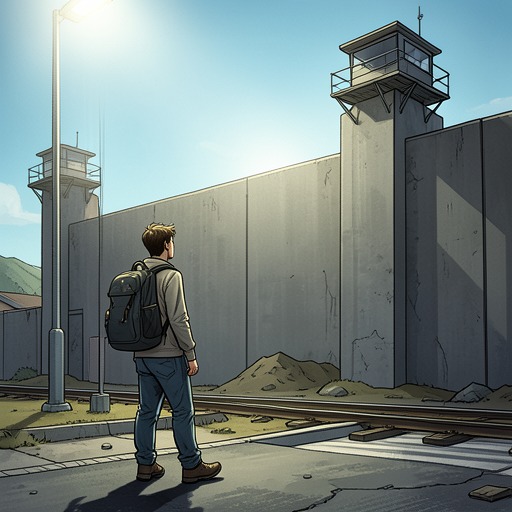
The policy became materially visible at the crossing between Egypt and Israel. A family traveling from Kuwait had to fly to Cairo, cross the Sinai Desert by bus, and approach a border wall that was still unfinished, with naked steel beams rising above a concrete foundation. To the traveler, the wall initially confirmed a military theory: Israel appeared to be expecting attack along its entire border. The actual function of the crossing was more unsettling. The border operated as a medical filter in which bodies, rather than documents or political declarations, determined admission.
Arrivals were taken from the bus and ordered to walk one at a time past large dogs held in cages. A border guard examined each person while the animals reacted to suspected infection. When the dogs attacked the confines of their cages near an old man with a torn, bloodstained garment, civilian-clothed men removed him in an unmarked van. The family behind him cried out, while the observer concluded that Israel was eliminating those too sick or old to be useful. A well-dressed American man was similarly seized after the dogs reacted to him; his struggle exposed a bloodstained bandage beneath his torn shirt. The scene made quarantine concrete as a ritual of sorting, with the apparently healthy allowed onward and suspected bodies transferred out of public view.
The same method later became widely copied. Darnell Hackworth explains that the first major use of military and police dogs was triage: people were sent past caged animals so that infection could be detected before the person entered a larger population. The cages protected handlers, travelers, and the animals themselves, since dogs could attack people, one another, or their handlers when overwhelmed by instinctive terror. Many handlers lost hands, arms, or throats, but that involuntary response was precisely what Israel relied upon, and it probably saved millions of lives. The border therefore served as both a national gateway and a prototype for an international system of biological screening.
Yeroham and the Managed Refugee
Those admitted were not simply welcomed into ordinary civic life. They were sent to the Yeroham resettlement camp, where quarantine and resettlement appeared to the newcomers as imprisonment: tents, overcrowding, guards, barbed wire, and the baking Negev Desert. The policy’s promise of asylum thus began with confinement. It suspended the normal relation between arrival and citizenship, making people’s bodies temporarily legible as potential threats before their families, histories, or legal papers could matter.
The examinations were exhaustive and repeated daily. Medical personnel collected and inspected blood, skin, hair, saliva, urine, and feces. The process was exhausting and mortifying, yet Palestinian doctors and nurses made it more bearable for Muslim detainees and probably prevented a riot. A doctor from Jabaliya in Gaza, himself a recent detainee, told the family that they had made the right decision and that everything Israel had said was true, even though the young narrator still resisted believing him. The presence of Palestinian medical workers complicated the policy’s political meaning: the quarantine was imposed by Israel, but its practical authority was enacted through people who shared the detainees’ background and could testify to the danger from within their own experience.
The family remained at Yeroham for three weeks while its papers were processed and its medical examinations cleared. Passports received little attention; unless the Israel Defense Forces or police wanted someone for earlier activities, a clean bill of health mattered more than documentary preparation. Afterward, the Ministry of Social Affairs supplied vouchers for subsidized housing, free schooling, and a job for the father at a salary sufficient to support the family. The policy thus moved from detention to incorporation, but only after health had been established as the decisive condition of entry.
Exception, Selection, and Reproduction
The quarantine’s logic extends beyond the border into a broader system of emergency governance. The same crisis produced plans that consolidated armed forces into defensible safe zones, evacuated only a small fraction of civilians, and left others in isolated areas as living bait to hold the undead away from retreating armies. It also produced labor classifications in which postwar governments treated skill as a strategic resource: in the United States, more than 65 percent of the civilian workforce was classified F-6 and required retraining for work such as carpentry, masonry, machining, and gunsmithing. The emergency did not merely restrict movement; it ranked lives according to health, usefulness, and capacity to sustain the state.
Other policies made the same principle visible through different bodies. Neighborhood Security Teams were conceived as part-time volunteer patrols, yet recruitment initially questioned whether Joe Muhammad, a disabled bicycle-shop owner and wheelchair user, could participate. His response exposed the program’s practical premise: patrols concerned the defense of one’s own neighborhood, and members were not expected to chase attackers over fences because the threat would come to them. Disability became an administrative obstacle only when officials forgot the specific conditions of the task.
At the opposite end of the life cycle, postwar Russia treated fertile women as strategic instruments. A woman in a reproductive clinic explains that few young women survived without drugs, AIDS, or exposure to the undead, and that the leader called a Russian woman’s uterus her greatest weapon. Her possible ignorance of her children’s fathers, and even uncertainty about the children themselves, was subordinated to service to the motherland. Across these settings, emergency rule turns private bodies into public resources: the infected are isolated, the healthy are admitted, the skilled are retrained, the disabled are assessed for usefulness, and the fertile are assigned reproductive value.
Political Consequences and Historical Meaning
The policy’s effectiveness was obscured by the political cost of acknowledging it. In the United States, officials defended Phalanx as a calming placebo because admitting that the disease reanimated the dead might have produced protests, riots, economic damage, legislative panic, and electoral collapse. They understood that the public would not accept a promise of continued peace and prosperity if told that the worst crisis lay ahead. The result was a governing culture that preferred reassurance to preparation, even when the underlying evidence was strong.
Israel’s Voluntary Quarantine therefore stands in sharp contrast to that denial. It made fear operational: a wall, a line of travelers, cages, dogs, examinations, detention, and eventual clearance. Yet the same procedure that saved lives also created a stark hierarchy between those recognized as protectable and those reduced to suspicious or disposable bodies. The policy’s asylum provision offered a genuine route to safety, while its quarantine apparatus imposed surveillance and humiliation as the price of passage. That tension is central to the event’s meaning. Israel’s warning was not simply correct; it was embodied in institutions that forced every arrival to confront the price of being believed.
In retrospect, the declaration becomes one of the outbreak’s decisive missed lessons. The Warmbrunn-Knight report was less than one hundred pages, concise and comprehensive, and carried fifteen other names besides Jurgen Warmbrunn and Paul Knight. Its authors believed that implementing its recommendations could have prevented the outbreak from reaching epidemic proportions. The later world instead learned the logic of quarantine piecemeal, after borders had become battle lines and emergency measures had spread from medical screening into detention, labor control, punishment, and population management.