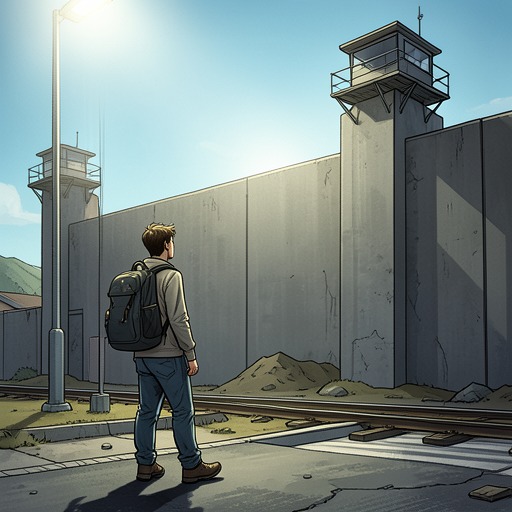
Israeli barrier and Taba border post
World War ZThe Israeli security fence and Taba crossing are both a physical frontier and a diagnostic threshold in the wartime movement of refugees into Israel. Reached from Kuwait by way of Cairo and a bus across the Sinai after Arab League travel restrictions eliminated direct flights, the crossing transforms an anxious journey into an ordeal of inspection. Its decisive significance lies in the fact that entry depends less on passports or declared identity than on whether the body can pass the state’s test of health.
A Militarized Border in the Sinai
The narrator first sees the Wall while approaching the border: unfinished steel beams rise above a concrete foundation in the barren desert. The structure contradicts his earlier belief that Israel’s notorious security fence surrounded only the West Bank and Gaza Strip. Its presence along the wider frontier makes him infer that Israel expects attack from every direction, and he initially interprets the barrier through the familiar language of regional military suspicion rather than public health.
The route to the crossing is itself shaped by political closure. The refugees cannot fly directly from Kuwait to Israel, and after the Arab League imposes travel restrictions, they must fly to Cairo, cross the Sinai by bus, and continue to Taba. The border therefore appears not as a simple national gate but as the final segment of a forced migration route in which airspace, diplomacy, desert transport, and quarantine policy converge.
Dogs, Cages, and Selective Removal
At Taba, the passengers are taken from the bus and ordered to walk single file past cages holding unusually large, fierce-looking dogs. A guard examines each person one at a time, extending a hand and giving hurried commands in barely recognizable Arabic. The procedure creates a public gauntlet: every traveler is exposed to the animals’ reactions, and the border’s hidden criterion becomes visible through barking, snarling, or the absence of either.
An elderly man with a long white beard and a cane provokes an immediate frenzy from the dogs. Two civilians escort him away after the narrator notices that his dishdasha is torn and stained with brown blood. His family wails as he is taken to a black, unmarked van, which the narrator recognizes as something other than an ambulance. The scene initially appears to him as cruel ageism, as though Israel were removing people judged too sick or too old to be useful.
The next suspected traveler is an American or Canadian man in a suit and tie. He protests that he is fine and struggles with the civilians, while matching luggage is thrown aside. When his shirt tears open, a bloodstained bandage is revealed around his stomach. His nationality and social appearance do not protect him; the dogs’ response places him in the same category as the injured elderly man, and he too is dragged into the nondescript van.
The border’s logic remains opaque to the narrator because severely injured refugees are sometimes allowed through and directed toward genuine ambulances. This contrast leads him to conclude that the dogs are not screening for ordinary wounds or Arab identity. He suspects rabies, an explanation that remains his working theory during the subsequent internment. The crossing thus produces knowledge indirectly: the state’s policy is not explained to the refugees, but its categories can be inferred from who is taken and who is released.
From Crossing to Quarantine
After passing the dogs, the narrator and his family are sent to a resettlement and quarantine camp outside Yeroham. He experiences it as imprisonment, defined by tents, overcrowding, guards, barbed wire, and the oppressive heat of the Negev Desert. The physical border therefore extends inward. The fence and checkpoint are only the first visible layer of a broader system that continues through confinement and surveillance.
The camp subjects detainees to daily examinations by large numbers of medical personnel. Blood, skin, hair, saliva, urine, and feces are inspected, a process the narrator finds exhausting and mortifying. Its harshness is partly moderated by the fact that many of the doctors and nurses are Palestinian, including the Gaza-born man who examines the male members of the family and had himself been detained only months earlier. He repeatedly assures them that coming to Israel was the right decision and that the Israeli warnings are true, though the narrator remains reluctant to accept the explanation.
The family stays at Yeroham for three weeks while their papers are processed and their medical examinations are cleared. Their passports receive little attention compared with their health status. Unless the Israeli Defense Forces or police have a prior reason to detain someone for earlier illicit activity, a clean bill of health is what matters. The crossing consequently reveals a reversal of ordinary border priorities: documentation establishes identity, but bodily condition determines admission.
Entry, Provision, and the New Social Order
Once cleared, the family receives assistance from the Ministry of Social Affairs: vouchers for subsidized housing, free schooling, and employment for the father at a salary sufficient to support the household. The provisions make the transition from suspected bodies to accepted residents unexpectedly swift. The narrator boards the bus for Tel Aviv convinced that the arrangement is too generous to be real and that punishment must still be approaching.
The crossing therefore contains a sharp institutional contrast. At its entrance, civilians remove people without explanation on the basis of a dog’s reaction; beyond it, the same national system supplies housing, education, and work to those who pass medical scrutiny. Protection and exclusion are not opposites here. They operate together, with quarantine serving as the mechanism that makes selective welcome possible.
Narrative Significance
The Israeli security fence and Taba crossing condense the book’s recurring concern with the boundary between the living and the infected. They turn invisible contagion into a visible ritual involving cages, animals, bodily samples, vans, wire, and waiting. Families arrive carrying passports and expectations of refuge, but the decisive document is written on the body and interpreted by trained dogs before officials explain anything.
The location also complicates the meaning of rescue. Refugees are not simply admitted or rejected; they are sorted, removed, confined, examined, cleared, and then incorporated into a state-managed resettlement system. The old man’s disappearance and the injured American’s struggle expose the violence concealed within protective screening, while the family’s eventual access to housing and schooling shows the material promise offered to those classified as safe. Taba is thus both a gateway to survival and the first stage of a political order built on inspection, quarantine, and controlled belonging.