Jesika Hendricks
World War ZJesika Hendricks is a naturalized Canadian from Waukesha, Wisconsin, and a member of the Wilderness Restoration Project at Sand Lakes Provincial Wilderness Park in Manitoba. Her decisive significance lies in the double perspective she brings to the aftermath of the Zombie War: she is both a survivor of the desperate civilian exodus north and one of the volunteers who must later clear its frozen remains. Through her, survival is shown not as a clean escape but as a prolonged passage through hunger, misinformation, moral compromise, and a landscape where the dead remain physically present.
Identity and Setting
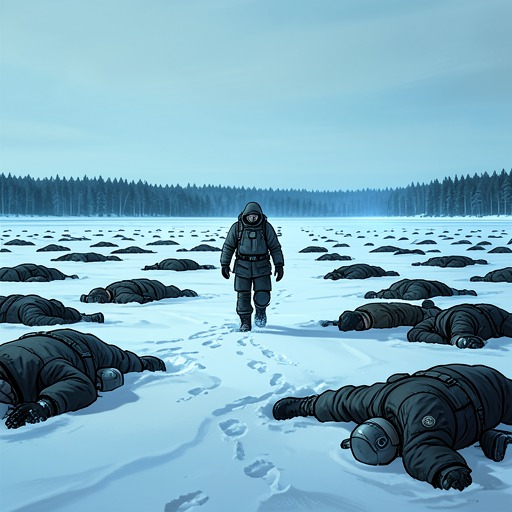
Jesika works each summer with several hundred other volunteers in the Wilderness Restoration Project, returning to a subarctic wasteland littered with abandoned vehicles, debris, and human corpses partially frozen into gray snow and ice. The project claims substantial progress, yet the wreckage offers no convincing end point. The setting is therefore more than a backdrop: it is the material record of a population diverted toward an alleged refuge without being given the information needed to reach or endure it.
Her testimony is framed by the contrast between her present labor and her childhood in Waukesha. She remembers the north not as a sanctuary already prepared for refugees, but as a route that civilians entered with little practical guidance. The restoration work makes her a witness twice over—first to the flight, and later to what that flight left behind.
The Decision to Go North
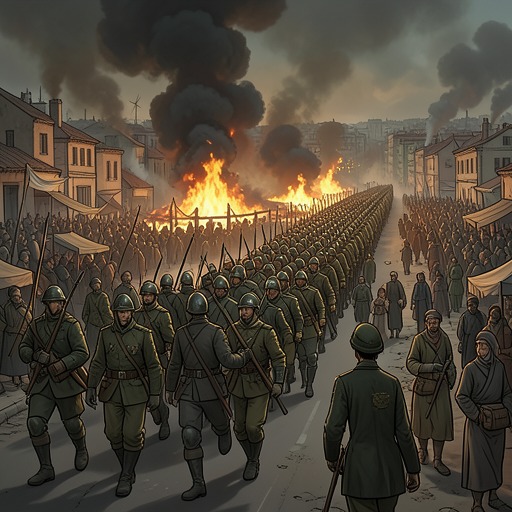
Jesika recalls that her family left in August, two weeks after the Battle of Yonkers and three days after the government began withdrawing west. Their neighborhood had seen only one nearby outbreak, six of the living dead feeding on a homeless man three blocks from the family home, and police officers had killed them quickly. That limited encounter nevertheless persuaded her father to leave. He had already been learning to load a new rifle while her mother nailed boards across the windows.
The family’s decision was shaped by a single public instruction repeated across television coverage: “Go north.” The media offered live and recorded images from Yonkers, contradictory experts, and sensational fragments rather than usable directions. It did not tell civilians where to go, what to bring, or how to survive on the road. Jesika remembers the slogan crawling across the screen until it became less an evacuation plan than a command detached from any workable route.
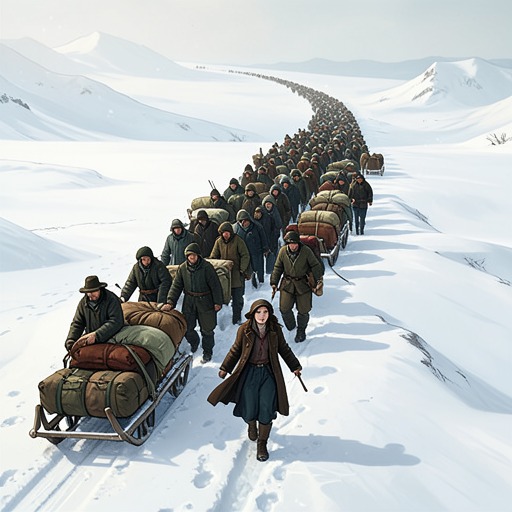
Her father had prepared more carefully than many travelers. He had stocked spare gas cans on the roof of the minivan and believed that only a journey far beyond population centers could preserve the family. Along the roads, however, they encountered stalled vehicles, closed gas stations, and exhausted groups carrying possessions that had become useless. Her father judged those who had stopped in parks or designated campgrounds as shortsighted, while her mother recognized that many had simply run out of fuel. Their disagreement reveals the unequal meaning of preparedness: a family with reserves could interpret another family’s collapse as bad judgment.
Hunger, Suspicion, and Family Collapse
The family briefly picked up Patty, a woman from Winnipeg who was walking alone through the rain while pulling a wheeled airline bag. Jesika’s mother persuaded her father to stop, and Patty offered them all the money she had in gratitude. The encounter changed when Patty sneezed and exposed a cloth-wrapped left hand marked by what looked like blood. Her parents became silent and avoided looking at Jesika. Later, they left Patty behind without explaining what had happened, telling Jesika only that the woman had asked to be dropped off. Through the rear window, Jesika thought she saw Patty running after the van, though exhaustion and confusion made her doubt her own perception.
That uncertainty becomes part of Jesika’s account of the journey. She admits that she shut a great deal out while driving north, and the omission is not presented as simple forgetfulness. It is the mental strategy of a child trying not to understand what adults have decided must be done. The family’s physical movement toward cold safety is accompanied by a retreat from speech, explanation, and moral clarity.
By November, Jesika had changed from a heavy child who lived on fast food and snacks into something close to a skeleton. Her parents were emaciated as well: her father’s stomach had disappeared, and her mother’s cheekbones had become narrow. Hunger transformed the family’s emotional structure. Parents who had once been progressive schoolteachers and had rarely raised their voices began fighting about everything. Jesika found their quarrels more frightening than the zombies because they revealed a different kind of collapse, one occurring inside the supposedly safe enclosure of family life.
Around Thanksgiving, Jesika was too weak to leave her sleeping bag. She had a swollen belly and sores around her mouth and nose while the smell of cooked meat drifted from a neighboring recreational vehicle. Her mother argued that “it” was necessary and insisted that it was not so bad because the neighbors, rather than the family, had actually done it. Her father refused to accept that solution and accused her of wanting the family to descend to that level. The argument turned vicious as her mother blamed him for bringing them north and for allowing Jesika to die. After a crack sounded outside, her mother returned holding snow over her eye, and her father came back with an expression Jesika had never seen before. The scene marks the point at which starvation threatens not merely the body but the moral identity the family had believed it possessed.
Betrayal and Institutional Failure
Jesika does not simply condemn the authorities for diverting civilians north. She understands the strategic problem: the government could not lead everyone west behind the Rocky Mountains, feed and screen all refugees, and simultaneously prevent the armies of the living dead from following them. Sending people north offered at least the possibility that winter would freeze the undead and allow some civilians to survive. She can forgive the decision to redirect refugees under impossible conditions.
What she cannot forgive is the irresponsible way the policy was communicated. The public received the destination but not the means: no reliable route, supplies, equipment list, or survival instruction. Jesika’s accusation is therefore directed at an information failure that multiplied the disaster. The frozen bodies in Sand Lakes Provincial Wilderness Park are the delayed consequence of that failure, preserved evidence that a policy can appear strategically rational while remaining lethal to the people forced to carry it out.
Her family’s experience also exposes the social distribution of risk. Those with fuel, a functioning vehicle, and a household capable of making hard decisions had a better chance than people walking with luggage after their resources ran out. Yet even preparation could not protect Jesika from hunger, exposure, and the psychological damage of witnessing adults conceal their choices. The north was presented as a universal refuge, but the ability to reach it and remain human there was sharply unequal.
Restoration and the Frozen Dead
At Sand Lakes, Jesika’s work confronts the physical residue of the exodus: wrecked vehicles, scattered debris, innumerable bones lying in a pit and only partly covered by ice, and living dead still trapped in frozen ground. The cold immobilizes bodies without necessarily ending their capacity to move. During one restoration operation, a zombie frozen from the waist down remains alive above the ice, thrashing, moaning, and clawing toward the team. When it lunges, its lower torso begins to snap; Jesika responds without ceremony, raising a long iron crowbar and smashing its skull.
The action is characteristic of her postwar role. She does not treat the frozen creature as a spectacle or indulge in a prolonged confrontation. She understands the landscape’s danger and performs the necessary work with practiced directness. The crowbar is both a restoration tool and a weapon, joining physical cleanup to the unfinished eradication of the threat.
Jesika’s testimony consequently refuses the comforting idea that the end of official hostilities ended the war’s consequences. Every summer, volunteers return to a place where infrastructure, corpses, and the living dead remain entangled. Restoration is measured in cleared ground and recovered safety, but the project’s lack of a visible endpoint suggests that the work is also an obligation to the people whom official narratives reduced to statistics.
Narrative Role and Significance
Jesika’s story gives the Zombie War a distinctly civilian and environmental aftermath. Her memories move from the television command to the crowded road, from the family minivan to the bones beneath the ice, and finally from helpless flight to deliberate reclamation. The sequence makes recovery neither triumphant nor abstract: it is a repetitive labor performed in the same kind of cold landscape that once promised protection.
Her account also connects human disaster to the wider rearrangement of the nonhuman world. The frozen terrain is not empty; it contains bodies that remain active, while the refugees’ route is shaped by temperature, fuel, terrain, and the biological behavior of the living dead. Jesika’s work therefore shows survival as an ecological and infrastructural problem as much as a military one. The decisive question is not only whether people can defeat the undead, but whether they can repair the places and institutions that failed them when they were told simply to go north.