Joe Muhammad
World War ZJoe Muhammad embodies the intimate, improvised face of survival after the Zombie War. A disabled man who owns Wenatchee’s bicycle-repair shop, he serves in the Neighborhood Security Teams while making art by sculpting molten metal. His story joins bodily experience, civic duty, and memory: the same man who insists on receiving an orange vest despite a skeptical recruiter later becomes a witness to the darkness, danger, and unexpected fellowship of a reorganized society.
Identity and Background
Joe’s ordinary occupation is practical and local: he runs a bicycle-repair shop in Wenatchee, Washington. His other vocation is artistic. In his spare time he shapes molten metal into elaborate works, and he becomes especially famous for the bronze Neighborhood Security Memorial on the mall in Washington, D.C., depicting two standing citizens beside a seated person in a wheelchair. The memorial gives public form to the kind of service Joe describes privately, linking neighborhood defense to the recognition of disabled citizens as participants rather than passive recipients of protection.
Joe’s disability is immediately visible, and it shapes the social friction surrounding his enlistment in the Neighborhood Security Teams. The recruiter repeatedly tries to dissuade him, asking whether he has consulted the NRA representative and whether he understands that other forms of essential war work are available. Joe initially cannot understand the objection because he already works at a recycling plant and understands the NST as a part-time volunteer service performed when he is home from his regular job. Only when he sees the recruiter glance toward his chair does he realize that his body, rather than his willingness or availability, is being treated as a disqualifying fact.
Recruitment and Neighborhood Service
Joe refuses the recruiter’s protective hesitation. He has read the security manual and argues that the program’s purpose is to patrol one’s own neighborhood, checking houses on foot or, in his case, by rolling along the sidewalk. If a team had to enter a building, at least two members remained outside in the street. The assignment did not require chasing the living dead over fences or across backyards; the danger came toward the patrol. Joe challenges the recruiter to name a scenario in which his physical condition would actually prevent him from performing the work, and when she retreats into procedural excuses, he refuses to leave until she obtains approval and gives him his orange vest.
The Neighborhood Security Teams are quasi-military but deliberately less formal than a conventional army. Members attend lectures and training courses, operate under designated leaders and fixed regulations, and do not have to salute or address superiors as “sir.” Their equipment is similarly improvised. Before the Lobotomizer became available, most weapons were hatchets, bats, crowbars, and machetes, while at least three people on each team carried firearms. Joe uses an AMT Lightning, a small semiautomatic .22-caliber carbine whose lack of recoil lets him fire without locking down his wheelchair. Standardized ammunition and still-available reloads make the weapon especially useful in the strained material conditions of the period.
Patrol work exposes Joe to a community being rebuilt under pressure. Team assignments shift with members’ schedules while the Department of Strategic Resources continually reorganizes the system. Night patrols are particularly difficult because streetlights and most household lights have disappeared; the teams move with ordinary store-bought flashlights fitted with red cellophane to preserve night vision. They stop at each house, knock, and ask the person on watch whether everything is secure. The resettlement program means that a neighborhood can acquire a dozen new neighbors or housemates in a single day as people emerge from camps, making security patrols also a form of social contact and orientation.
Combat Experience and Physical Agency
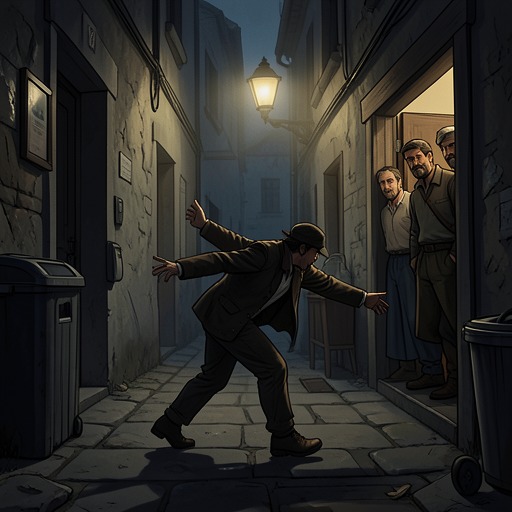
Abandoned houses are marked with police tape across doors and windows. A broken seal may indicate that a zombie has entered, and Joe describes the sounds that follow: shouts, gunfire, moans, scuffling, and the return of a teammate carrying a bloody hand weapon and a severed head. He kills several of the living dead himself. While others search a building, he remains in the street with his rifle ready, responding to movement in bushes or to the rasp and drag of something approaching through the dark.
His most revealing encounter occurs while clearing a damaged two-story house, a four-bedroom, four-bath residence partly collapsed after someone drove a Jeep Liberty through the living-room window. Distracted by the operation inside, Joe permits his partner to take a brief break behind the bushes and fails to notice what is behind him. A legless “dragger” seizes the right wheel of his chair and tries to climb over it. The chair buys him the roughly two and a half seconds needed to swing his flashlight and bring the carbine into position. He kills the attacker, recognizing that the same chair the recruiter had viewed as an impediment has physically delayed the zombie and preserved his life. Afterward, he treats the lapse in attention as a professional failure and does not again relax his vigilance.
Joe’s account also distinguishes the undead from the human disorder surrounding them. Looters and squatters are often not hardened criminals but desperate people searching for necessities. His teams generally invite such people home, provide what they need, and care for them until housing officials can intervene. Professional criminals are different, and Joe identifies them as the only human threat that seriously injures him. The distinction shows a security system operating within a moral economy: survival requires defense, but it also requires recognizing deprivation and incorporating displaced people into the community whenever possible.
Art, Memory, and Community
Joe’s metalwork gives his testimony a second register. During the postwar period he completes a thirteen-inch statuette of a man caught in mid-shuffle, wearing a torn Baby Bjorn and staring forward with lifeless eyes. The piece is grotesque and satirical, preserving the visual absurdity of the catastrophe rather than turning it into a clean heroic legend. Alongside the formal Neighborhood Security Memorial, it demonstrates how Joe transforms the material residues and social contradictions of the war into objects that can be seen, handled, and remembered.
His reflections on the aftermath are cautiously hopeful. He rejects the idea that the war was good, yet acknowledges that it brought people together. His parents, who had emigrated from Pakistan, had missed the sense of community associated with their earlier life but had barely known their American neighbors before the crisis. Afterward, the shared experience extends beyond a single block or nation. On a cruise across the islands, Joe meets people from many places and finds that although the details differ, the stories are broadly the same. The catastrophe produces a common memory powerful enough to connect strangers who previously lived beside one another without real contact.
Joe does not assume that solidarity will last forever. Once children and grandchildren grow up in a peaceful, comfortable world, he expects people may become selfish and narrow-minded again. Yet he believes that what everyone endured cannot simply disappear. His chosen proverb, “One cannot cross a river without getting wet,” expresses that conviction: survival leaves a mark even when later generations no longer remember the water’s danger.
Narrative Role and Significance
Joe’s character challenges the assumption that wartime usefulness belongs only to the conventionally strong. His service is not presented as an inspirational exception detached from practical reality. The narrative specifies his weapon, the limits of its recoil, the patrol rules, the darkness, the abandoned houses, and the moment when the wheelchair’s structure creates the decisive interval between vulnerability and survival. Disability is therefore treated through the social model as well as the bodily one: Joe’s physical condition exists, but the principal barrier is the recruiter’s failure to imagine a security task designed around actual circumstances.
His testimony also supplies a ground-level counterpoint to the strategic language of production, logistics, and the resource-to-kill ratio. The wider war depends on industrial capacity, standardized weapons, ammunition, and continent-wide resupply, but those systems acquire meaning in Joe’s neighborhood through flashlights, orange vests, police tape, house checks, and a .22-caliber carbine. His experience shows how national survival is enacted through small teams making repeated judgments about danger, need, and responsibility.
Finally, Joe’s art and optimism prevent the postwar account from ending with military victory alone. He remembers severed heads and the scrape of a dragger against his chair, but he also remembers neighbors who had once ignored one another learning to share a street, a home, and a future. The seated citizen in his memorial is not outside the civic body; that figure is part of the composition. Joe’s decisive significance lies in making that inclusion both a fact of survival and an image of what survival might mean.