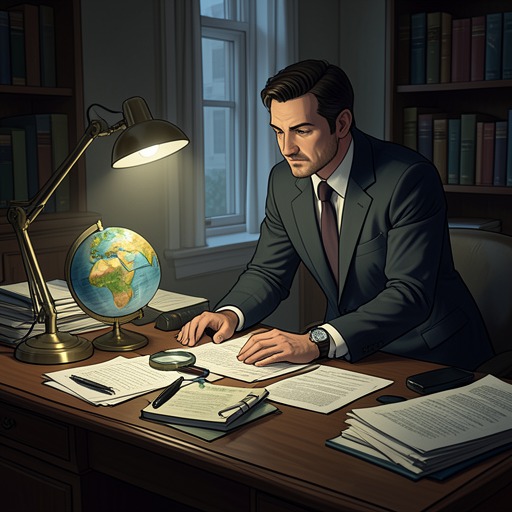
Jurgen Warmbrunn
World War ZJurgen Warmbrunn is an Israeli intelligence veteran, possibly still connected to an Israeli intelligence service, whose defining contribution to the plague crisis is the refusal to accept a convenient explanation. Meeting in Tel Aviv at a Falasha restaurant, he presents himself as a former spy rather than as a scientist or physician. His investigation begins with fragments that others dismiss: corrupted Chinese communications, rumors from South Africa, scattered cases labeled as rabies, and reports buried in international bureaucracy. By testing those fragments against one another, he identifies the outbreak as a worldwide, murderous phenomenon and helps produce the Warmbrunn-Knight Report, an early attempt to prevent the crisis from becoming an epidemic.
Identity and Professional Background
Jurgen Warmbrunn is described as having bright pink skin, unruly white eyebrows, and Einstein-like hair, an appearance that might suggest a crazed scientist or college professor. The description is deliberately misleading: he is neither. His actual background is in intelligence, although he never specifies which Israeli service employed him and openly allows that he could once have been called a spy. His professional identity is therefore built less around institutional disclosure than around habits of suspicion, cross-checking, and strategic interpretation.
Warmbrunn explains that his vigilance is connected to being born into a people living under the persistent fear of extinction. He does not portray that inheritance as personal superiority. Instead, he treats it as a historical education in the consequences of overlooking warning signs. The experience of Israel’s security culture gives him a particular relationship to unlikely possibilities: absurdity is not a reason to stop investigating when the cost of being wrong could be annihilation.
First Clues to the Plague
Warmbrunn’s first warning comes through professional contacts in Taiwan, who report that a new software decryption program is failing to render some e-mails from mainland Chinese sources. The characters decode correctly, but the text itself concerns a viral outbreak that kills victims and then reanimates their corpses as homicidal berserkers. Warmbrunn initially rejects the literal meaning. Because the Taiwan Strait crisis begins soon afterward and the messages about rampaging corpses abruptly cease, he assumes that the reports refer to a weapon system or a secret war plan, perhaps concealed beneath a second layer of encryption.
The clue remains with him even after he tries to dismiss it. At a wedding reception for his daughter, a professor from Hebrew University recounts stories heard from a cousin connected to work in South Africa. The professor speaks of golems, but these alleged beings are not clay figures and are not docile; the account concerns the reanimation of human bodies. Warmbrunn follows the lead to a man who had been in Cape Town on an “Adrenaline Tour.” After a shark bites the tourist in the buttocks, he recovers at Groote Schuur, where the first victims from Khayelitsha township are brought in. The tourist has not seen the cases himself, but hospital staff have told him enough stories for Warmbrunn to record and investigate.
Warmbrunn submits those South African stories together with the decrypted Chinese e-mails to his superiors. His discovery is not a single dramatic revelation but a pattern assembled from imperfect testimony. The grotesque detour through a shark attack, the wedding conversation, and the corrupted messages all become parts of the same evidentiary chain. His method depends on treating rumor as a lead without mistaking rumor for proof.
The Discipline of Disagreement
Warmbrunn grounds his investigation in Israel’s failure during the 1973 Arab sneak attack. Israeli intelligence had possessed warning signs, yet analysts failed to imagine a coordinated conventional assault arriving on a holy day. For Warmbrunn, the lesson is not merely that intelligence can be incomplete; it is that institutions can stare directly at information while refusing to perceive its implications. The required correction is a national policy of institutional disagreement: if nine analysts reach the same conclusion, the tenth has a duty to challenge it.
That principle determines how Warmbrunn handles the possibility of reanimated dead. He does not accept the stories because they are sensational. He investigates precisely because they are unlikely and because a small possibility of ravenous killing machines demands deeper examination. With China’s intelligence channels cut off by the Taiwan crisis, he works through a sparse and unreliable field of sources. Internet material offers fantasies about zombies from space and Area 51, while more useful evidence emerges from reports of rabies-like cases, psychological evaluations of Canadian mountain troops returning from Kyrgyzstan, and a Brazilian nurse’s blog describing the murder of a heart surgeon.
The World Health Organization becomes his most valuable source. Warmbrunn finds incidents across the world, each buried under a plausible local explanation. By comparing those cases, he constructs a coherent mosaic: the subjects are dead, hostile, and spreading. The investigation also produces a practical discovery—there is a way to terminate their existence. This conclusion changes his work from warning interpretation into a search for operational survival knowledge.
The Warmbrunn-Knight Report
Paul Knight has been Warmbrunn’s friend since Entebbe and is a former government official who later works for a private consulting firm in Bethesda, Maryland. When Warmbrunn visits him, he learns that Knight has independently been pursuing the same investigation. Knight’s file is nearly as substantial as Warmbrunn’s, and the two men spend the entire night reading each other’s findings in silence. Their parallel research confirms that the threat is not the product of one observer’s obsession; separate experts have reached similar conclusions before being brought together.
The report is consequently collaborative rather than the work of only two men. Warmbrunn objects to the familiar name “Warmbrunn-Knight,” noting that fifteen other people contributed, including virologists, intelligence operatives, military analysts, journalists, and a United Nations observer who was monitoring elections in Jakarta when the first outbreak reached Indonesia. Their document is just under one hundred pages, concise but comprehensive, and designed to ensure that the outbreak never reaches epidemic proportions.
Warmbrunn also distinguishes the report from the later South African war plan. He acknowledges the value of that plan, yet argues that widespread attention to the report and implementation of its recommendations might have made the later plan unnecessary. The report therefore represents both an achievement and an indictment: the knowledge existed, but knowledge alone could not guarantee that governments would act upon it.
Narrative Role and Significance
Warmbrunn functions as the story’s investigator of neglected connections. His account moves from technical failure to hearsay, from hearsay to archived reports, and from isolated cases to a global diagnosis. The structure reproduces the experience of recognizing a catastrophe after the fact: each clue seems explainable until the accumulation of clues makes ordinary explanations impossible.
His character is defined by disciplined doubt rather than by effortless prescience. He initially misreads the Chinese reports as coded military information and nearly lets them go, but the Israeli lesson of 1973 teaches him to return to the possibility others would prefer to exclude. That mixture of error and correction makes his intelligence credible. He is not the person who knows the truth immediately; he is the person willing to keep digging after the first explanation appears sufficient.
Through Warmbrunn, the plague is framed as a failure of collective attention as much as a biological disaster. The decisive danger lies in the gap between having information and recognizing what it means. His work closes that gap temporarily by turning dismissed incidents into a shared report, while the later need for a South African war plan shows how costly it becomes when institutions fail to convert warning into preparation.