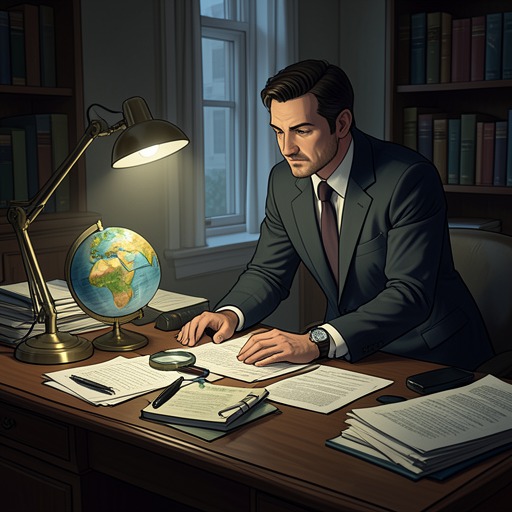
Jurgen Warmbrunn–Paul Knight collaboration
World War ZThe Jurgen Warmbrunn–Paul Knight collaboration is the investigative partnership that first gave the global plague a coherent strategic identity. Jurgen Warmbrunn and Paul Knight independently followed evidence that governments, media organizations, and the public explained away, then compared their findings and produced the Warmbrunn-Knight Report: a concise, comprehensive assessment intended to prevent an outbreak from becoming an epidemic. Its decisive importance lies not only in what the two men discovered, but in the institutional failure that followed. The report identified the threat and a practical way to stop it, yet insufficient attention to its recommendations helped make the later catastrophe possible.
Origins in Intelligence and Doubt
Jurgen Warmbrunn approached the crisis through the habits of Israeli intelligence culture. He described himself as someone shaped by a community living under the constant fear of extinction, and by the lesson that apparent consensus can conceal a fatal blind spot. After the 1973 Arab attack, Israeli intelligence adopted the principle that if nine analysts reached the same conclusion, the tenth had a duty to disagree. Warmbrunn applied that discipline to reports of corpses being reanimated as homicidal attackers, refusing to dismiss them merely because the claim sounded absurd.
His first warning came through Taiwan, where friends and customers reported that a new software-decryption program was producing unintelligible translations of messages from the People’s Republic of China. Warmbrunn suspected that the fault lay not in the software but in the messages themselves. Once he reviewed the material, he found that the characters were being decoded correctly and that the underlying reports described a viral outbreak that killed victims and reanimated their corpses. The simultaneous Taiwan Strait crisis made him doubt the literal reading; he initially assumed the references to dead bodies concealed a weapons system or secret war plan. Even after he set the matter aside, his intuition continued to signal that the messages contained a genuine danger.
Parallel Investigations Become Collaboration
With China inaccessible and intelligence gathering disrupted by the Taiwan crisis, Warmbrunn worked through fragments rather than a normal intelligence stream. Internet material supplied noise, including fantasies about zombies from space and Area 51, but he gradually assembled more useful evidence: cases of what would later be called African rabies, psychological evaluations of Canadian mountain troops returning from Kyrgyzstan, and the blog records of a Brazilian nurse who described the murder of a heart surgeon. The World Health Organization became his richest source. Its reports contained incidents from around the world, each buried beneath a plausible explanation; taken together, they formed a mosaic of dead, hostile, and spreading subjects.
Warmbrunn also discovered the practical vulnerability of the creatures. Their brains did not require the bodily support system on which human life depended, so destroying the brain was necessary to terminate them. The solution was simple only after the problem had been recognized, and recognition required abandoning ordinary assumptions about death and disease.
Paul Knight had been Warmbrunn’s friend since Entebbe. He had devised the idea of using a double of Idi Amin’s black Mercedes and, after retiring from government service before his agency’s reforms, worked for a private consulting firm in Bethesda, Maryland. When Warmbrunn visited him, he was startled to learn that Knight had independently been investigating the same threat in his spare time. Knight’s file was nearly as thick and heavy as Warmbrunn’s. The two men spent the entire night reading one another’s findings, speaking almost not at all, absorbed by the evidence until they finished at nearly the same moment as dawn approached.
The Report and Its Wider Network
After turning the final page, Knight recognized the scale of the danger and asked what they would do about it. That exchange marked the practical beginning of the collaboration, and it led directly to the report bearing their names. Warmbrunn resisted treating the document as the achievement of only two men. Fifteen additional names appeared on it, including virologists, intelligence operatives, military analysts, journalists, and a United Nations observer who had been monitoring elections in Jakarta when the first outbreak reached Indonesia. Each contributor had reached a similar conclusion independently before being contacted.
The report ran to just under one hundred pages. Warmbrunn characterized it as concise and fully comprehensive, designed to ensure that the outbreak never reached epidemic proportions. Its method was fundamentally collaborative: local incidents, medical observations, military testimony, intelligence fragments, and international reporting were not left as isolated anomalies but assembled into a single explanation. The partnership therefore functioned as a bridge between private initiative and collective expertise. Warmbrunn and Knight supplied the organizing frame, while the wider group supplied the disciplinary range needed to make the threat legible.
The report also anticipated the importance of communication systems. Its evidence emerged through defective decryption, internet records, international health reports, and scattered testimony, while later wartime information moved through civilian radio bands, formal broadcasts, and surveillance satellites. These channels could conceal the crisis, distort it, or make coordination possible. The collaboration’s achievement was to treat the failures and fragments of those systems as evidence rather than as reasons to wait for a cleaner official picture.
Reception, Suppression, and Historical Consequences
Warmbrunn insisted that the report deserved more recognition than it received. Later observers credited the South African war plan, and he acknowledged that credit as deserved, but argued that if more people had read the report and implemented its recommendations, the war plan would never have been necessary. The report was not defeated by a lack of information; it was weakened by the reluctance of institutions to accept information that threatened political stability, economic confidence, and familiar categories of reality.
That reluctance appeared in the response to Phalanx. Officials understood that Phalanx did not work, yet used it as a placebo because acknowledging an “uber-plague” that reanimated the dead might have provoked protest, riots, property destruction, congressional paralysis, and electoral disaster. The media also helped bury the danger. Networks owned by major corporations had financial reasons to avoid another panic, and after Phalanx reached the shelves and reported cases declined, the story became manageable and then old news. Alternative outlets could repeat that the dead were walking, but most of the public tuned them out.
The collaboration’s warnings thus existed in an uncomfortable middle ground: specific enough to guide action, but too disruptive to fit the political and cultural order that received them. The later evidence of the war exposed the cost of that failure. Information Reception operators aboard the UNS Ural transmitted findings from government safe zones while hearing civilians plead for help over the same open bands; the operators were not permitted to answer, and none remained alive after the war. Orbital surveillance could show bodies torn apart in extraordinary detail but could not hear the conversations of soldiers trapped in battles such as Chongqing and Yonkers. Even the Chinese space station, Yang Liwei, revealed a scorched-space policy rather than cooperation. Against these fractured information systems, the Warmbrunn-Knight collaboration stands as an early attempt to convert dispersed suffering into actionable knowledge.
Significance of the Partnership
The collaboration embodies a central tension of the plague narrative: the truth can be available before society is willing to recognize it. Warmbrunn’s intelligence training taught him to interrogate consensus, while Knight’s parallel research confirmed that the warning was not one eccentric analyst’s obsession. Their trust rested less on sentiment than on converging evidence, and the night they silently read each other’s files dramatized the moment private suspicion became shared responsibility.
Their partnership also joins epistemological courage to political tragedy. They found that the threat was real, identified its global spread, established that the subjects were dead and hostile, and determined that the brain was the point of termination. They then produced a report broad enough to include experts from medicine, intelligence, military analysis, journalism, and international observation. What failed was not their investigation but the conversion of knowledge into timely policy. The Warmbrunn-Knight Report survives, consequently, as both a model of interdisciplinary warning and an indictment of the denial, self-interest, and institutional delay that made a preventable epidemic into a world war.