Kijōrī
World War ZWhales are among the most consequential nonhuman casualties of World War Z. Their destruction is not incidental background damage but a measure of how thoroughly the war converts the ocean into a human supply system: hungry refugees become boat people, navies become fishing fleets, and factory ships pursue enormous marine animals whose habitat offers little protection from organized technology.
War at Sea and the Collapse of Sanctuary
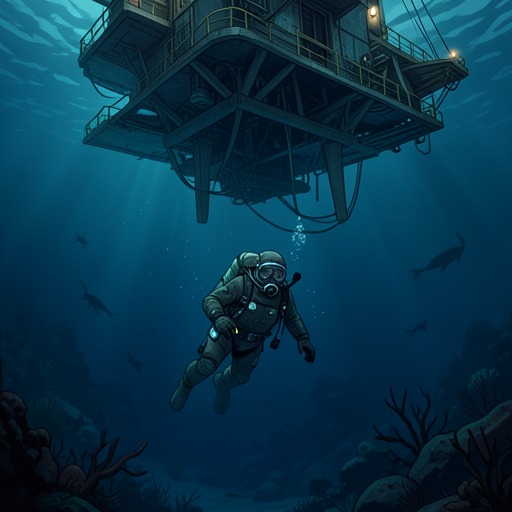
Michael Choi explains that whales had little chance once several million hungry boat people crowded the seas and much of the world’s navies had been converted to fishing fleets. The killing required comparatively little force. A helicopter-dropped torpedo could detonate close enough to leave a whale deaf and dazed without causing immediate physical damage; factory ships could then approach before the animal understood the danger. Water carried the sound of the detonations for miles, turning the ocean itself into an acoustic conduit for the attack.
This account places whales inside the same logistical logic that governs the human war effort. The conflict is repeatedly defined by shortages, transport, and the conversion of available infrastructure toward survival. The same maritime systems that move refugees and gather food also become instruments of predation. Whales are therefore defeated not by a single spectacular battle, but by the cumulative pressure of hunger, naval adaptation, and industrial reach.
The California Grays
Choi’s grief is most specific when he remembers the California grays. His father worked at the oceanographic institute outside San Diego, and that family connection helped lead him into the navy and taught him to love the ocean. Before the war, the grays had been making a recovery after approaching extinction through hunting. They had also ceased to fear humans, allowing people to paddle close enough to touch them.
Their physical power makes their destruction especially stark. A California gray could have killed a person with one sweep of its twelve-foot tail fluke or one lunge from its body weighing more than thirty tons. Early whalers called such animals devilfish because of the fierce resistance they offered when cornered. Yet the whales could distinguish between threat and harmless contact: they sometimes allowed people to pet them, or, when protecting a calf, gently brushed them away. Their immense capacity for violence coexisted with a recognizable restraint, making their later annihilation feel less like the defeat of a monster than the murder of a living population that had learned to tolerate humanity.
Extinction Across the Oceans
The loss was not confined to California grays. Choi states that blue whales, finbacks, humpbacks, and right whales also disappeared. A few belugas and narwhals were reportedly sighted beneath Arctic ice, while some intact orca pods remained, but pollution and the collapse of fish stocks made their survival uncertain. Even a population that endured the fighting might lack enough members to maintain a sustainable gene pool.
The war thus produces an ecological break that cannot be repaired merely by restoring human order. Choi’s insistence that a California gray cannot simply be made again gives extinction a material finality. Unless a genetic archivist preserved the species before the torpedoes arrived, no postwar program can recreate what was lost. Recovery has a limit: institutions may rebuild armies, factories, roads, and communities, but they cannot automatically restore an animal population whose evolutionary history has been erased.
Contrast with Other War Animals
The treatment of whales contrasts sharply with the wartime use of other animals. Monkeys flee the living dead along refugee routes, climbing poles and scattering above stalled vehicles; military dogs are trained to detect infection, escort long-range missions, and confront feral packs; and F-lions become dangerous predators in landscapes altered by the collapse of human control. These animals remain active within human survival systems, whether as witnesses, workers, threats, or adapted competitors.
Whales occupy a different position. They are neither trained auxiliaries nor manageable land predators. Their size and distance once seemed to offer a kind of independence from human violence, but the ocean becomes no refuge when naval technology and resource scarcity converge. Their fate exposes the asymmetry between human organization and nonhuman vulnerability: the whales possess overwhelming bodily strength, yet coordinated human systems can disable and harvest them at industrial scale.
Ecological and Narrative Significance
Whales give the war’s aftermath a planetary dimension. The military confronts approximately two hundred million living dead and develops new doctrines, weapons, and supply networks to defeat them, including mass-produced ammunition designed to destroy the brain without requiring wasteful cremation. Against that immense human effort, the disappearance of the whales is quieter but no less permanent. It is an ecological casualty produced by the same emergency economy that helps humanity survive.
The whales also complicate familiar claims about what war destroys. Choi rejects the idea that the deepest losses can be reduced to human innocence or humanity, because the record includes species that cannot be politically represented and cannot speak in the reconstruction that follows. The California grays’ extinction becomes a counter-memory to victory: humanity may win the war and still inherit an ocean emptied of creatures whose return is impossible.