Kwang Jingshu
World War ZKwang Jingshu is the physician whose encounter with a twelve-year-old Patient Zero identifies the outbreak that will become the Zombie War. His testimony moves from clinical observation to personal danger, state repression, and eventual reconstruction, making him both an early investigator of the plague and a living measure of what survives it: not infrastructure or population, but responsibility to other human beings.
Identity and Setting
Kwang Jingshu serves as a medical doctor in Greater Chongqing, a region that once held more than thirty-five million people and, after the war, contains barely fifty thousand. The postwar landscape has no central power grid and no running water apart from the Yangtze River. Its streets have been cleared of rubble, however, and a local security council has prevented further outbreaks. Despite advanced age and wartime injuries, Kwang remains the council’s chairman and continues to make house calls throughout the devastated region.
His role is therefore both medical and civic. He practices in a society where formal systems have receded, treating patients across a territory whose population collapse makes every surviving institution appear provisional. The contrast between Greater Chongqing’s former scale and its reduced population gives his work an austere significance: each visit is care delivered against demographic ruin, material scarcity, and the possibility that another outbreak could undo the fragile recovery.
Discovery of the Outbreak
Kwang’s account begins with a confusing emergency call from a remote village officially without a name. Its residents called the settlement New Dachang, partly to preserve a connection with Old Dachang, a town dating to the Three Kingdoms period that had been dismantled and rebuilt on higher ground when the Three Gorges Dam reservoir rose. The old town survived as a national historic museum, an irony for peasants who could see their former home preserved yet could visit it only as tourists. Kwang did not know that this second New Dachang existed, which explains his initial confusion when the call reached his hospital.
The hospital had been quiet during Kwang’s shift, despite a growing number of drunk-driving accidents as motorcycles became increasingly popular. He was exhausted, with aching back and feet, and was preparing to smoke a cigarette and watch dawn arrive when he was paged. A new receptionist, unable to understand the local dialect, could communicate only that there had been an accident or illness and that help was urgently needed. Kwang’s arrival at New Dachang thus comes through an ordinary medical summons, but the apparently local emergency is the first visible point of a catastrophe that will cross borders.
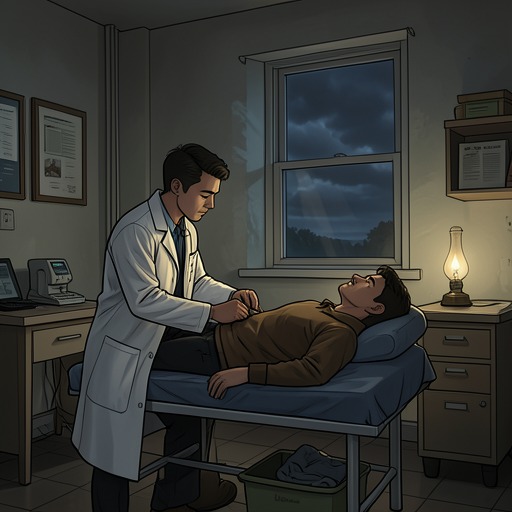
At the scene, Kwang examined six patients with similar symptoms and wounds. The most lucid patient said that the injuries had occurred while the villagers were trying to subdue “him.” Kwang then found Patient Zero behind the locked door of an abandoned house. The patient was a twelve-year-old boy whose wrists and feet had been bound with plastic packing twine. He had rubbed the skin from his bonds, yet there was no blood; neither the gouges on his arms and legs nor the large dry gap where his right big toe had been produced any bleeding.
The boy’s condition overturned the assumptions of everyone present. He writhed and growled behind a gag, with cold gray skin, no detectable heartbeat or pulse, wild eyes sunk deep into their sockets, and a fixed, predatory focus on the doctor. Although the villagers warned Kwang not to touch him because he was cursed, he put on a mask and gloves and began the examination. The boy’s violence forced him to summon two of the largest villagers to restrain him. When they hesitated, Kwang ordered them to help even though he possessed no lawful authority to command them. His first response to the unknown disease is consequently practical rather than theoretical: establish contact, protect the examiners, and physically contain the patient.
Medical Insight and Institutional Failure
Kwang’s investigation later reveals why the outbreak could move through medical systems in ways that ordinary screening failed to detect. The infection’s early access to the circulatory system meant that an injury directly involving the heart could carry the virus to the brain within seconds. A transplanted liver, kidney, or section of skin would behave differently: if taken from a newly infected donor, it might contain only a minute trace of the virus, allowing days or weeks to pass before the infection entered the recipient’s bloodstream. A patient could therefore appear healthy and even seem to be recovering while carrying a delayed threat introduced through transplantation.
This insight extends Kwang’s significance beyond the village. The plague is not only a violent encounter between the living and the dead; it is also a systems problem moving through transport, medicine, borders, and professional trust. Air smugglers in eastern China transported wealthy clients to London, Rome, and San Francisco under tourist visas, while later infections reanimated travelers on roads toward Kashi and elsewhere. Refugees crossed borders by land and sea, and five million United States refugees eventually reached Cuba under its Quarantine Resettlement Program. Kwang’s medical reasoning helps expose the same structural vulnerability that appears in these migrations: a danger can remain invisible while being carried through institutions designed to certify safety.
The wider response also demonstrates the cost of withholding information. Jesika Hendricks recalls that governments diverted refugees north toward regions where winter might freeze the undead, but failed to provide vital information that could have saved lives. Kwang experiences a more direct form of official suppression. The Ministry of State Security arrests him and incarcerates him without formal charges. By the time he escapes, the outbreak has spread beyond China’s borders. The state thus treats the physician who recognizes the danger as a problem to be contained, while the danger itself continues to expand.
The First Warning and Personal Stakes
Before his arrest, Kwang understands that New Dachang is not an isolated incident. He asks whether an old associate is armed and receives the reassurance that everything will be all right. The phrase becomes a grim refrain: Kwang immediately realizes that other ears may be listening, ends the call, and contacts his daughter in Guangzhou. He urges her to accompany her husband when the husband next travels abroad and to take Kwang’s granddaughter with them for as long as possible.
Kwang has no time to explain the danger. His signal is jammed just as the first helicopter appears, and the last words he manages to tell his daughter repeat the same reassurance he has just heard. The repetition carries an unmistakable reversal. Words meant to calm his family become evidence of how little control he possesses; the physician who can describe the pathogen cannot secure his daughter’s safety, preserve an open communications line, or prevent the authorities from taking him away.
His family concern also places the outbreak inside an ordinary network of work and travel. His son-in-law’s employment with China Telecom requires him to spend at least one week of every month abroad, making mobility both a livelihood and a potential route of exposure. Kwang’s warning is not abstract public-health advice. It is an attempt to protect a daughter and granddaughter by redirecting the family’s movement before the state can explain the crisis or the public can understand it.
Postwar Care and Narrative Significance
Years later, Kwang’s final house call of the day is to a little boy with a respiratory illness. The child’s mother fears tuberculosis, but Kwang assures her that it is only a chest cold; relief returns to her face, followed by tears and gratitude as the doctor walks with the narrator down the dusty street. The scene answers the violence of Patient Zero with a quieter form of diagnosis. At the beginning of Kwang’s testimony, examination reveals a body that appears biologically impossible and violently hostile. At the end, examination restores a family’s confidence in an ordinary future.
Kwang finds comfort in seeing children born after the war, children who know the living dead as part of the world but have not been shaped by the original terror. They know not to play near water, to go out alone, or to venture outside after dark in spring and summer. They do not know to be afraid, and he regards that absence of fear as the greatest gift that survivors can leave them. His postwar practice therefore becomes a form of inheritance: knowledge of danger is preserved, but terror need not be.
Kwang’s arc joins revelation, persecution, and service. He discovers the outbreak through close attention to a patient whom others describe as cursed; he is punished rather than honored for recognizing the threat; and after the war he returns to the most basic medical obligation, traveling through a damaged region to treat whoever calls. His decisive contribution is not a battlefield victory but a refusal to abandon the sick. In a world where populations, governments, and technologies fail on a global scale, Kwang’s house calls give survival a human scale and turn care into the foundation of reconstruction.